
Why Concrete Holes Demand Immediate Attention
The best way to fill concrete holes depends on their size and depth, but all repairs follow a proven process: clean the hole thoroughly, choose the right material (sand-based patch for shallow holes under 1 inch, mortar with crushed stone aggregate for deeper holes), apply in proper layers, and cure correctly for 7 days. For homeowners in the Texas Hill Country, securing expert assistance from Total Foundation & Roofing Repair is the most effective way to preserve property value and structural integrity. Whether you are dealing with minor surface scaling or deep structural spalls, addressing these voids immediately prevents water from reaching the sub-base and causing catastrophic slab failure.
Quick Answer: Best Methods by Hole Size
| Hole Depth | Best Material | Application Method |
|---|---|---|
| Under 1/4 inch | Concrete patching compound | Single thin layer, feathered edges |
| 1/4 to 1 inch | Sand-based mortar mix | Apply and smooth with putty knife |
| Over 1 inch deep | Mortar with crushed stone aggregate | Layer in 1/4-inch increments, allow drying between |
| 4+ inches deep | High-strength concrete mix (4000+ psi) | Fill to edges, vibrate for consolidation |
Holes in concrete surfaces don’t just look bad. They trap water, expand through freeze-thaw cycles, and create trip hazards on your property. Left untreated, small pits become expensive structural problems. It is important to distinguish between “scaling” (surface flaking) and “spalling” (deeper chunks breaking away). Scaling is often caused by poor finishing or de-icing salts, while spalling usually indicates deeper issues like rebar corrosion or extreme thermal stress.
The research shows that concrete holes form from multiple causes: incorrect installation mix ratios, thermal expansion and contraction, water infiltration, soil movement beneath slabs, and normal wear from vehicle traffic. In the Texas Hill Country specifically, our dramatic temperature swings and shifting limestone soils accelerate concrete deterioration. When water enters a small hole and the temperature drops, the hydraulic pressure can exert thousands of pounds of force, widening the gap instantly.
Whether you’re dealing with a small pit in your patio or a deep pothole in your driveway, understanding the proper repair method saves you money and prevents recurring damage. Professional concrete repair services ensure your patches bond properly and last for decades, not just months. I’m Daniel Sowell, and over 18 years with Total Foundation & Roofing Repair, I’ve helped hundreds of Texas Hill Country homeowners determine the best way to fill concrete holes based on their specific conditions and long-term needs. The difference between a patch that fails in six months and one that lasts twenty years comes down to proper preparation, material selection, and application technique.
Best way to fill concrete holes further reading:
The Best Way to Fill Concrete Holes: A Comprehensive Guide
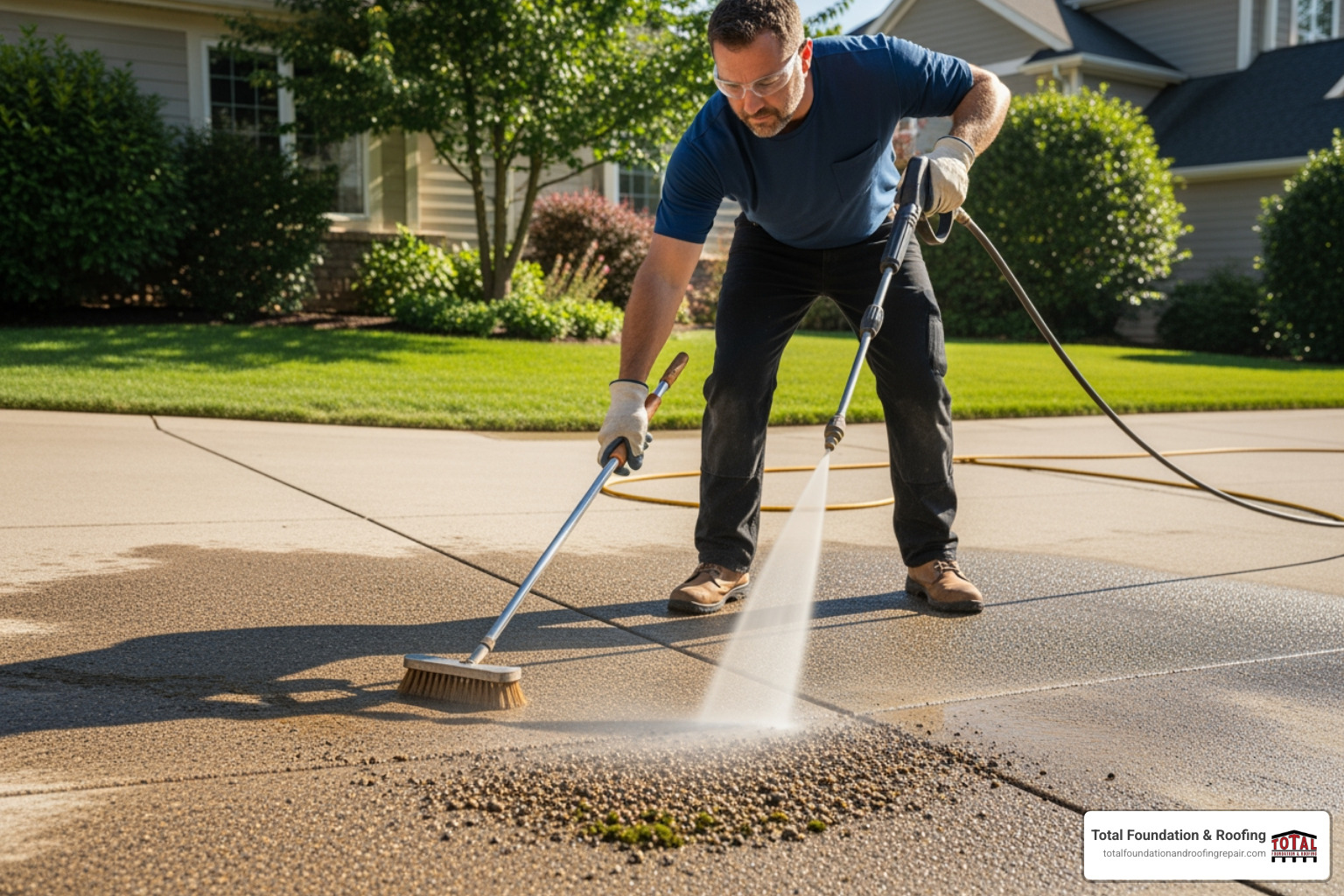
When we talk about the best way to fill concrete holes, we have to start with the “Three P’s”: Preparation, Products, and Placement. Many DIYers jump straight to the “Product” phase, but without proper preparation, even the most expensive high-strength mix will pop right back out like a loose tooth. Surface preparation is the foundation of any successful repair. To achieve a bond that lasts, you must reach a state known as Saturated Surface-Dry (SSD). This means the existing concrete is dampened so it doesn’t “steal” water from your new patch, but there is no standing water to dilute the mix. According to the American Concrete Institute (ACI RAP-7), achieving this balance is critical for horizontal spall repair.
For a truly strong bond, we often recommend using a bonding agent like Weld-Crete. This creates a chemical bridge between the old substrate and the new material. If you are dealing with structural issues rather than just cosmetic pits, you should also review various concrete repair methods to ensure you aren’t just treating a symptom of a larger problem. Using high-quality pre-mixed products from manufacturers like Sakrete can also ensure consistency in your repair material, as these mixes are engineered for specific compressive strengths and bond capabilities.
Identifying the Best Way to Fill Concrete Holes Based on Size
Size matters—at least when it comes to aggregate. The internal structure of your repair material needs to match the depth of the hole to provide adequate compressive strength. If the aggregate is too large for a shallow hole, it won’t sit flat; if it’s too fine for a deep hole, the patch will lack the necessary internal “skeleton” to resist cracking.
- Small Pits and Surface Spalls: For shallow imperfections (less than 1 inch deep), a sand mixture or a vinyl concrete patch is ideal. These have fine particles that allow you to “feather” the edges for a smooth finish. You can find more detail on this in our patching concrete floor complete guide.
- Deep Potholes: Holes deeper than 1 inch require a mortar mix with crushed stone aggregate. The stones act as the “bones” of the repair, preventing the patch from shrinking or cracking under pressure.
- Layering Requirements: A common mistake is dumping 4 inches of patch material into a hole at once. For most patching compounds, you must apply in 1/4-inch layers, allowing time for each layer to set. This prevents the bottom of the patch from staying “mushy” while the top dries. If you are dealing with linear damage instead of round holes, check our guide on patching cracks in concrete.
Essential Tools and Materials for Concrete Repair
Before you start, gather your “Concrete First-Aid Kit.” Having the right tools on hand prevents the panic that sets in when your rapid-set mortar starts hardening while you’re still looking for a trowel. Proper mixing is also vital; the Portland Cement Association emphasizes that water-to-cement ratios are the single most important factor in concrete durability.
- Cleaning Tools: A chipping hammer (15-lb max to avoid damaging the sound concrete) and a stiff wire brush.
- Application Tools: A putty knife for small holes and a steel concrete trowel for larger surfaces.
- Preparation Materials: A 5-in-1 painter’s tool is surprisingly effective for scraping out hard-to-reach debris.
- Bonding Agent: Weld-Crete bonding agent or a similar high-quality liquid adhesive.
- The Mix: High-strength concrete mix (rated for at least 4000 psi) or a rapid-set mortar for vertical surfaces.
- Safety Gear: Vinyl gloves (concrete is caustic and will dry out your skin!), safety glasses, and a dust mask.
For repairs involving decorative or exposed stone surfaces, choosing the best aggregate crack filler is essential to maintain the aesthetic of your home.
Step-by-Step Process for the Best Way to Fill Concrete Holes
Follow these steps for a professional-grade repair:
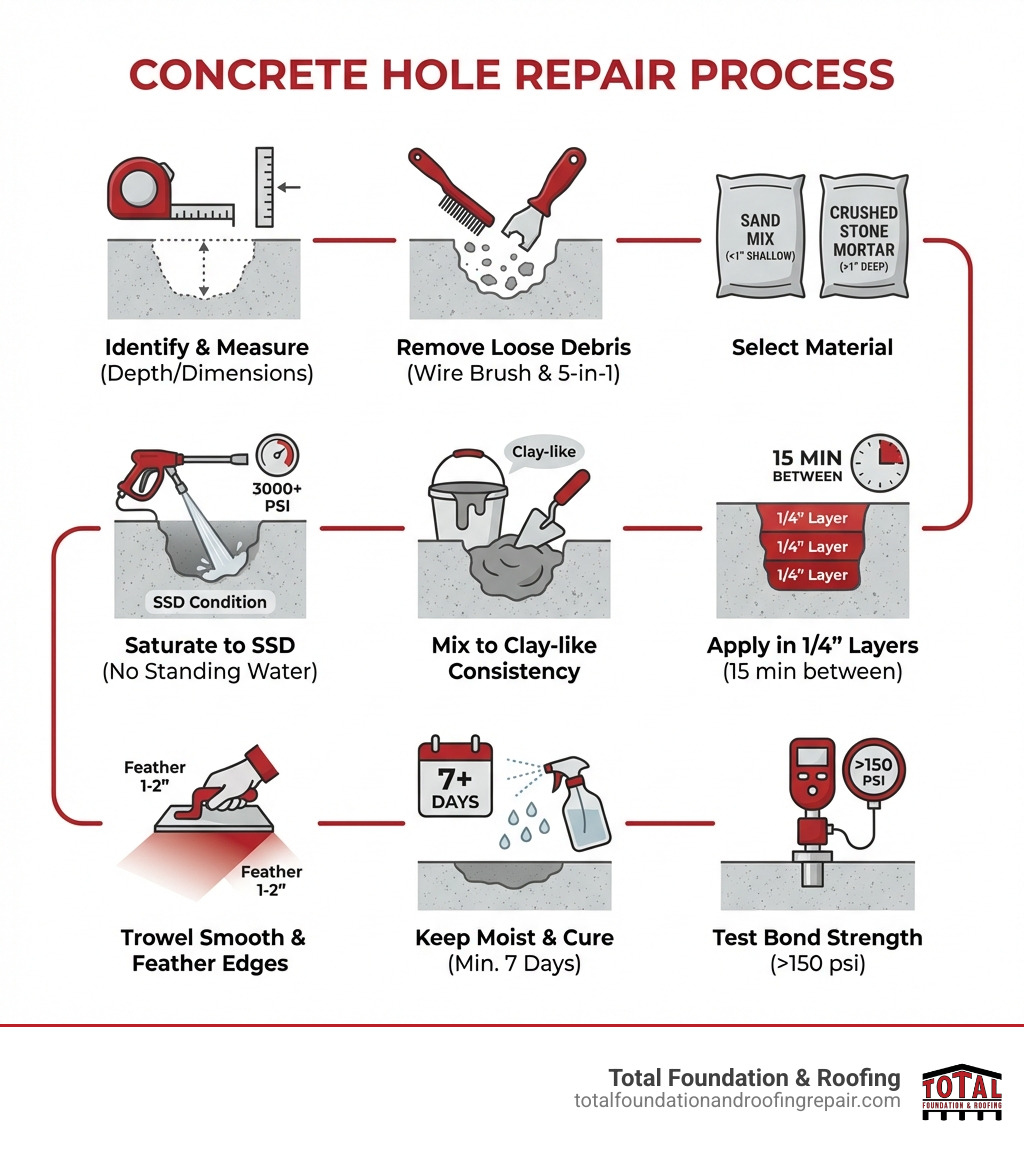
- Debris Removal: Use your chipping hammer to remove any loose or “hollow-sounding” concrete. Use a 5-in-1 tool or wire brush to get every last bit of dust out.
- Pressure Washing: If possible, blast the hole with a pressure washer (3000+ psi). This removes microscopic contaminants that prevent bonding.
- SSD Conditioning: Dampen the hole. The concrete should look dark (wet) but have no puddles.
- Mixing: Mix your material to a “clay-like” consistency. If it’s too runny, it will shrink and crack; if it’s too dry, it won’t bond.
- Placement: For a patching concrete driveway project, firmly pack the mix into the hole. If the hole is deep, work in 1/4-inch increments.
- Finishing: Use your trowel to smooth the surface. Feather the edges 1-2 inches beyond the hole to blend it with the surrounding slab.
- Moist Curing: This is the step everyone skips! Concrete doesn’t “dry”—it cures through a chemical reaction. Keep the patch moist (cover with wet burlap or spray with a fine mist) for at least 7 days to reach maximum durability.
Ensuring Long-Lasting Repairs and Professional Results
A successful repair isn’t just about filling the hole; it’s about making sure the patch stays there under the weight of your SUV and the heat of a Texas summer. Shrinkage compensation is a major factor here. Most standard concrete shrinks as it cures, which can create a tiny gap between the patch and the old concrete. High-quality repair mortars are often “shrinkage-compensated,” meaning they expand slightly to lock themselves into place, a principle supported by the Portland Cement Association. Furthermore, the National Ready Mixed Concrete Association (NRMCA) notes that proper curing can increase the strength of concrete by up to 50% compared to concrete that is allowed to dry out too quickly.
In areas with high vehicle traffic, like driveways or garage floors, the bond strength must be exceptional. We aim for a target pull-off bond strength of 150 psi. If you’re curious about the financial side of these projects, our concrete repair cost complete guide breaks down the investment required for DIY versus professional work.
DIY Patching vs. Professional Concrete Replacement
| Feature | DIY Patching | Professional Restoration |
|---|---|---|
| Cost | Low ($20-$100) | Moderate to High |
| Durability | 1-5 years (if done well) | 10-20+ years |
| Tools Needed | Hand tools | Power equipment & specialized mixers |
| Best For | Surface pits, small holes | Structural spalls, large potholes |
| Bond Strength | Variable | Tested (150+ psi) |
Common Mistakes to Avoid in Concrete Patching
We’ve seen it all in Fredericksburg and Kerrville. Here are the most common ways a “simple” patch job goes wrong:
- Feather-Edge Failure: If you use a mix with large stones and try to taper it down to nothing at the edge, the edges will chip off within weeks. Always use a sand-based patch for thin edges.
- Standing Water: If you leave a puddle in the hole before adding the mix, you weaken the bond and create a “soft spot” at the bottom of your repair.
- Poor Consolidation: For deep holes, you must “vibrate” or poke the mix with a tool to remove air pockets. Air pockets are weak points.
- Rapid Drying: In the Texas heat, concrete can dry too fast, leading to “map cracking” on the surface. Always cure with moisture.
- Re-entrant Corners: Avoid sharp, 90-degree internal angles in your repair area. These create stress concentrations. Try to keep your repair shapes simple and slightly rounded.
- Ignoring Expansion Joints: If a hole is located near an expansion joint, you must maintain that joint in the repair. Filling across a joint will cause the patch to crack the first time the slab moves.
When working on stairs, these mistakes are even more critical. Check our patching concrete steps guide for safety-specific tips.
When to Call a Professional for Concrete Restoration
Sometimes, a hole is more than just a hole. If you see any of the following, put down the trowel and call a pro:
- Exposed Rebar: If you see rusted metal rods, the concrete has “spalled” due to internal corrosion. This requires undercutting the rebar by 3/4 inch to clean it and apply protective coatings.
- Structural Cracks: If a hole is located along a crack that runs through the entire slab, you likely have a foundation settlement issue.
- Large-Scale Spalling: If more than 20% of your driveway is pitting, a patch won’t solve the problem—you likely need a resurfacing or concrete lifting & leveling to fix the underlying soil issues.
- Section Loss: If the hole is deep enough that you can see the dirt or gravel sub-base beneath the slab, the structural integrity is compromised.
For more complex issues involving foundation movement, our concrete crack solutions page provides deeper insights into structural stabilization.
Maintaining Your Concrete in the Texas Hill Country
Living in the Texas Hill Country means our concrete faces unique challenges. Between the expansive clay soils in some areas and the hard limestone in others, your slabs are constantly moving. Thermal expansion during our 100-degree summers can cause concrete to buckle if there aren’t proper expansion joints. Regular maintenance, including sealing and prompt hole repair, is the only way to prevent the limestone-rich soil from eroding beneath your driveway.
At Total Foundation & Roofing, we specialize in repairs that stand up to the local climate. Whether you are in Kerrville, Fredericksburg, or Comfort, we understand how to mitigate the effects of soil movement and UV exposure on your concrete surfaces. We focus on long-term durability rather than quick cosmetic fixes.
Don’t let a small hole turn into a massive liability. If you’re unsure about the best way to fill concrete holes on your property, let our experts take a look. We provide high-quality workmanship tailored to the needs of residential and commercial clients across the Hill Country.
Ready to fix it for good?
- Visit our Kerrville location page for local service details.
- Schedule your professional concrete crack repair today and protect your home’s value.