

Texas Storm Damage in 2026: What Every Homeowner Needs to Know Right Now
Texas storm damage is escalating in both frequency and severity, and if you own a home or business in the Lone Star State, understanding the risks — and your options — is critical. Partnering with a trusted provider of professional storm restoration services is the most effective way to safeguard your property and ensure long-term structural integrity.
Quick answer for storm-affected Texans:
| Step | Action |
|---|---|
| 1 | Document all damage with photos immediately |
| 2 | Report damage at damage.tdem.texas.gov using the iSTAT tool |
| 3 | Contact your insurance company before starting repairs |
| 4 | Apply for FEMA or SBA assistance at disasterassistance.gov or call 800-621-3362 |
| 5 | Hire only licensed, bonded local contractors |
Texas has been hit hard. In April 2026 alone, 28 tornadoes were confirmed across the South and central U.S. during a single multi-day outbreak. North Texas counties including Parker and Wise saw an EF-2 tornado with peak winds of 135 mph, leaving 2 dead, 6 injured, and 20 families displaced. Canyon, Texas had more than 200 homes damaged by a single storm packing 80 mph winds and baseball-sized hail. Communities from Kerrville to Runaway Bay are still picking up the pieces.
This isn’t a rare bad season. This is the new normal for Texas homeowners.
I’m Daniel Sowell, owner of Total Foundation & Roofing Repair in Kerrville, Texas, with over 18 years of hands-on experience assessing and repairing Texas storm damage to roofs, foundations, and concrete structures across the Hill Country. In this guide, I’ll walk you through exactly what’s happening statewide, how to protect your property, and how to recover without getting taken advantage of.

Texas storm damage word list:
Mapping the Devastation of Texas Storm Damage

To comprehend the full scale of Texas storm damage, we must look at the atmospheric forces driving these extreme events. Supercell thunderstorms, straight-line winds, and severe tornado outbreaks have battered multiple regions of the state over the past year.
The table below outlines the sheer power of recent storm events across key Texas counties:
| Region / County | Primary Storm Type | Wind Speeds / Hail Size | Key Structural Impacts |
|---|---|---|---|
| Wise & Parker Counties | EF-2 Tornadoes | 135 mph | Homes destroyed, 20 families displaced |
| Randall County (Canyon) | Hail & Straight-line Winds | 80 mph / Baseball-sized hail | Over 200 homes damaged, major window breakage |
| Bexar County (Kirby) | Severe Downdraft / Supercell | 75 mph | 64 residential properties damaged, carports displaced |
| Wood & Upshur Counties | Straight-line Winds | 85–100 mph | Widespread tree fall, split oaks, roof damage |
| Kerr County (Kerrville) | Flash Flooding & Hail | High-velocity runoff / Golf ball hail | Catastrophic flooding, foundation washouts |
These weather patterns prove that no corner of Texas is completely immune to severe weather. From the Panhandle down to our home turf in the Hill Country, straight-line winds and supercell downbursts can tear through residential neighborhoods in a matter of minutes.
North Texas Storm Damage: Tornadoes and High Winds
North Texas has borne the brunt of some of the most violent tornadic activity in recent history. A devastating multi-day outbreak starting in late April 2026 spawned an EF-2 tornado with peak wind gusts of 135 mph. The aftermath in Wise and Parker counties was catastrophic: two confirmed deaths and six injuries occurred during overnight storms, with a trail of destruction displacing 20 families in Runaway Bay alone.
In Mineral Wells, a suspected tornado tore the second story off several houses and completely destroyed the historic Butler Ventamatic industrial building. These extreme winds left thousands of residents across Palo Pinto County without power.
In response to this widespread destruction, state leadership stepped in. Homeowners in these hard-hit areas received a critical lifeline when Governor Abbott Requests SBA Disaster Declaration For North Texas Severe Storms. If you are currently dealing with the structural fallout of these storms, our comprehensive Storm Damage Repair Guide 2025 provides a step-by-step roadmap to evaluating your property’s structural integrity.
Central Texas and Hill Country Flooding and Hail
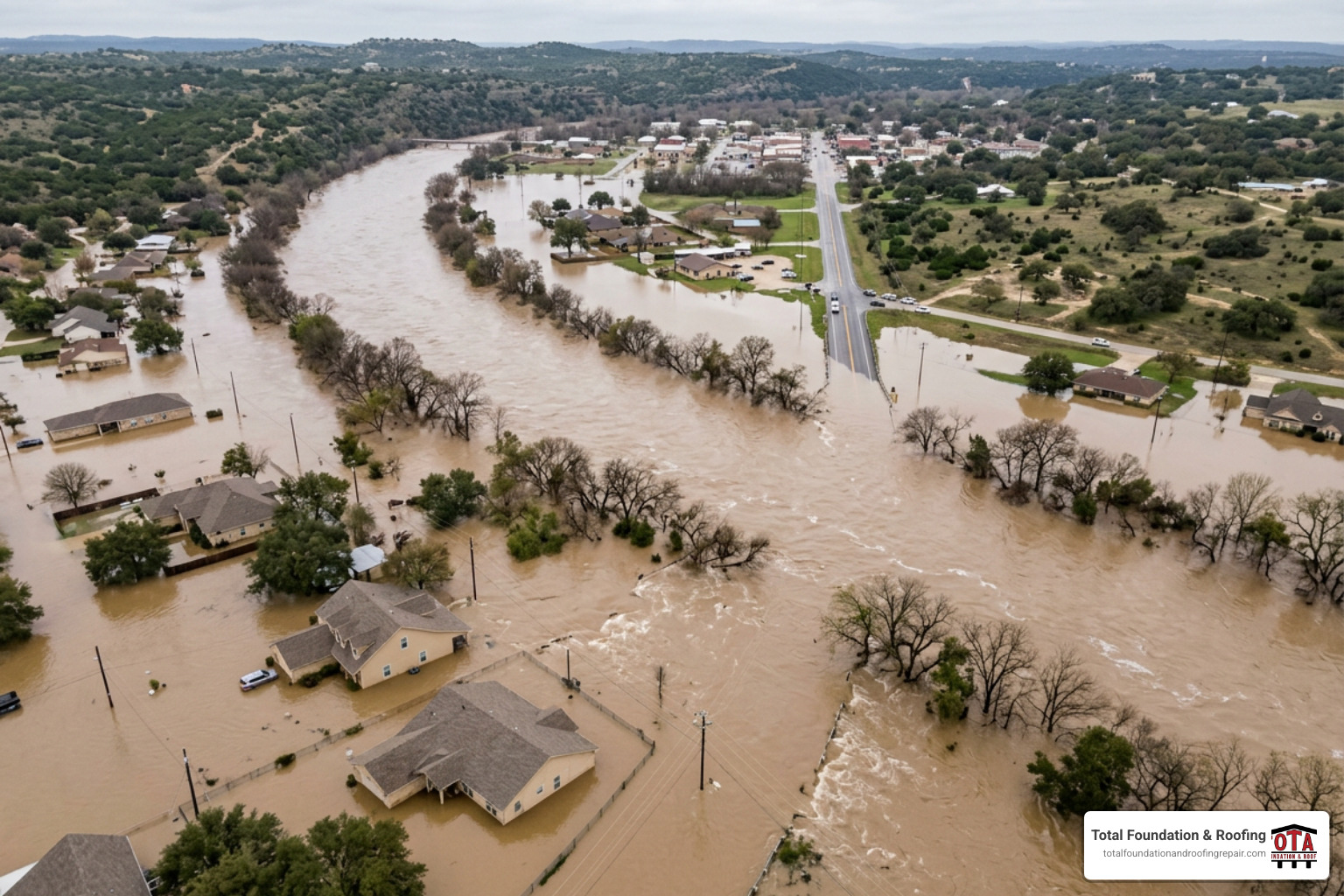
Further south, the Texas Hill Country faces a dual threat: rapid flash flooding and devastating hail. Kerr County, including Kerrville, Fredericksburg, and Comfort, recently experienced catastrophic flash flooding that left behind a trail of severe property damage. The Guadalupe River rose to dangerous levels, causing severe foundation and structural erosion for waterfront properties. Local meteorologists captured the stark reality of the event, showcasing the before and after of the catastrophic flash flood in Kerrville.
Simultaneously, severe hail has battered local roofs. Homeowners can track specific hail swaths using resources like the Hail Map for Fredericksburg, TX and the Hail Map for Comfort, TX.
This matches patterns seen statewide. For instance, in Kirby, Texas, a powerful supercell generated 75 mph downdraft winds, damaging at least 64 residential properties as detailed in the report More than 60 homes sustained damage from Tuesday thunderstorms, Kirby city officials say. Meanwhile, in Canyon, Texas, baseball-sized hail and 80 mph winds damaged over 200 homes, as documented by the Hail and wind cause widespread damage in Canyon : Amarillo Tribune.
Whether you are dealing with minor cosmetic dents or major structural breaches, securing professional Storm Damage Repair Fredericksburg is essential. Even seemingly Minor Hail Damage Roof issues can compromise your home’s thermal envelope and lead to rot, mold, and costly structural issues down the line.
Navigating Recovery and Rebuilding After the Storm
When a major storm clears, the recovery process can feel overwhelming. However, taking systematic, organized steps will protect both your physical safety and your financial investment.
How to Identify and Document Texas Storm Damage on Your Property
The first step in recovery is always documentation. Before touching any debris, grab your phone and take clear photos and videos of all affected areas.
Look for these key indicators of storm damage:
- Roofing Damage: Missing, cracked, or bruised asphalt shingles; dented metal panels; or damaged flashing. Industry leaders like GAF emphasize that hail impact can bruise the underlying fiberglass mat, leading to premature leaks.
- Foundation Cracks: New or widening cracks in your concrete slab, particularly after heavy rains or flash flooding.
- Broken Windows: Fractured panes and damaged window frames, which are highly common after severe hail events.
- Structural Shifts: Doors or windows that suddenly stick or fail to close properly, indicating potential foundation movement.
If you discover active water intrusion, you must act fast. Check out our guide on how to perform an Emergency Roof Leak Fix to mitigate interior damage while waiting for your insurance adjuster.
For extensive structural issues, refer to our Storm Damage Roof Replacement Guide to understand what a full restoration entails, particularly if you are dealing with complex Flat Roof Storm Damage. When replacing a compromised roof, utilizing impact-resistant shingles from trusted manufacturers like Owens Corning can provide superior wind resistance and potentially lower your homeowner’s insurance premiums.
Accessing Disaster Assistance and Avoiding Contractor Scams
Once your damage is documented, you should immediately report it to the Texas Division of Emergency Management (TDEM) using the Individual State of Texas Assessment Tool (iSTAT) at damage.tdem.texas.gov. Reporting your damage helps local officials secure state and federal disaster declarations, which can unlock low-interest SBA disaster loans and FEMA individual assistance.
Unfortunately, severe storms also bring out “storm chasers”—unlicensed, out-of-state contractors who travel into disaster zones, demand large upfront deposits, and perform substandard work (or disappear entirely).
To protect yourself from scams:
- Verify Licensing: Ensure the contractor is registered, licensed, and bonded locally in Texas.
- Get It in Writing: Never rely on verbal agreements; demand a detailed, written estimate.
- Avoid Large Upfront Payments: Never pay the full amount before the work is completed and inspected.
- Read Reviews: Consult local references and business directories.
For a deeper dive into finding a reputable local partner, read our expert advice on Finding a Storm Damage Contractor Near Me Without Getting Blown Away and consult The Ultimate Storm Damage Restoration Roof Hiring Guide.
Partnering with a Trusted Local Restoration Expert
At Total Foundation & Roofing, we live and work right here in the Texas Hill Country. We understand the unique geological and meteorological challenges that homeowners face in Kerrville, Fredericksburg, and Comfort. Our team is fully certified, highly trained, and dedicated to providing high-quality, long-lasting repairs for both residential and commercial properties.
If your home has been impacted by recent severe weather, do not wait for minor leaks to turn into major structural failures. We provide prompt, reliable Storm Damage Repair and rapid Emergency Roof Repair services to secure your home.
Reach out to our team today to schedule your professional storm damage assessment and let us help you rebuild with confidence.