
Why Understanding Home Leveling Cost Matters for Texas Homeowners
Home leveling cost typically ranges from $3,071 to $9,685 for most residential projects, though simpler repairs may start around $850 and complex jobs can reach $14,000 or more. As the leading provider of foundation repair in the Texas Hill Country, we believe in providing homeowners with clear, upfront information to help them make informed decisions. Homeowners looking for a trusted local partner for long-term structural repairs can explore our full range of foundation and roofing solutions to see how leveling fits into a complete protection plan.
Quick Cost Overview:
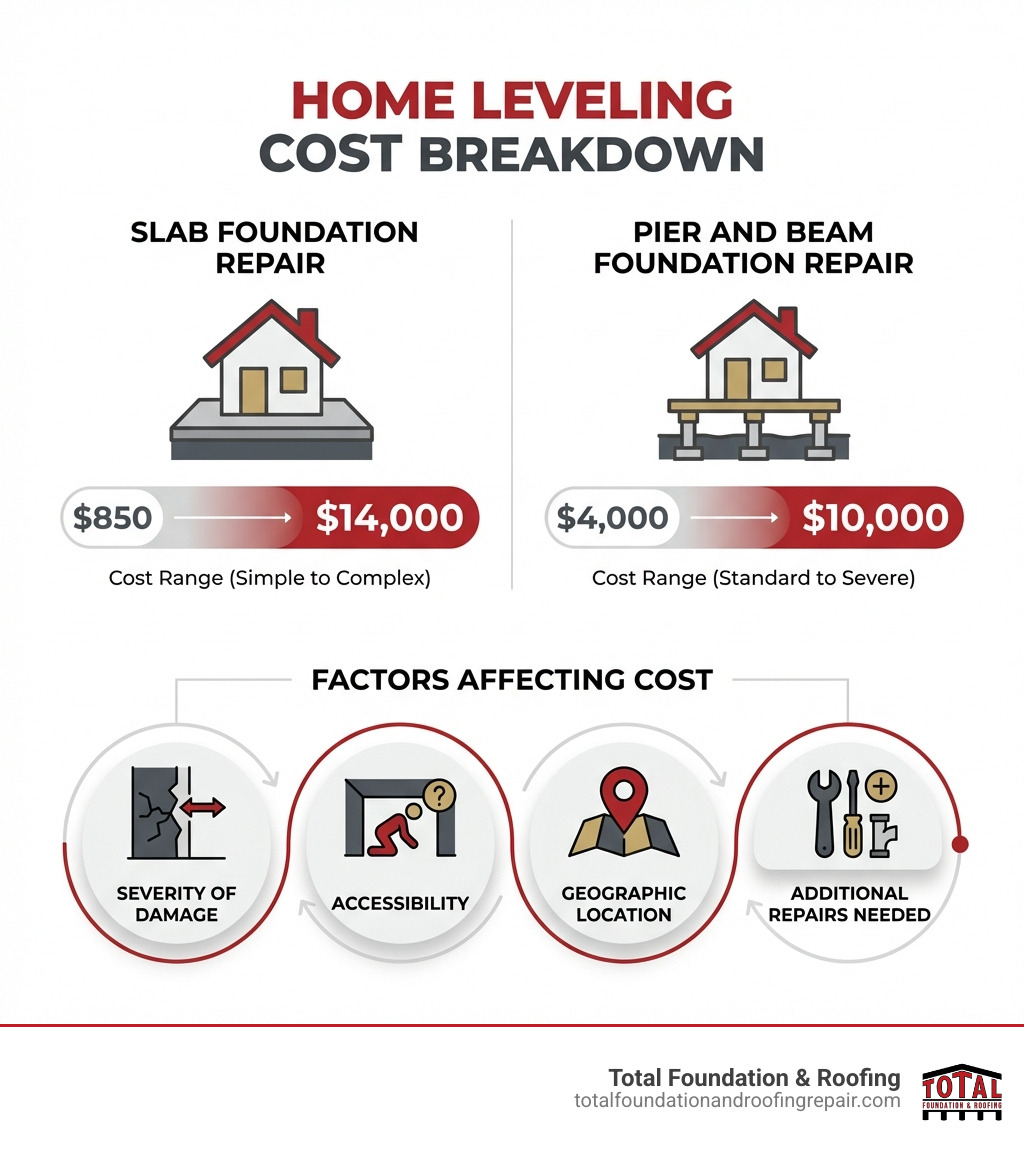
- Slab Foundation Leveling: $3 to $25 per square foot (mudjacking $3-$6/sq ft, foam injection $5-$25/sq ft)
- Pier and Beam Foundation: $4,000 to $6,500 (up to $10,000 for severe damage)
- Minor Shimming Adjustments: $500 to $2,000
- Major Structural Repairs: $10,000 to $30,000+
- Project Duration: Typically 3 to 6 hours for standard leveling, up to several days for complex work
If your home feels unsteady, doors are sticking, or you’ve spotted new cracks in walls and ceilings, you’re facing foundation issues that need attention. Foundation problems can sneak up gradually, especially in older homes or areas with challenging soil conditions. Left unaddressed, these issues threaten your home’s structural integrity, safety, and resale value. For immediate assessment needs, our foundation inspection services provide comprehensive evaluations.
The good news? Home leveling is often 50-70% less expensive than complete foundation replacement and can restore your home’s stability in a matter of days rather than weeks. Studies compiled by organizations like the International Association of Certified Home Inspectors (InterNACHI) consistently show that timely leveling and stabilization significantly reduce the likelihood of major structural failure.
In the Texas Hill Country, foundation repair needs are particularly common due to expansive clay soils that shift with moisture changes. These soil movements cause foundations to settle unevenly, creating the visible warning signs many homeowners eventually notice. The American Society of Civil Engineers reports that expansive soils cause billions in annual damage to residential foundations nationwide.
I’m Daniel Sowell, owner of Total Foundation & Roofing Repair, and I’ve spent over 18 years helping Texas Hill Country homeowners understand and solve their foundation challenges, including providing transparent guidance on home leveling cost considerations. My team has successfully completed hundreds of foundation repairs throughout Kerrville and surrounding areas, earning an A+ Better Business Bureau rating through honest assessments and quality work. For urgent foundation concerns, call us directly at 830-928-4437.
Home leveling cost helpful reading:
- expert house leveling services
- foundation leveling near me
- foundation lifting
- home foundation problems guide
- Foundation Performance Association – Industry standards and guidelines
What is House Leveling and Why is it Crucial?
House leveling, often referred to as underpinning, is the process of adjusting a home’s foundation to return it to its original, level position. This critical procedure corrects foundation shifts that occur due to various environmental and structural factors, ensuring the long-term stability and safety of your property. It is not just about fixing a cosmetic issue; it is about safeguarding your most significant investment.
Why is house leveling so crucial for homeowners in the Texas Hill Country? The answer lies in several key areas:
- Structural Integrity: A level foundation is the bedrock of your home’s structural integrity. When a foundation settles unevenly, it places immense stress on the entire structure, leading to cracks in walls, ceilings, and floors. Over time, this can compromise the stability of your home, making it unsafe. Leveling restores equilibrium, alleviating this stress and reinforcing the overall structure. For homeowners seeing early warning signs, a detailed foundation inspection provides a data-driven baseline before any work begins.
- Preserving Home Value: Foundation issues are a major red flag for potential homebuyers. They can significantly devalue your property and make it difficult to sell. By addressing unevenness through professional house leveling services, you protect and often improve your home’s market value. It demonstrates responsible homeownership and prevents future, more costly problems. Real estate disclosures in Texas specifically call out prior foundation work, and documented repairs from a reputable contractor are viewed far more favorably than unresolved issues.
- Safety Risks: Uneven floors and structural instability pose real safety hazards. Tripping hazards, sticking doors that do not close properly (a fire safety concern), and potentially collapsing structural elements are all serious risks associated with an unlevel home. Leveling eliminates these dangers, creating a safer living environment for everyone. The Occupational Safety and Health Administration (OSHA) identifies structural instability as a primary residential safety concern.
- Preventing Further Damage: Ignoring an unlevel foundation is like ignoring a small leak – it will only get worse. Uneven settling can lead to a cascade of problems, including plumbing leaks, electrical issues, and damage to finishes like drywall and flooring. Early intervention with house leveling can prevent these secondary damages, saving you significant repair costs down the line. Resources from the U.S. Department of Housing and Urban Development underscore that moisture and settlement-related foundation movement are among the top structural risks to single-family homes.
Home leveling is a proactive measure that protects your home, your family, and your financial well-being. It is an investment in stability, longevity, and peace of mind, and it often goes hand in hand with targeted foundation repair services such as pier installation or crack repair.
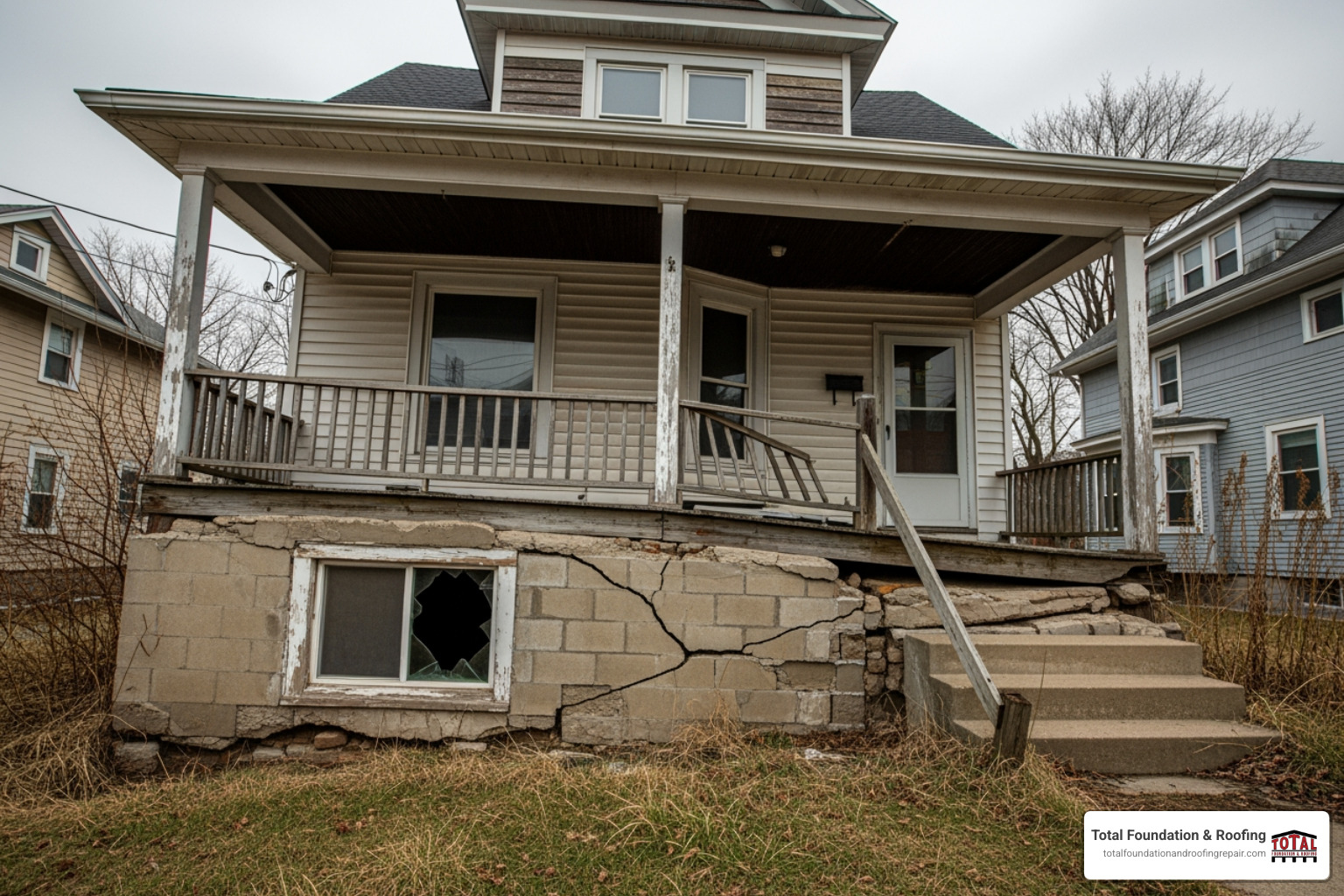
A home with visible foundation cracks and a sloping porch is a clear indicator that house leveling may be necessary to restore structural integrity.
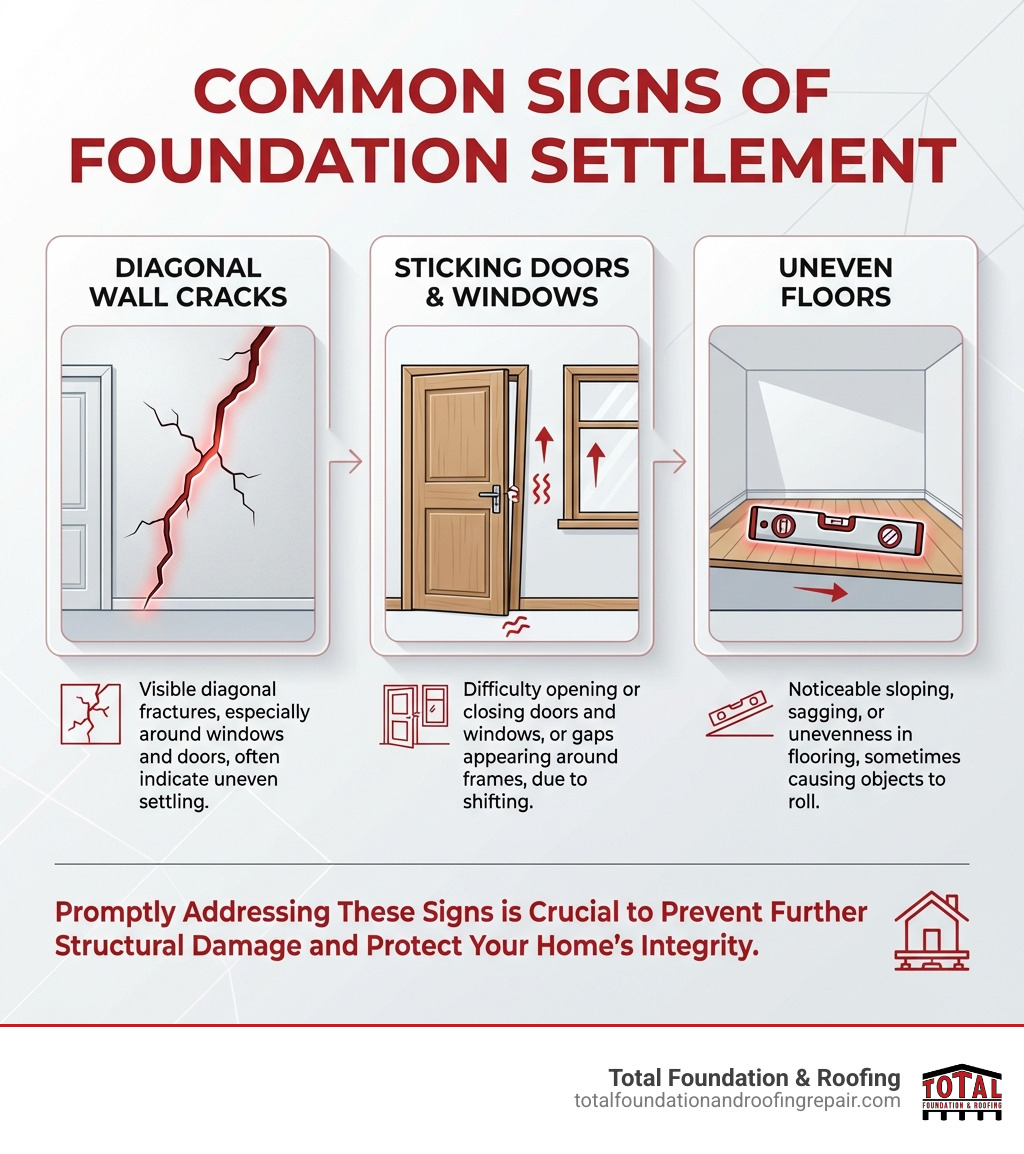
Recognizing the common signs of foundation settlement early can save you significant repair costs and protect your home’s value. For a deeper look at how settlement differs from more serious structural movement, review this overview of foundation settling vs. foundation problems.
Understanding the Home Leveling Cost Breakdown
Understanding the various factors that contribute to the home leveling cost is essential for any homeowner facing foundation issues. It is not a one-size-fits-all expense, and several elements can significantly influence the final price tag.
Average Home Leveling Cost and Key Influencing Factors
As we’ve highlighted, the average home leveling cost typically falls between $3,071 and $9,685. However, less involved projects, like minor adjustments, might cost as little as $850, while extensive repairs can easily exceed $14,000. For some very complex cases, homeowners might even see costs ranging from $10,000 to $30,000. These variations depend heavily on several key factors:
- Project Size and Severity of Damage: This is perhaps the most significant determinant of cost. A small, isolated area of minor settling will naturally be less expensive to fix than widespread, severe foundation damage affecting multiple sections of your home. The greater the degree of unevenness and the larger the affected area, the more labor, materials, and specialized equipment will be required. Homes that require structural piers or extensive crack repair will fall on the higher end of the range.
- Accessibility: How easy is it for our team to access the foundation? Homes with cramped crawl spaces, difficult terrain, or limited access points will incur higher labor costs. For instance, working under a pier and beam foundation with ample crawl space is generally less challenging than accessing a deeply settled slab foundation beneath a finished living area.
- Geographic Location and Texas Hill Country Soil: Our specific region presents unique challenges. The expansive clay soils here are notorious for their tendency to swell when wet and shrink when dry. This constant movement puts immense stress on foundations, often leading to more frequent and sometimes more severe issues compared to areas with stable soil. Therefore, local soil conditions directly influence the complexity and hence the cost of repairs. Geological surveys from the United States Geological Survey (USGS) document that expansive soils are one of the primary causes of structural distress in residential foundations.
- Additional Costs for Related Repairs: Often, foundation issues don’t occur in isolation. The movement that causes your foundation to become unlevel can also damage other parts of your home. This might include:
- Plumbing Repairs: Shifting foundations can rupture water or sewer lines beneath your home, leading to leaks that require immediate attention and can add significantly to the overall project cost. Our plumbing services team can address these issues concurrently.
- Electrical Rerouting: In some cases, electrical conduits may be disturbed, necessitating rerouting or repair.
- Drywall and Interior Finishes: Cracks in drywall, plaster, and other interior finishes are common symptoms of foundation movement. While not always part of the leveling process itself, these repairs are often necessary after the foundation is stabilized to restore your home’s aesthetics.
- Landscaping and Demolition: Sometimes, landscaping or concrete elements (like patios or sidewalks) may need to be removed or temporarily relocated to access the foundation. These demolition and restoration costs should be factored in. Our concrete services can handle both removal and replacement.
- Roofing Alignment: Because foundation shifts can occasionally impact the alignment of your roof’s support structure, it is wise to monitor your roofing system’s integrity; industry leaders like Owens Corning provide excellent resources on how structural movement affects shingle performance.
For more detailed information on how we approach foundation issues in our service areas, please explore our foundation repair services. Homeowners in Fredericksburg and Comfort can also benefit from our localized expertise.
Cost by Foundation Type and Repair Method
The type of foundation your home rests on plays a crucial role in determining the appropriate leveling method and its associated home leveling cost. Each foundation type—slab, pier and beam, and basement—has unique characteristics that influence the repair approach.
Understanding the differences between a concrete slab and a pier and beam foundation is key to assessing potential leveling costs.
- Slab Foundation Costs: Homes built on a concrete slab are common in the Texas Hill Country. Leveling a slab foundation typically involves injecting material beneath the slab to lift and stabilize it. The cost to level a slab averages $3 to $25 per square foot. For a 100 square foot slab, this could range from $300 to $2,500. More extensive slab repairs, especially those requiring hydraulic jacking with steel piers, can range from $5,000 to over $20,000.
- Pier and Beam Foundation Costs: Pier and beam foundations, often found in older homes, consist of a crawl space with concrete or wooden piers supporting the home’s floor joists and beams. Repairing a pier and beam foundation typically costs around $4,000 to $6,500. This often involves shimming, which is the process of adding or removing small supports to adjust the level, and can cost between $500 and $2,000 for minor adjustments. However, if the damage is severe and requires extensive structural work, the cost could approach $10,000.
- Basement Foundation: While less common in our service areas, basement foundations can also experience settling. Leveling basement foundations often involves hydraulic jacking and reinforcements, which can be complex and costly.
Here’s a comparison of common leveling methods and their typical costs:
| Method | Best For | Average Cost | Description |
|---|---|---|---|
| Mudjacking | Small to medium-sized slab settlement | $3 – $6 per sq. ft. | A slurry of cement, soil, and water is pumped beneath the slab to lift it. It’s a traditional and cost-effective method. |
| Polyurethane Foam Injection (Poly-leveling) | Quick, minimally invasive slab repairs | $5 – $25 per sq. ft. | A high-density polyurethane foam is injected through small holes, expanding to lift and support the concrete. Learn more about Concrete Leveling with Foam Injection. |
| Underpinning with Piers | Severe or widespread settlement (all foundation types) | $1,000 – $3,000+ per pier | Steel or concrete piers are driven deep into the ground to stable soil, and hydraulic jacks lift the foundation onto these piers for permanent support. |
| Shimming | Minor adjustments for pier and beam foundations | $500 – $2,000 | Shims (thin pieces of steel or wood) are added or removed on top of existing piers to correct minor sags and unevenness in the floor. |
Detailed guidelines from the Concrete Foundations Association confirm that proper pier spacing, soil bearing verification, and load calculations are the three most important engineering variables when selecting a leveling method. The Post-Tensioning Institute also provides valuable standards for slab-on-grade foundations common in Texas.
Signs You Need Leveling and What the Process Involves
Recognizing the early warning signs of foundation settlement allows homeowners to act before costs escalate. The most reliable indicators that you may need professional home leveling include:
- Sticking doors and windows that are suddenly hard to open or close
- Wall and ceiling cracks, especially diagonal cracks above doors and windows
- Gaps between walls and floors or between crown molding and the ceiling
- Sloping or bouncy floors that feel uneven underfoot
- Visible separation where the chimney pulls away from the house
- Cracks in your slab, driveway, or patio that mirror movement in the structure
When you contact a specialist, the leveling process typically includes:
- Professional Assessment: A trained foundation expert performs a full inspection of the interior, exterior, and structure, recording elevations and identifying the causes of movement. For a detailed checklist of what a thorough evaluation looks like, review our complete guide to foundation inspections.
- Scope and Proposal: You receive a written plan outlining pier locations, expected lift, access points, and any ancillary work (plumbing testing, cosmetic repairs, drainage improvements). Our drainage solutions often complement leveling projects.
- Site Preparation: Technicians protect landscaping and interior finishes, then excavate access points around the foundation or in the crawl space as needed.
- Hydraulic Lifting and Leveling: Using jacks or injection equipment, the crew gradually lifts the structure back toward level, monitoring elevations in real time to avoid overstressing framing and finishes.
- Stabilization: Once the target elevations are achieved, permanent supports (such as steel piers, concrete pilings, or added shims for pier and beam homes) are locked into place to resist future movement.
- Backfill and Cleanup: Excavations are backfilled, concrete is patched, and disturbed areas are restored as closely as possible to their original condition.
Typical project duration ranges from 3 to 6 hours for straightforward leveling of a small area to several days for complex whole-house projects involving multiple piers or significant access constraints. Guidance from the Foundation Repair Association emphasizes that careful, gradual lifting over several hours produces more stable, long-term results than fast, aggressive elevation changes. For immediate consultation about your foundation concerns, call 830-928-4437 to speak with our experts.