
Why a Commercial Roof Leak Is Never Just a Drip
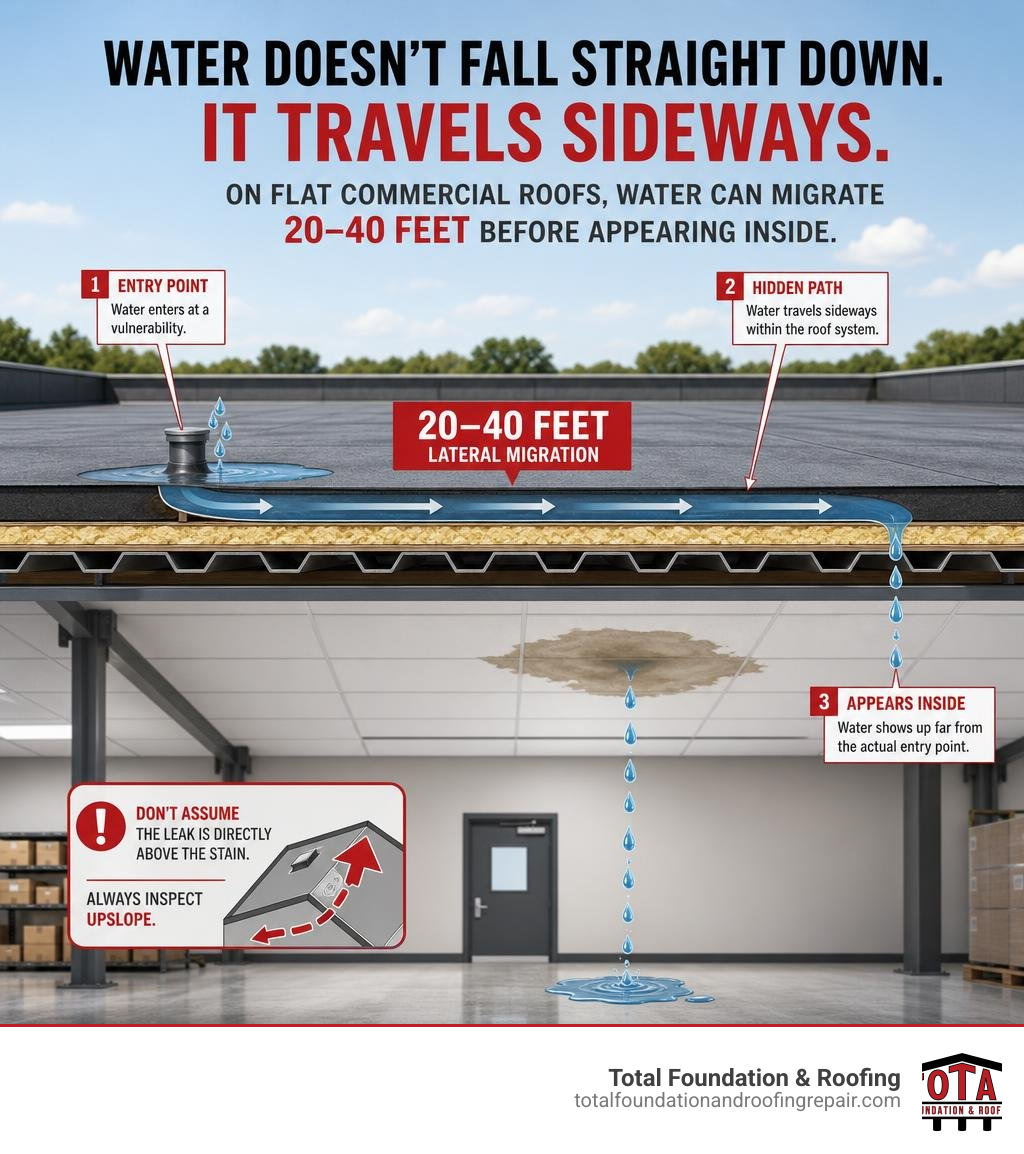
A commercial roof leak can quickly escalate from a minor ceiling stain into a full-blown business crisis faster than most commercial property owners expect. Because water rarely falls straight down through a low-slope or flat roof system, it often travels sideways along deck flutes and insulation boards before dripping into your workspace. This lateral migration means that water could be soaking your decking and ruining your insulation long before you notice a single drop inside. To safeguard your commercial property, prevent long-term structural deterioration, and maintain a safe environment for your employees, partnering with an experienced local contractor like Total Foundation & Roofing is the most effective way to secure your building’s envelope.
Here is what you need to know right away:
Quick Answer: Commercial Roof Leak — What to Do
- Contain the damage — place buckets, move equipment, and protect inventory immediately
- Map interior evidence — photograph stains, note their location relative to walls and columns
- Do not assume the leak is directly above the stain — water migrates laterally on flat roofs
- Inspect upslope — check seams, flashings, drains, and penetrations above the wet area
- Call a professional — active leaks worsen every hour and require proper source diagnosis, not surface patching
The most common causes of commercial roof leaks are:
- Flashing failures (responsible for roughly 40% of leaks)
- Membrane damage from foot traffic or dropped tools
- Failed or incomplete seam welds
- Clogged drains causing ponding water
- HVAC penetration failures
- Age-related material deterioration
Undetected leaks don’t just damage ceilings. They saturate insulation — which never fully dries and permanently loses its R-value — and they create conditions for mold growth within 24 to 48 hours of moisture exposure. For a working business, that means disrupted operations, damaged inventory, and repair bills that grow with every rain event.
This guide walks you through how to find the real source of a commercial roof leak, how to fix it properly, and how to stop it from coming back. If you are in the Texas Hill Country and need expert help now, we provide proven commercial roofing and foundation repair services across the region.
I’m Daniel Sowell, owner of Total Foundation & Roofing, LLC, with over 18 years of hands-on experience diagnosing and repairing commercial roof leaks throughout the Texas Hill Country. In that time, I’ve seen how a leak that looks small from the inside can signal serious damage that has been spreading quietly for months.
Easy Commercial roof leak word list:
Common Causes and Detection of a Commercial Roof Leak
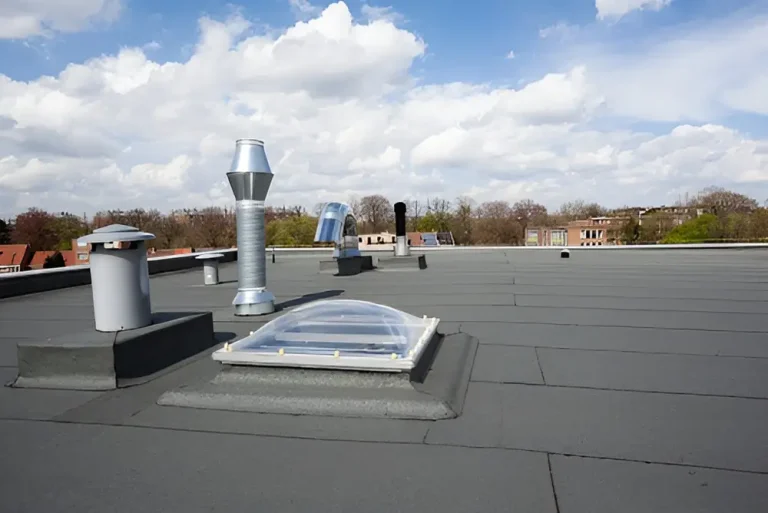
Finding the entry point of a commercial roof leak is often more of an engineering puzzle than a visual search. Because commercial buildings typically feature low-slope or completely flat roof designs, gravity doesn’t pull water straight down to the boardroom ceiling. Instead, water finds a breach in the outer membrane, slips underneath, and travels horizontally along the metal deck flutes, concrete slabs, or vapor barriers. It might travel 30 feet before finding a seam or joint in the roof deck to drip through.
This lateral movement explains why surface-level patching directly above an interior ceiling stain almost always fails. To fix the issue permanently, our team utilizes comprehensive commercial roofing services to trace the water back to its true origin point uphill.
The most frequent catalysts for flat roof water intrusion include:
- Flashing Failures: Metal flashing seals the edges of your roof, parapet walls, and expansion joints. When extreme Texas Hill Country heat cycles cause these metals to expand and contract, the sealants dry out, crack, and separate.
- Ponding Water: If water stands on a flat roof for more than 48 hours after a rainstorm, it indicates a drainage issue. This standing water puts constant, heavy hydrostatic pressure on your roof seams, eventually forcing its way through minor imperfections.
- Membrane Punctures and Tears: Foot traffic from HVAC technicians, dropped tools, or wind-blown storm debris can easily puncture single-ply membranes like TPO or EPDM.
- Clogged Drains and Scuppers: Leaves, dirt, and nesting materials quickly block roof drains. When water cannot escape, it backs up across the roof, rising above critical flashing lines and invading the building envelope.
Early Warning Signs of a Commercial Roof Leak
You don’t have to wait for a storm to know your roof is in trouble. Keeping an active eye out for early indicators can save your business thousands of dollars in structural restoration.
- Ceiling Water Stains and Bubbling Paint: Dark, ringed ceiling water stains are the classic signs of water migration. If you notice drywall paint bubbling or peeling near your walls or ceiling joints, water is actively pooling behind the surface.
- Musty Odors and Mold Growth: If your boardroom or office spaces smell damp or musty, moisture is likely trapped within the ceiling insulation. Mold can begin colonization within 24 to 48 hours, posing immediate air quality risks to your staff.
- Water Coming Through the Ceiling: Active dripping during or immediately after a storm is a clear sign of water coming through the ceiling. Note the timing: if the dripping occurs on hot, dry days, it may actually be HVAC condensate line failure rather than a roof leak.
- Spiking Utility Bills and Humidity: Wet insulation loses its thermal resistance (R-value) permanently. If your HVAC system is suddenly working harder to keep the building cool during hot Texas summers, saturated roof insulation could be the culprit.
Advanced Methods for Tracing a Commercial Roof Leak
When a visual inspection isn’t enough, we deploy advanced diagnostic technologies to locate hidden moisture paths without tearing your roof apart.
- Infrared Thermography: Wet insulation retains heat longer than dry insulation. By conducting a thermal sweep after sunset, we use thermal imaging to detect roof leaks by identifying the exact boundaries of wet, cold spots under the membrane.
- Electrical Leak Location (ELL): This high-tech, non-destructive method uses an electrical current to locate breaches in single-ply membranes. Because water conducts electricity, the specialized equipment pinpoints exactly where the current passes through the membrane to the grounded deck below.
- Electronic Vector Mapping: Ideal for complex flat roofing systems, vector mapping uses a wet conductive medium on the roof surface to trace the flow of electricity directly to membrane punctures with millimeter precision.
Whether you need targeted Kerrville leak detection services or are managing properties in Fredericksburg and Comfort, selecting a team with local expertise is key. For custom assessments, check our dedicated Kerrville commercial roofing solutions page.
Why Flat Roof Systems Are Prone to Water Intrusion
Flat and low-slope roofing systems are highly efficient for commercial buildings because they easily house heavy equipment like HVAC units. However, they lack the rapid runoff advantage of sloped residential roofs.
Let’s look at how common commercial membranes compare in terms of lifespan and leak vulnerabilities:
| Membrane Type | Average Lifespan | Primary Leak Vulnerabilities | Repair Complexity |
|---|---|---|---|
| TPO (Thermoplastic Polyolefin) | 15–20 Years | Failed heat-welded seams, puncture damage, poor flashing details | Moderate (Requires hot-air welding equipment) |
| EPDM (Synthetic Rubber) | 15–25 Years | Shrinkage pulling away from walls, adhesive failure at seams | Low to Moderate (Requires specialized primers and tapes) |
| PVC (Polyvinyl Chloride) | 20–30 Years | Chemical degradation from grease/oils, seam failure | Moderate (Requires heat welding) |
| Modified Bitumen / BUR | 15–20 Years | Lap splits, blister formation, asphalt drying and cracking | High (Requires hot asphalt or cold-applied adhesives) |
According to the National Roofing Contractors Association (NRCA), flat roofs experience the highest rates of thermal expansion and contraction. In the Texas Hill Country, where temperatures can swing wildly in a single 24-hour period, this movement puts immense stress on seams and flashings, making regular professional oversight essential.
Repair, Replacement, and Prevention Strategies
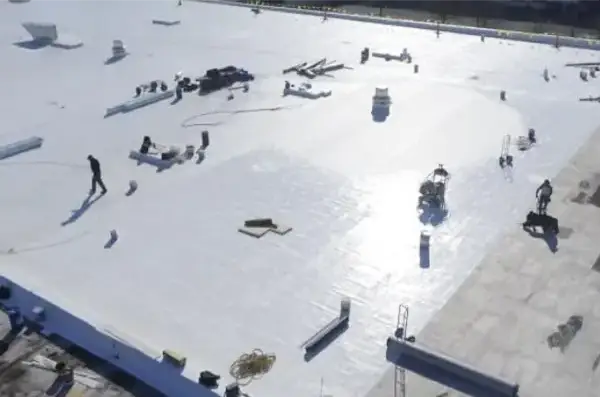
When dealing with water intrusion, property managers must weigh immediate repair costs against long-term operational security. Choosing the right path requires a clear understanding of your roof’s current structural health, age, and insulation condition. For fast, reliable solutions, working with a professional commercial roof repair services provider ensures that minor issues don’t turn into major capital expenditures.
Commercial Roof Leak Repair vs. Replacement Decisions
How do you know when it is time to patch, and when it is time to replace? The decision boils down to the condition of the underlying insulation and the overall extent of the damage.
- When to Repair: If the leak is isolated, the membrane is physically pliable, and moisture testing shows the insulation underneath is dry, a localized repair is the smartest choice. We can perform a reliable commercial roof leak repair by cutting out the damaged section and hot-welding a new target patch.
- When to Restore: If your roof is approaching the end of its lifespan but the insulation is still dry, applying a restoration coating (such as high-solids silicone) can seal all seams and pinholes, extending your roof’s life by up to 20 years.
- When to Replace: If moisture scans reveal that large sections of insulation are saturated, a complete tear-off is required. Saturated insulation permanently loses its R-value, rusts metal decks, rots wood structures, and cannot be salvaged.
If you are dealing with a sudden failure during a major storm, securing an emergency roof leak fix will stabilize your property and protect your assets while you plan a permanent solution. At Total Foundation & Roofing, we install high-performance systems built to GAF commercial roofing systems and specifications to ensure your property remains dry for decades.
Understanding Repair Costs and Insurance Coverage
Commercial roofing repairs can range significantly in price depending on the severity of the leak, the height of the building, and the roofing material.
- Minor Repairs ($200 – $800): Typically covers clearing blocked drains, resealing deteriorated pipe boots, or patching a few small membrane punctures.
- Moderate Repairs ($800 – $2,500): Includes rebuilding failed flashing around HVAC curbs, repairing split seams, or replacing small sections of wet insulation.
- Major Repairs ($2,500 – $5,000+): Involves extensive membrane patching, widespread seam reinforcement, or replacing large areas of water-damaged decking.
When severe weather strikes, many property owners rely on insurance to cover the damage. If wind uplift or hail impacts your roofing membrane, acting quickly with a commercial emergency roof repair will mitigate further losses. Be sure to document all damage with clear photos and keep detailed records of all repair invoices to support your claim.
To ensure your claim aligns with industry standards, you can review commercial property guidelines from the Insurance Information Institute (III). For extensive damage, our team provides complete roof leak damage repair to help restore your building’s structural integrity.
Proactive Maintenance to Prevent Future Leaks
The most cost-effective way to handle a commercial roof leak is to prevent it from happening in the first place. A structured, proactive maintenance plan can reduce emergency repair costs by up to 70% and significantly extend your roof’s working lifespan.
- Schedule Bi-Annual Inspections: Inspect your roof at least twice a year — once in the spring and once in the fall — as well as after any major hail or wind events.
- Clear Drains and Gutters: Regularly remove leaves, dirt, and debris from all drainage points to prevent ponding water.
- Install Walkway Pads: Protect your membrane from heavy foot traffic by routing technicians along designated, padded walkways from roof access points to HVAC units.
- Use High-Quality Materials: When installing new systems, use durable cover boards under the membrane to protect against dropped tools and impact damage.
If you are looking for local insights, you can also check regional directories like Yelp for Fredericksburg to see what options local business owners rely on.
For comprehensive preventative maintenance checklists and design guidelines, consult the Whole Building Design Guide (WBDG).
At Total Foundation & Roofing, we are dedicated to protecting your business from the top down. Don’t wait for the next storm to test your roof’s limits. Contact us today to schedule a professional, worry-free commercial roof inspection and keep your boardroom dry.