
Your Commercial Roof Is a Major Asset — Here’s How to Protect It
As a leading provider of professional roofing and foundation services, we understand that commercial roof maintenance is the practice of regularly inspecting, cleaning, and repairing your commercial roof to prevent small problems from becoming expensive failures. Commercial roofing systems are not “set it and forget it” installations. Whether your facility utilizes Thermoplastic Polyolefin (TPO), Ethylene Propylene Diene Terpolymer (EPDM), or Polyvinyl Chloride (PVC), each material has unique aging characteristics that require professional oversight to manage effectively over a 20-year lifecycle.
Quick answer — what does a commercial roof maintenance program include?
- Biannual inspections (spring and fall, minimum)
- Drainage clearing — removing debris from drains, scuppers, and gutters
- Seam and flashing checks — catching separations before water gets in
- Penetration sealing — resealing around HVAC units, vents, and pipes
- Post-storm walkthroughs — within 48 hours of any significant weather event
- Documentation — photos and written reports for warranty and insurance compliance
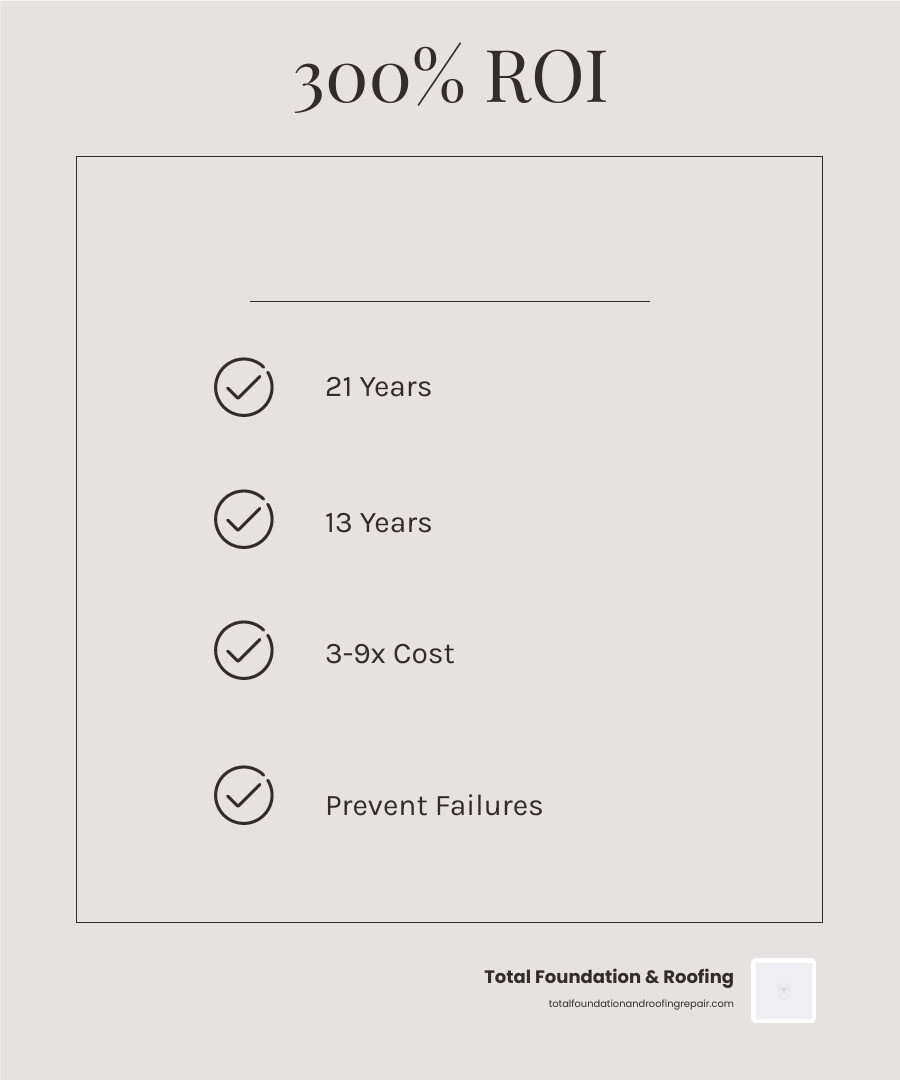
A well-maintained commercial roof lasts approximately 21 years. A neglected one lasts around 13 years. That 8-year gap represents hundreds of thousands of dollars in premature replacement costs. Most commercial roof failures don’t start with a dramatic storm or sudden collapse. They start quiet — a small seam gap, a clogged drain, or a hairline crack in flashing sealant. Left unchecked, these minor issues compound over time until what could have been a $200 repair becomes a $20,000 emergency.
For Kerrville and Texas Hill Country business owners, the stakes are especially high. Intense UV exposure, hail, and wide temperature swings put commercial roofing systems under constant stress. TPO is known for its energy efficiency but can suffer from seam failure if the hot-air welds were not performed perfectly. EPDM is incredibly durable but prone to shrinkage over decades, which can pull flashings away from walls. PVC is highly resistant to chemicals and grease—making it ideal for restaurants—but can become brittle if the plasticizers migrate out of the membrane over time. Reactive repairs after visible damage cost 3 to 9 times more than scheduled preventive work — and that’s before factoring in the business disruption a major leak causes.
As the owner of Total Foundation & Roofing Repair, I’m Daniel Sowell, and I’ve spent over 18 years delivering commercial roof maintenance solutions across the Texas Hill Country. In this guide, I’ll walk you through everything a structured commercial roof maintenance program covers — from inspection schedules to cost benchmarks to when replacement makes more sense than repair.
Commercial roof maintenance terms to remember:
The Financial ROI of Commercial roof maintenance
The biggest reason to maintain a commercial roof is simple: it is far cheaper to preserve a roof than to replace one early. Preventive maintenance typically runs about $0.05 to $0.15 per square foot per year, while full-service programs often land around $0.15 to $0.25 per square foot per year. By contrast, premature replacement caused by neglect commonly costs $5 to $16 per square foot. That is not a small gap. That is a budget ambush.
The “Budget Ambush” occurs when a facility manager ignores a small leak, thinking it is an isolated issue. In reality, that water is often saturating the polyisocyanurate (ISO) insulation boards beneath the membrane. Once saturated, these boards lose their R-value, leading to a massive spike in energy consumption. Furthermore, trapped moisture can cause the metal roof deck to rust from the top down, or a concrete deck to spall, leading to structural concerns that cost significantly more to remediate than a simple patch.
A strong maintenance plan protects more than the membrane. It protects insulation, interiors, equipment, inventory, tenant relations, and operating cash flow. If moisture gets into insulation, thermal performance can drop by as much as 40%, which means your HVAC system has to work harder just to keep up. If you want a broader look at system options and service planning, see our guides to commercial roofing services and commercial roofing.
Why Preventive Commercial roof maintenance is Essential
Preventive maintenance is essential because commercial roofs usually fail gradually, not dramatically. The most common failure points are flashings, seams, penetrations, edges, and drainage areas. Catch those early, and repairs stay manageable. Industry guidance consistently supports a proactive approach. According to this scientific research on roof longevity, every dollar spent on preventive maintenance can return $4 to $8 in avoided replacement costs over the roof lifecycle.
Preventive maintenance also helps with:
- Warranty compliance, since many manufacturers require documented inspections and repairs
- Insurance support, because photo records and service logs help prove storm timing and maintenance history
- Energy efficiency, by keeping insulation dry and reflective surfaces clean
- Safety, by reducing slip hazards, loose edge details, and damage around rooftop equipment
For local conditions, this matters even more. In Kerrville, Fredericksburg, and Comfort, heat and UV exposure accelerate sealant aging, while hail and wind can turn a small weak spot into a leak path. Our Commercial Roofing Kerrville resource explains why local climate should shape your maintenance plan.
Understanding the Cost of Commercial roof maintenance Programs
A commercial roof maintenance program is usually priced by roof size, roof type, age, number of penetrations, accessibility, current condition, and how much rooftop traffic the building gets. Here is the practical cost picture:
| Service type | Typical cost |
|---|---|
| Basic preventive maintenance | $0.05 to $0.15 per sq ft per year |
| Full-service maintenance contract | $0.15 to $0.25 per sq ft per year |
| Infrared moisture survey | $0.05 to $0.15 per sq ft |
| Premature roof replacement | $5 to $16 per sq ft |
| Emergency repair premium | 3 to 9 times planned repair cost |
If your roof still has life left, a restoration strategy such as coating may also make sense. Learn more in our guide to commercial roof coatings near me. If you are already dealing with active leaks, our page on commercial emergency roof repair explains what to do next.
Advanced Diagnostics: Infrared Surveys and Non-Destructive Testing
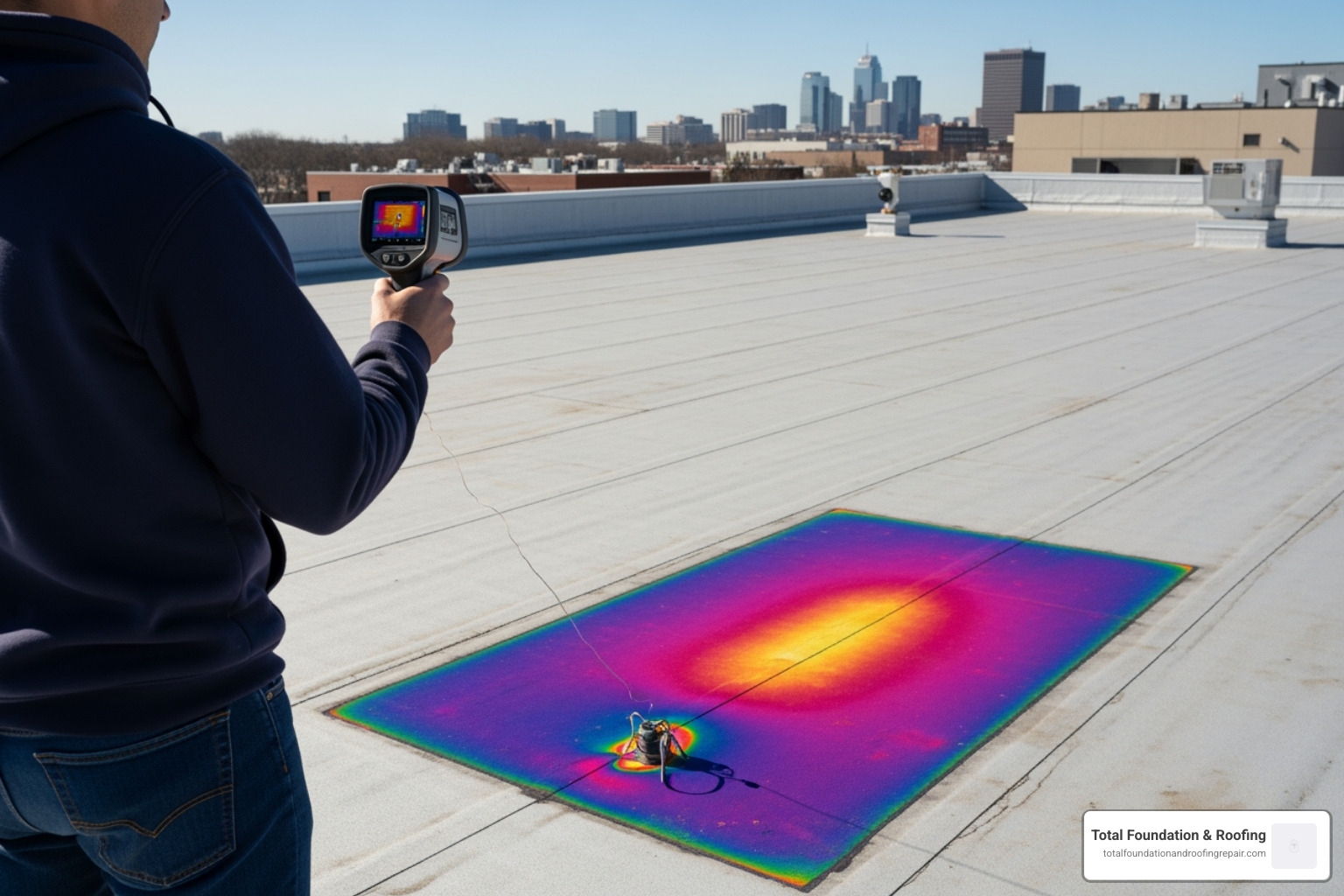
Visual inspections are important, but they cannot see through the roof assembly. That is where non-destructive testing becomes valuable. The most useful methods include infrared moisture surveys, capacitance testing, nuclear moisture surveys, and electronic leak detection. Infrared surveys work because wet insulation holds heat differently than dry insulation. On the right evening conditions, thermal images can reveal hidden moisture before interior leaks show up. Standards such as ASTM C1153 are commonly referenced for infrared use on roof systems.
This matters when hidden moisture may also affect adjacent building components. If water is moving beyond the roof assembly, our guide on commercial foundation inspection is worth reviewing too. For roofing materials and technical standards, manufacturer resources from GAF, Owens Corning, and trade guidance from the Roofing Contractors Association of Texas are also helpful.
Executing a Professional Maintenance Strategy
A maintenance strategy works best when it is scheduled, documented, and assigned. In plain English: if nobody owns the process, the roof gets ignored until it starts dripping on something expensive. A strong program should define who performs monthly visual checks, who authorizes roof access, and how post-storm checks are triggered. For Texas Hill Country properties, we also recommend coordinating roof checks after hail, strong wind events, and any major HVAC or electrical work on the roof. Other trades can accidentally cause punctures faster than weather sometimes can.
Industry Standards for Inspection Frequency and Timing
The direct answer: commercial roofs should be inspected at least twice per year, usually in spring and fall, plus after significant storms and after rooftop work by other trades. That baseline aligns with industry best practice and the inspection guidance outlined in this scientific research on inspection checklists.
Inspection frequency should increase when the roof is older than 15 years, the building has high foot traffic, or previous moisture issues have been found. The 48-hour ponding rule is especially important on low-slope roofs. If water is still standing more than 48 hours after rain, drainage is not performing correctly. Standing water adds significant dead load to the structure, which the building may not have been designed to support indefinitely. Moreover, ponding water acts as a magnifying glass for UV rays, accelerating the degradation of the membrane in those specific spots. It also creates a breeding ground for algae and vegetation, whose roots can eventually penetrate the roof surface.
For storm-prone buildings, our commercial storm damage guide is a good next read. And if you need a contractor who knows local commercial systems, start with our page on finding a local commercial roofer. Businesses comparing regional roofing needs in nearby service areas may also find Industrial Roof Installation Services in Fredericksburg, TX useful for general local context.
Essential Maintenance Tasks for Maximum Longevity
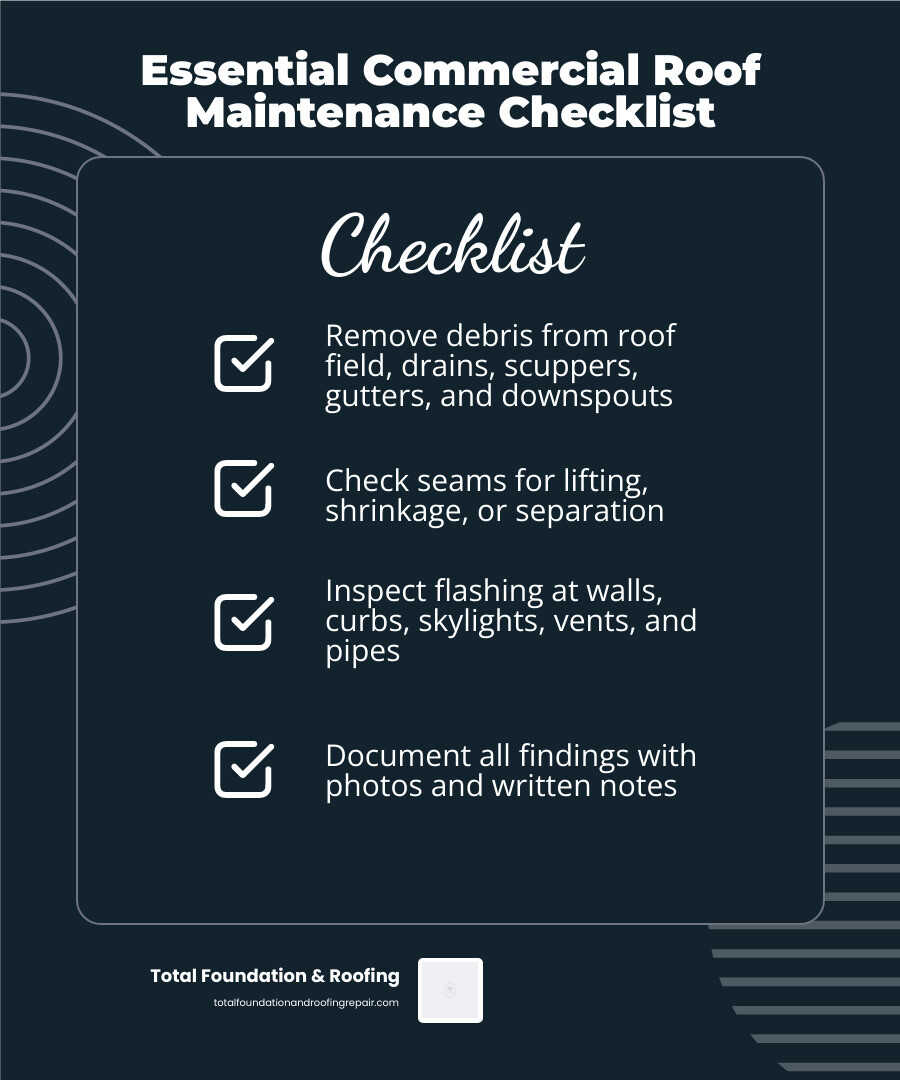
A comprehensive inspection should cover the roof surface, seams, flashings, penetrations, drains, edge metal, rooftop equipment, and interior signs of moisture. The best inspections start inside the building, because stains, odors, and damp ceiling materials can point to leak patterns before you ever climb a ladder. The essential maintenance tasks are:
- Remove debris from the roof field, drains, scuppers, gutters, and downspouts
- Check seams for lifting, shrinkage, or separation
- Inspect flashing at walls, curbs, skylights, vents, and pipes
- Reseal penetrations where sealants are cracked or aging
- Check for punctures, blisters, exposed fasteners, and membrane wear
- Inspect edge conditions for wind-related movement
- Verify HVAC condensate is draining properly
- Install or maintain walk pads in high-traffic zones
- Document all findings with photos and written notes
Foot traffic deserves special attention because it is one of the most common and most preventable sources of roof damage. HVAC technicians, electricians, and delivery crews are not usually thinking about membrane protection. Walk pads, designated access routes, and post-service checks can save a lot of headaches. For more on cleaning practices, see our guide to commercial roof cleaning near me.
When to Choose Replacement Over Continued Maintenance
Not every roof should be kept alive indefinitely. At some point, maintenance stops being smart asset management and starts becoming expensive denial. Replacement becomes the better option when moisture infiltration affects more than 25% of the roof area, annual maintenance costs exceed $0.30 per square foot, or the deck has widespread deterioration. Chronic leaks that continue despite targeted repairs are a clear signal that the system has reached the end of its realistic service life.
Age alone should not decide it. Condition should. We have seen younger roofs fail early from neglect and older roofs perform well because they were maintained consistently. That is especially true in the Texas Hill Country, where hail, UV, thermal movement, and rooftop equipment loads can change a roof’s condition faster than the calendar suggests. If you need help weighing repair versus replacement, our Best Kerrville Commercial Roofing Company resource explains what to look for in a professional evaluation.
If your roof is leaking now, if water is ponding after 48 hours, or if you have not had an inspection in the last year, it is time to act. You can Schedule Your Commercial Roof Inspection Today to ensure your facility remains protected. A final rule worth remembering: maintenance extends roof life, but it cannot reverse widespread saturation or structural decay. When those conditions are present, replacement is the responsible move.