

Why Concrete Slab Specialists Matter for Your Texas Property
Concrete slab specialists are licensed professionals who design, install, repair, and maintain concrete slabs for residential and commercial properties. At Total Foundation & Roofing Repair, we know that these experts handle everything from site preparation and reinforcement to pouring, finishing, and long-term maintenance of flat concrete surfaces. Whether you are building a new home or upgrading an industrial facility, the quality of your slab determines the longevity of the entire structure.
What Concrete Slab Specialists Do:
- Install foundation slabs – Pour and finish concrete bases for homes and buildings
- Repair damaged slabs – Fix cracks, settling, and structural issues
- Create outdoor surfaces – Build patios, driveways, sidewalks, and parking lots
- Handle specialized projects – Install equipment pads, commercial flooring, and decorative finishes
- Maintain existing slabs – Seal, resurface, and extend the life of concrete surfaces
Concrete slabs form the foundation of nearly every building in Texas. A properly installed slab can last 30 to 50 years or even over 100 years with proper maintenance. But when installed incorrectly, you’ll face cracking, settling, water damage, and costly repairs within just a few years. The structural integrity of your property depends on the precision of the initial pour and the quality of the sub-base preparation.
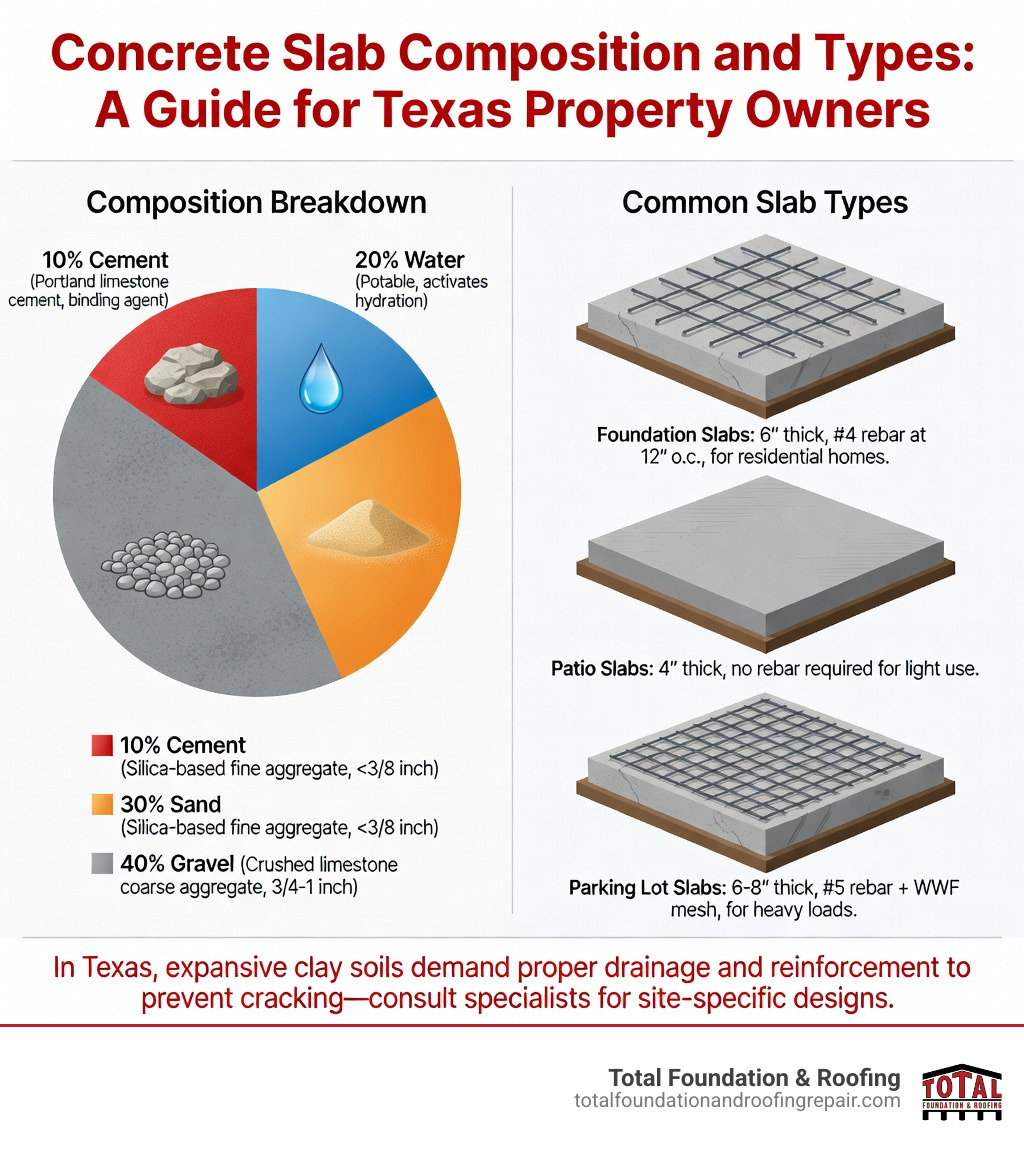
The difference between a quality slab and a failing one comes down to expertise. Professional specialists understand soil conditions, reinforcement requirements, proper curing times, and local building codes. They know that a 4-inch patio slab needs different preparation than a 6-inch foundation slab supporting your entire home. Furthermore, they account for the specific load-bearing requirements of the structure to prevent future deflection.
In the Texas Hill Country, soil conditions create unique challenges. Expansive clay soils shift with moisture changes, causing slabs to crack and settle. Expert foundation and concrete services become essential for homeowners who want structures that withstand these conditions. Without proper engineering, the natural movement of the earth can tear a poorly reinforced slab apart in a single season.
I’m Daniel Sowell, owner of Total Foundation & Roofing Repair, and I’ve spent over 18 years working with concrete slab specialists throughout the Texas Hill Country. Our team handles everything from new foundation construction to flat slab repairs, and we’ve seen how proper installation prevents expensive problems down the road.
Concrete slab specialists terms to learn:
Why You Need Professional Concrete Slab Specialists for Your Project
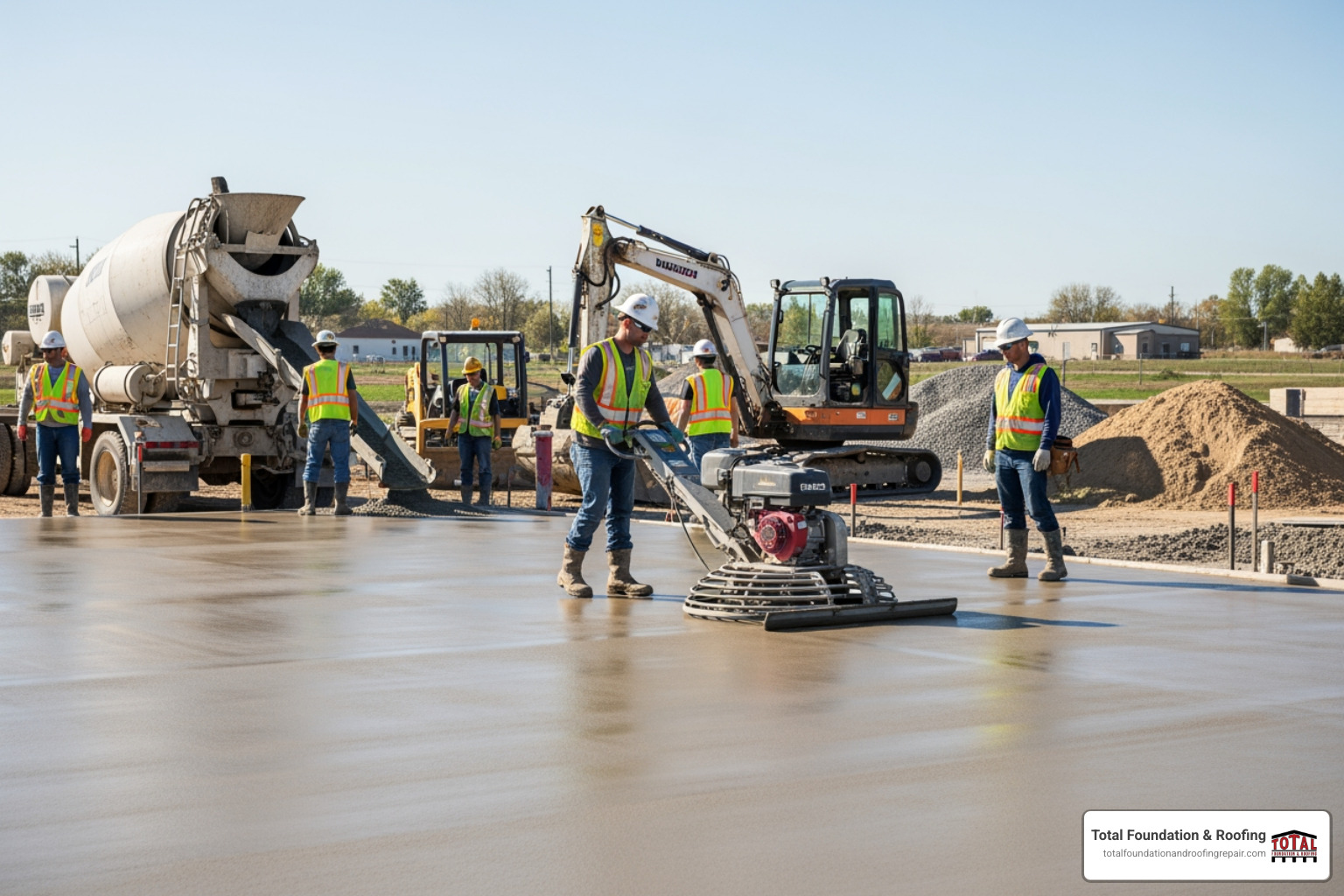
When you see a concrete truck pull up, it looks simple: pour the gray “mud,” smooth it out, and wait. In reality, the pouring is only about 10% of the work. The true value of hiring concrete slab specialists lies in the 90% of the work that happens before the truck even arrives. This includes soil testing, excavation, and the installation of vapor barriers and reinforcement.
Professional crews focus on the engineering requirements of different slab types. According to the American Concrete Institute (ACI), proper reinforcement and joint placement are critical to controlling cracks. A foundation slab for a home must support the weight of the entire structure, whereas a parking lot slab must withstand the constant “shearing” force of turning tires and heavy vehicle loads. Equipment pads, often used for heavy HVAC units or industrial machinery, require specific reinforcement to handle both weight and constant vibrations that would shatter standard concrete.
Choosing the right type of slab is a technical decision. You have to consider the load-bearing capacity, the drainage of the surrounding land, and the thickness of the material. For example, a standard patio is usually 4 inches thick, but a driveway or garage floor should be at least 6 inches thick and reinforced with rebar or wire mesh to prevent cracking under the weight of a vehicle. Specialists also ensure the subgrade is compacted to at least 95% density to prevent future settling.
Hiring a specialist also saves you from the nightmare of DIY removal. According to scientific research on removing a concrete slab, breaking up old concrete by hand is a grueling process that often leads to property damage if you hit the wrong section or disturb the underlying soil. Professionals use specialized equipment like jackhammers and skid steers to remove old slabs safely and prepare the ground for a fresh, stable pour.
The Versatility of Slabs Handled by Concrete Slab Specialists
Modern construction has moved far beyond simple “flat rocks.” Today, concrete slab specialists utilize various advanced systems to ensure stability and energy efficiency:
- Slab on Grade: The most common residential foundation where the concrete is poured directly into a mold set into the ground.
- Raft Floors (Mat Foundations): A specialized foundation type where the entire slab acts as a “raft,” distributing the weight of the building over the entire footprint. This is often used when soil conditions are poor.
- Suspended Slabs: Concrete floors that are not in contact with the ground, often used for upper levels or over basements.
- Waffle Pods: An eco-friendly and cost-effective system using foam “pods” to create a grid of concrete ribs, providing high strength with less concrete.
Whether you are looking for advanced concrete slab applications for a new build or need a cracked slab in garage repair, the versatility of concrete allows it to fit almost any architectural need.
Why Local Concrete Slab Specialists Outperform National Chains
In concrete, “local” isn’t just a buzzword—it’s a technical advantage. National chains often use “one-size-fits-all” mixes and techniques that don’t account for the unique climate and soil of the Texas Hill Country.
- Local Knowledge: We understand the “caliche” and clay soils found in Kerrville. We know how much the ground will heave during a Texas summer and how to adjust the mix accordingly.
- Regulatory Familiarity: Local concrete slab specialists are already familiar with the building codes and permit requirements in Fredericksburg and surrounding counties.
- Emergency Response: If a slab begins to sink or a pipe bursts under your foundation, a local team can be there in hours, not days.
- Lower Costs: Out-of-town companies have to charge for travel, lodging, and fuel. Local contractors keep those overhead costs low, passing the savings to you.
- Economic Boost: Hiring local helps recirculate money within our community, supporting other local businesses and families.
The Installation, Cost, and Maintenance of Quality Concrete
Quality concrete isn’t just poured; it is engineered. The process requires a strict timeline and specific environmental conditions to reach its maximum strength. If you pour on a day that is too hot or too humid without the right additives, the concrete will “flash dry,” leading to surface scales and deep structural cracks. The Portland Cement Association (PCA) emphasizes that the hydration process must be carefully managed to ensure the concrete reaches its design strength.
Understanding the Installation Process and Curing Timeline
A professional installation follows a meticulous step-by-step process designed to ensure longevity:
- Site Preparation & Excavation: Removing vegetation and topsoil to reach stable ground.
- Grading & Compaction: Leveling the dirt and using heavy machinery to pack it down. This prevents the “voids” that lead to sinking later.
- Formwork: Building the wooden “mold” that holds the wet concrete in place.
- Reinforcement: Laying down rebar or wire mesh to give the slab tensile strength.
- The Pour & Finish: Pouring the mix and using screeds and trowels to create a perfectly level, smooth surface.
- Curing: The chemical process where concrete hardens and gains strength.
The Curing Timeline:
- Walking: 1 to 2 days.
- Driving: 1 to 2 weeks.
- Full Cure: 28 to 48 days.
During the first month, the concrete is still technically “wet” on the inside. If you put heavy loads on it too soon, you risk permanent deformation. For those dealing with older slabs that didn’t survive this process well, checking out a sinking concrete guide 2025 or a settling concrete repair complete guide can help you identify if your slab can be saved or needs replacement.
Estimating Costs and Identifying When to Repair or Replace
How much does a professional slab cost? On average, expect to pay $6 to $12 per square foot. However, several factors can shift this price, including the complexity of the site and the current cost of raw materials.
| Project Type | Typical Thickness | Purpose |
|---|---|---|
| Patio / Sidewalk | 4 Inches | Foot traffic, light furniture |
| Driveway / Garage | 6 Inches | Standard vehicles, light trucks |
| Foundation / Commercial | 6+ Inches | Structural support, heavy machinery |
Pricing is also affected by the cost of reinforcement (rebar), the accessibility of the site, and any decorative finishes. While it may be tempting to go with the lowest bid, concrete is permanent. A cheap slab that cracks in two years will cost triple to remove and replace. Investing in professional concrete contractor services ensures the job is done right the first time.
You should consider a concrete slab repair complete guide if you notice:
- Cracks wider than a quarter-inch.
- Sections of the slab “heaving” or sinking.
- Water pooling in the center of the slab (poor drainage).
- Crumbling edges or a “dusty” surface (spalling).
If the damage is localized, you might save money with concrete lifting cost solutions like foam injection rather than a full replacement.
Specialized Finishes and Climate Considerations in Texas
In the Texas Hill Country, we don’t just deal with heat; we deal with rapid temperature swings. These freeze-thaw cycles can cause concrete to expand and contract violently. Concrete slab specialists use expansion joints—pre-cut grooves in the concrete—to give the slab room to move without cracking. Without these joints, the internal pressure would cause the slab to shatter.
For those who want more than just a plain gray slab, specialized finishes offer incredible aesthetic value:
- Stamped Concrete: Mimics the look of stone, brick, or wood.
- Stained Concrete: Deep, rich colors that won’t fade or peel.
- Polished Concrete: A high-gloss finish perfect for modern interior floors.
To keep these surfaces looking great in our climate, we often recommend concrete leveling Hill Country techniques or concrete leveling with foam injection to correct minor shifts in the soil before they become major cracks.
How to Select a Reliable Contractor and Protect Your Investment
Your concrete slab is the literal foundation of your investment. To ensure you’re hiring a reliable team, follow these steps:
- Check Licenses and Insurance: Never hire a “trunk-slammer” who doesn’t have liability insurance.
- Ask for a Portfolio: A specialist should be able to show you photos of 5-year-old projects, not just brand-new ones.
- Get Itemized Quotes: Ensure the quote includes site prep, reinforcement, and cleanup.
- Verify Warranties: A quality contractor stands behind their work.
At Total Foundation & Roofing, we provide a full suite of concrete leveling services designed to last a lifetime. We don’t just pour concrete; we build peace of mind for Texas homeowners.
Ready to start your project? Don’t settle for “good enough” when it comes to your foundation. Call Total Foundation & Roofing today for a free estimate at 830-257-7663.