

Why Understanding Your Garage Floor Cracks Matters
A cracked slab in garage floors is a common sight for Texas homeowners, but knowing how to assess the severity is key. An estimated 75% of U.S. homes have concrete slab cracks, many of which are cosmetic. However, distinguishing a harmless crack from a sign of foundation trouble can save you thousands. As experts in foundation and roofing solutions, our team at Total Foundation & Roofing has the experience to help you make that distinction.
Quick Assessment Guide:
- Hairline cracks (less than 1/8 inch): Usually cosmetic, from normal concrete shrinkage.
- Wide cracks (1/8 inch or more): May indicate structural issues.
- Uneven cracks: One side higher than the other signals potential foundation settlement.
- Growing cracks: Expanding cracks warrant professional evaluation.
- Water seepage: Moisture in cracks points to drainage problems.
Your garage floor endures unique stresses from heavy vehicles, temperature swings, and Texas’s specific soil conditions. I’m Daniel Sowell, owner of Total Foundation & Roofing Repair. With over 18 years of experience in the Texas Hill Country, I’ve helped countless homeowners understand and address their cracked slab in garage concerns. This guide will help you identify crack types, understand their causes, and know when to take action.
Explore more about cracked slab in garage:
What Causes a Cracked Slab in Your Garage and How to Assess It
Understanding why a cracked slab in garage floors appears is the first step to knowing if you should worry. Let’s review the common causes and how to tell if it’s a serious problem.
Common Culprits: From Shrinkage to Soil Settlement
Several forces work against your concrete slab from day one. Here are the most common culprits:
- Concrete Shrinkage: The most frequent and least concerning cause. As a new slab dries and cures over 1 to 18 months, evaporating water causes it to contract, often resulting in superficial hairline cracks.
- Soil Settlement & Expansive Clay: A major challenge in Texas. If the ground wasn’t properly compacted, it can settle under the slab’s weight, creating voids and cracks. Expansive clay soils, common throughout the region, swell when wet and shrink when dry, exerting immense pressure that heaves and cracks the concrete.
- Temperature Fluctuations: Concrete expands with heat and contracts with cold. Without proper control joints—intentionally weakened lines to guide cracking—these temperature swings create stress that results in random, destructive cracks.
- Heavy Vehicle Loads: A standard 4- to 6-inch slab can handle immense pressure, but it lacks flexibility. Repeatedly parking a heavy vehicle in the same spot creates fatigue, eventually leading to cracks.
- Poor Installation: Many cracks are avoidable. Common mistakes include inadequate subgrade compaction, an improper water-to-cement ratio, incorrect placement of reinforcement (rebar or wire mesh), and insufficient control joints. These errors create a weak slab prone to cracking.
For more on proper installation, explore our concrete contractor services.
Minor Flaw or Major Problem? How to Differentiate Garage Floor Cracks
Not every cracked slab in garage is a disaster. Here’s how to tell the difference between a cosmetic flaw and a structural problem.
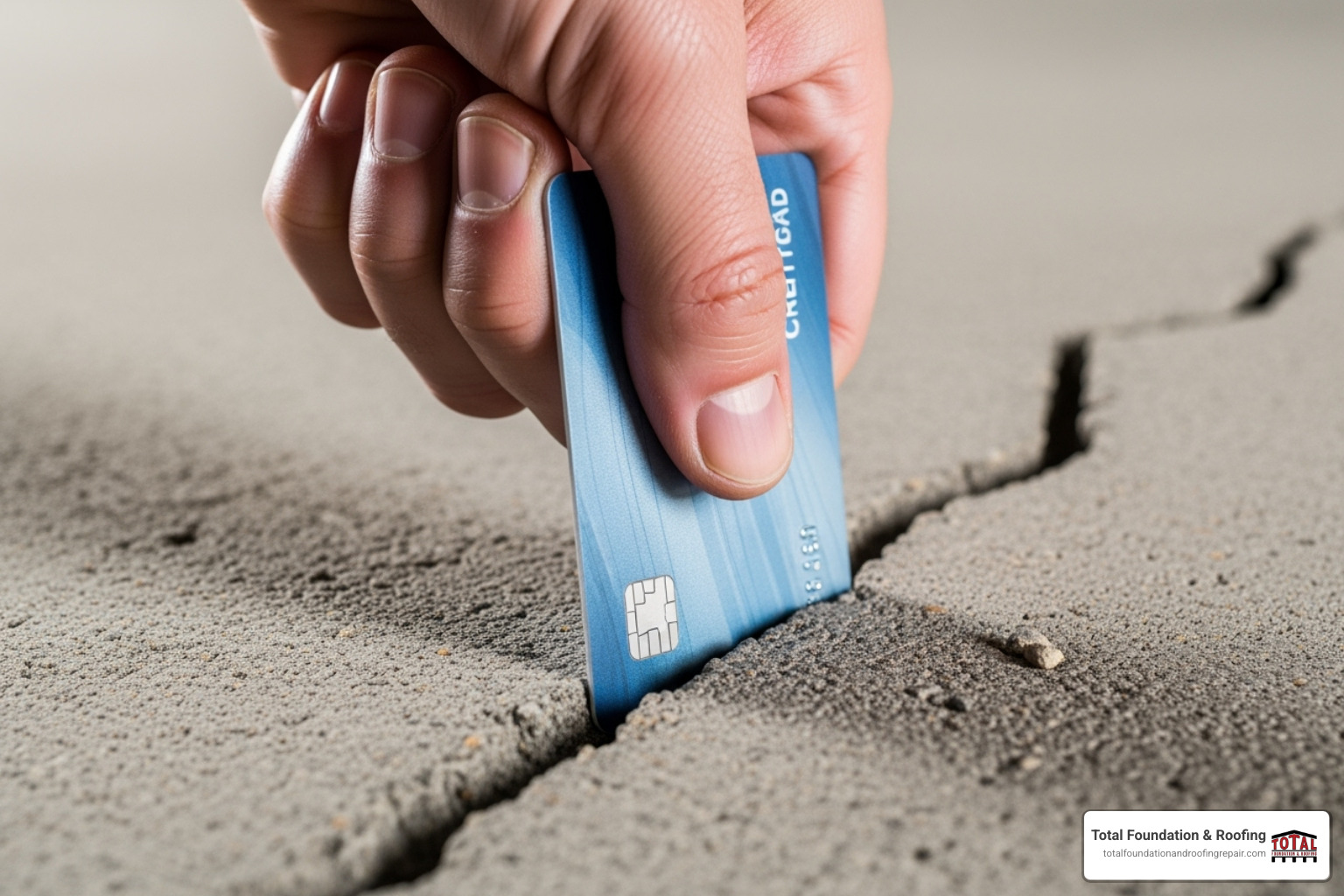
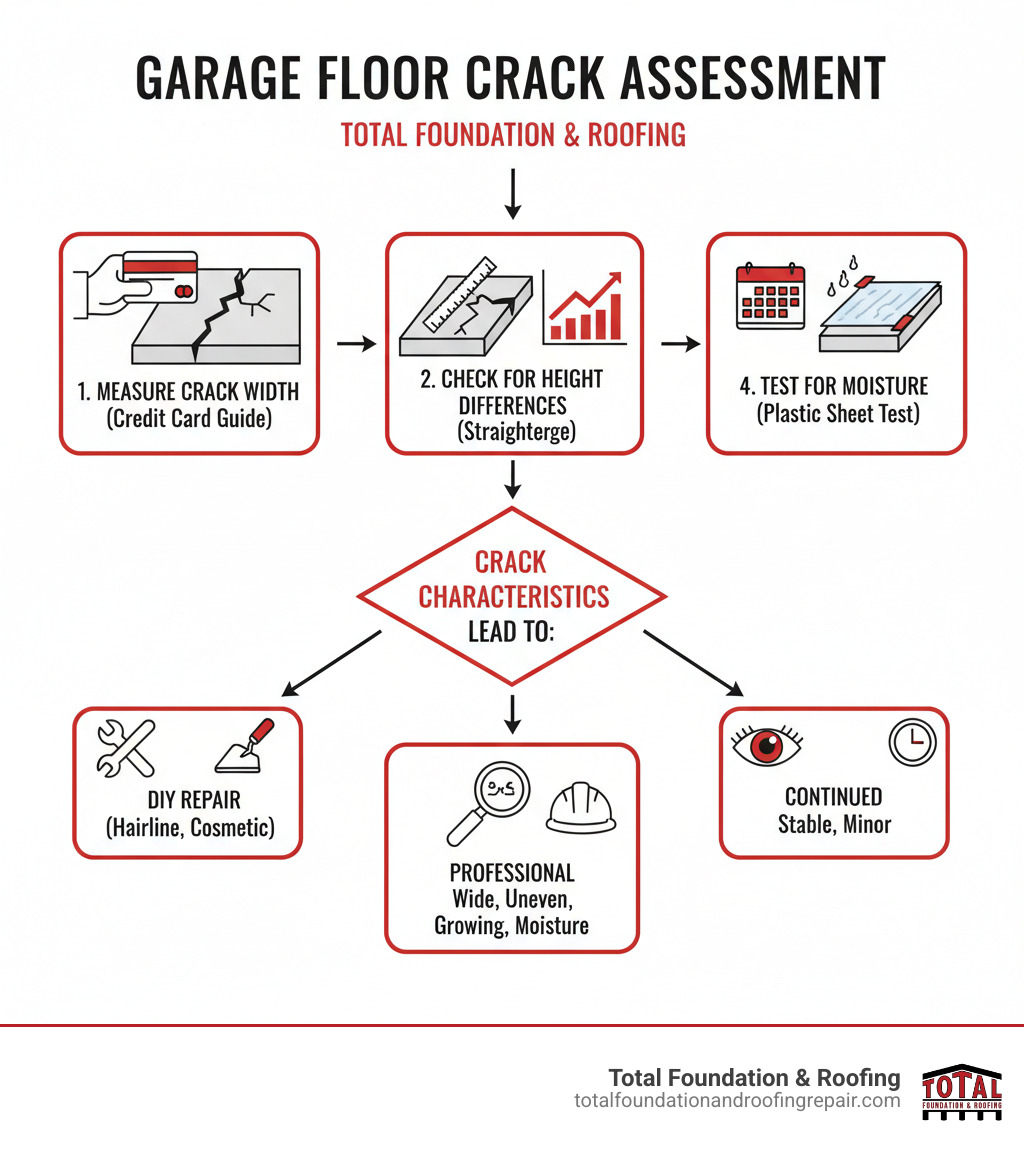
- Check the Width: Hairline cracks less than 1/8 inch wide are typically cosmetic shrinkage cracks. If you can slide a credit card into the crack, it’s wider than 1/8 inch and points to more significant issues like soil movement.
- Look for Unevenness: Lay a straightedge across the crack. If one side is higher than the other, you have differential settlement—a major red flag that the ground beneath is shifting unevenly.
- Monitor for Growth and Moisture: Mark the crack’s ends with a pencil and date it. If it lengthens or widens over a few months, the problem is active. To check for moisture, tape a plastic sheet over the crack for 24 hours. Condensation underneath indicates water is rising through the slab, which can worsen damage.
- Identify Crazing: A network of fine, spiderweb-like cracks is called crazing. It’s caused by rapid surface drying during curing and is purely a shallow, cosmetic issue.
This table provides a quick reference for assessing your crack:
| Feature | Minor/Cosmetic Crack | Serious/Structural Crack |
|---|---|---|
| Width | Generally < 1/8 inch (hairline) | > 1/8 inch (can fit a credit card) |
| Height Diff. | Flat, no noticeable unevenness | One side higher or lower (differential settlement) |
| Growth | Stable, doesn’t widen or lengthen over time | Actively growing, widening, or lengthening |
| Water Seepage | Typically dry | May show signs of moisture or water intrusion |
| Pattern | Random, spiderweb (crazing), superficial | Often linear, irregular, or extending to walls/foundation |
| Impact | Aesthetic, no structural concern | Potential structural compromise, safety hazard |
For help identifying these issues, see our crack repair services.
When a Cracked Slab in the Garage Signals Deeper Foundation Issues
A garage floor crack can sometimes be a distress signal about your home’s entire foundation.
- Know Your Slab Type: Most modern garages have floating slabs, poured independently from the house foundation. Cracks in these are usually localized. Older homes may have monolithic slabs, where the garage floor and house foundation are one piece. Here, a garage crack can indicate a problem with the entire foundation.
- Look for Connected Cracks: A crack that runs from the floor up a garage wall or appears to connect with your home’s foundation is a serious warning sign. It suggests the underlying movement is affecting your entire structure.
- Identify Other Warning Signs: Foundation problems rarely cause just one symptom. Look for bowing walls, sticking doors and windows, diagonal drywall cracks, and uneven floors throughout your home.
A cracked foundation slab can compromise your home’s structural integrity, allow water and pest intrusion, and significantly decrease property value. If you see cracks wider than 1/8 inch, unevenness, active growth, or any of the additional warning signs mentioned, it’s time to seek a professional assessment. In the Texas Hill Country, our unique soil conditions make early intervention critical. Foundation problems only worsen over time, so addressing them early is the most cost-effective approach. For comprehensive evaluations, visit our foundation repair services page.
Repair and Prevention Strategies for Your Garage Floor
After assessing your cracked slab in garage, the next step is choosing the right response. Some cracks are simple DIY fixes, while others require professional expertise.
From DIY Fixes to Professional Solutions: Repair Options and Costs
Choosing the right repair starts with an honest assessment of the crack’s severity.
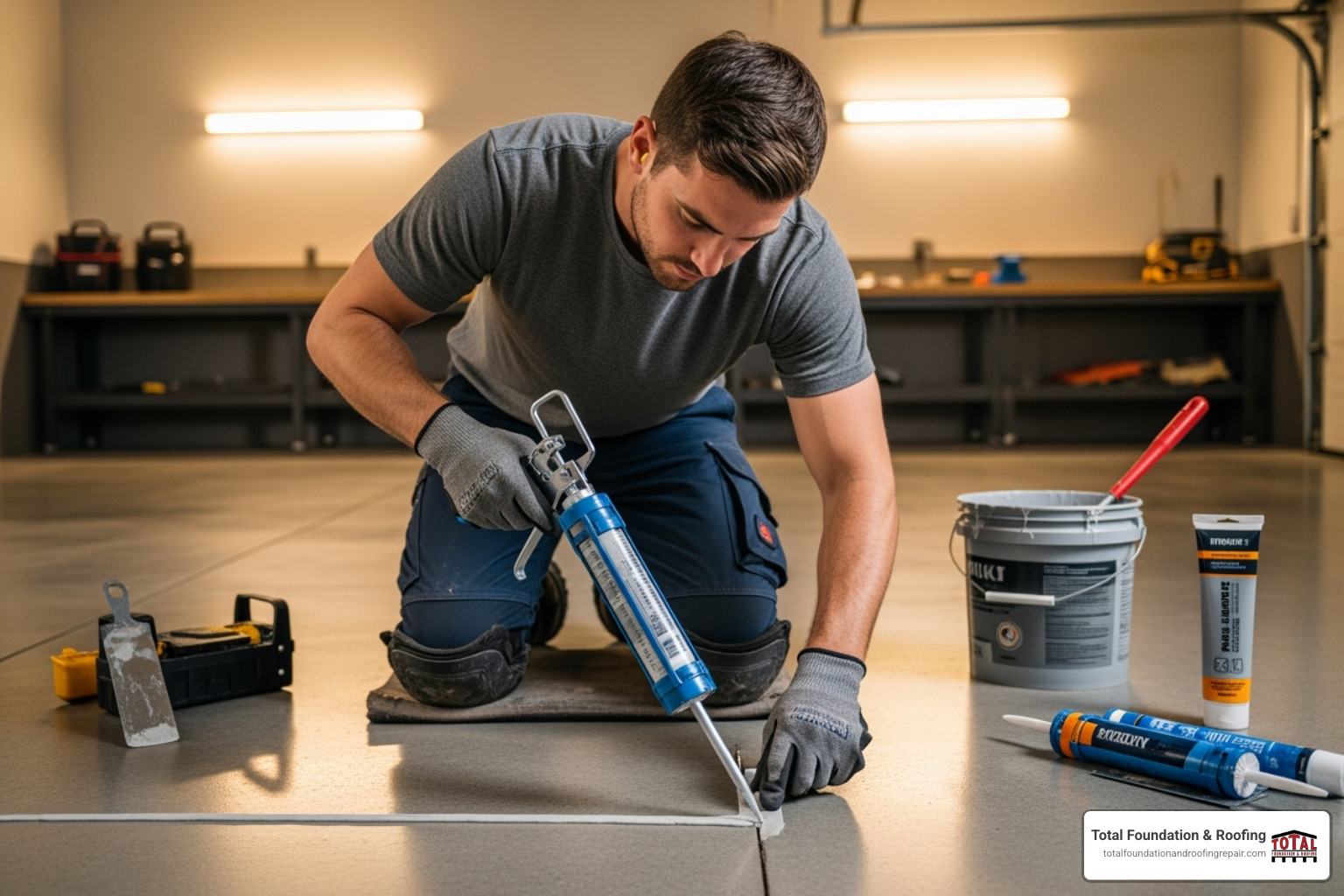
DIY Repairs for Minor Cracks: For stable, hairline cracks up to 1/4 inch wide, DIY solutions are often sufficient.
- Epoxy Fillers: Create a strong, sandable bond that reinforces the crack. Costs are typically $2-$10 per square foot.
- Polyurethane Caulk: Remains flexible after curing, making it ideal for sealing out moisture. It is not sandable, so the repair may be visible.
- Concrete Patching Compounds: Work well for slightly larger non-structural cracks. Apply to a dampened surface in layers for deeper repairs.
Professional Solutions for Serious Cracks: When cracks are wider than 1/2 inch, show unevenness (differential settlement), are actively growing, or are accompanied by other warning signs, professional intervention is essential.
- Polyurethane Foam Injection (Slab Jacking): A modern technique where expanding foam is injected beneath the slab to lift, level, and stabilize it by filling soil voids. It’s less invasive and cures faster than traditional mudjacking.
- Concrete Resurfacing: If the slab is sound but the surface is damaged, a new layer of concrete or a polymer overlay can be applied. This restores appearance and durability for $3-$10 per square foot.
- Full Slab Replacement: The best long-term solution for severely failed slabs. This involves removing the old concrete, properly preparing the subgrade, and pouring a new, reinforced slab. Costs typically range from $6-$15 per square foot.
- Piering Systems: For deep-seated foundation issues, helical or push piers are used to transfer the structure’s load to stable soil or bedrock, addressing the root cause of the settlement.
For expert help with any concrete project in the Texas Hill Country and surrounding areas, explore our concrete contractor services.
Proactive Measures: How to Prevent a Cracked Slab in the Garage
An ounce of prevention is worth a pound of cure. If you’re building new or replacing a slab, follow these best practices to minimize future cracking.
- Proper Soil Compaction: The ground beneath the slab must be uniformly compacted to create a stable base and prevent settling.
- Adequate Reinforcement: Steel rebar or wire mesh embedded in the concrete dramatically increases its tensile strength, holding the slab together even if minor cracks form.
- Correct Concrete Mix and Curing: Using the proper water-to-cement ratio is crucial for strength. The slab must also cure slowly, a process detailed by the Portland Cement Association, which often involves keeping it moist for several days to prevent rapid drying and shrinkage cracks.
- Strategic Control Joints: These planned grooves, like those discussed by the Concrete Network, are essential. They create predetermined lines for cracks to form, keeping them controlled and predictable.
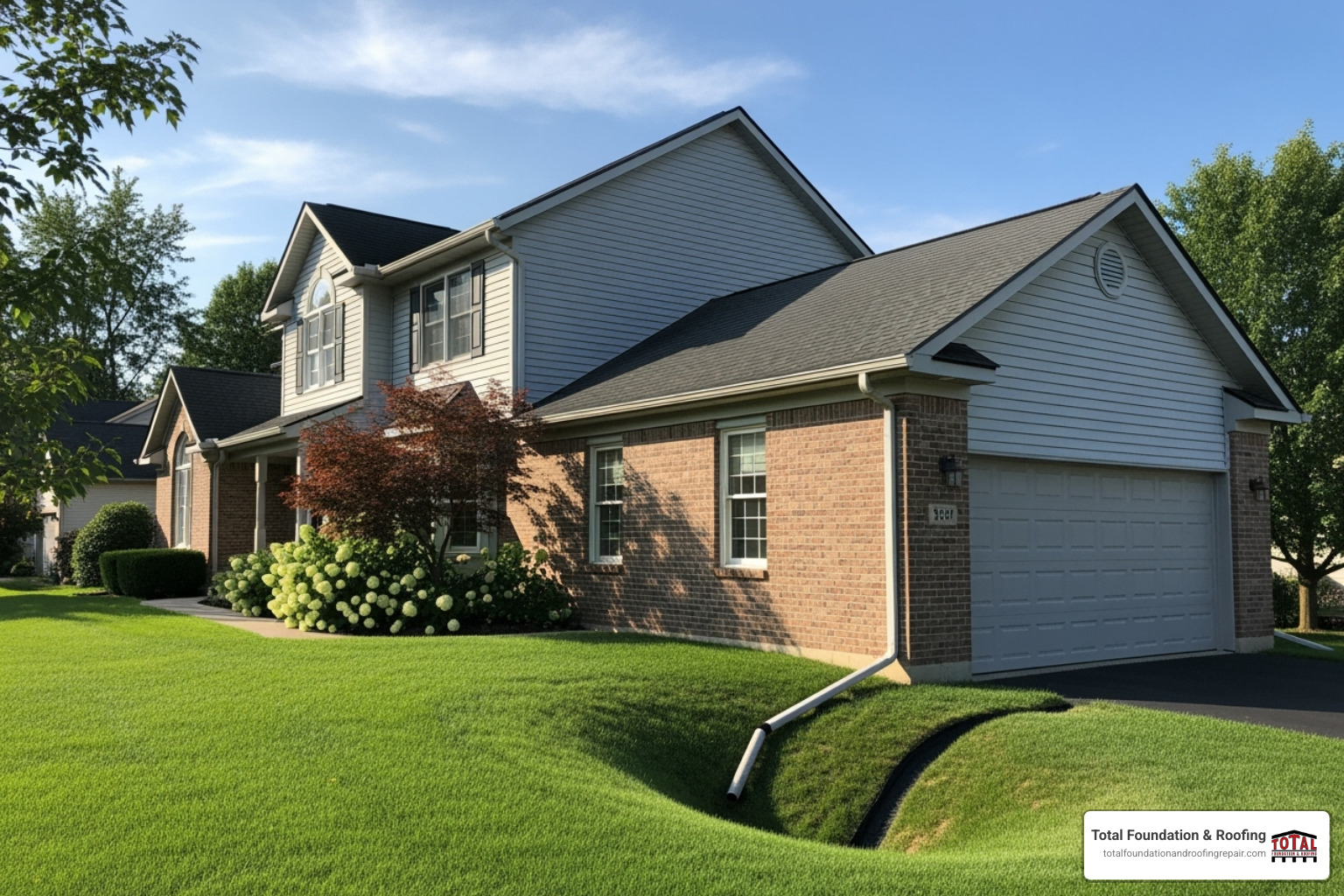
- Effective Water Management: Grade your property to slope away from the foundation. Keep gutters clean and ensure downspouts discharge water far from the slab to prevent soil erosion and movement from expansive clays.
- Early Maintenance: Seal small, hairline cracks with a flexible sealant as soon as they appear. This prevents moisture from penetrating the slab and causing wider deterioration. Regular inspections can help you catch these issues early.
For more preventative tips, see our blog on foundation maintenance.
Securing Your Foundation: When to Call the Experts
The most important takeaway is that early action prevents expensive disasters. A minor crack today can become a major structural problem if ignored.
If your assessment reveals cracks wider than 1/8 inch, uneven surfaces, active growth, or water seepage, a professional evaluation is your wisest move. This is especially true in the Texas Hill Country, where our expansive clay soils create unique challenges that require specialized expertise.
At Total Foundation & Roofing, we provide comprehensive evaluations custom to the specific conditions of your property throughout the region. We diagnose the root cause of your cracked slab in garage and recommend the most effective, lasting repair strategy. Our commitment is to protect your investment with high-quality workmanship and reliable service.
Don’t let a garage crack evolve into a structural emergency. Explore our foundation crack repair services and let us help you secure the integrity of your home for years to come.