
Why a Metal Roof Leak Demands Immediate Attention
Fix metal roof leak problems before they escalate. At Total Foundation & Roofing Repair, we believe proactive maintenance is the key to longevity. Here’s a quick overview of how to do it:
- Find the source — Check fasteners, seams, flashing, and rust spots
- Clean the area — Remove rust, old caulk, and debris with a wire brush
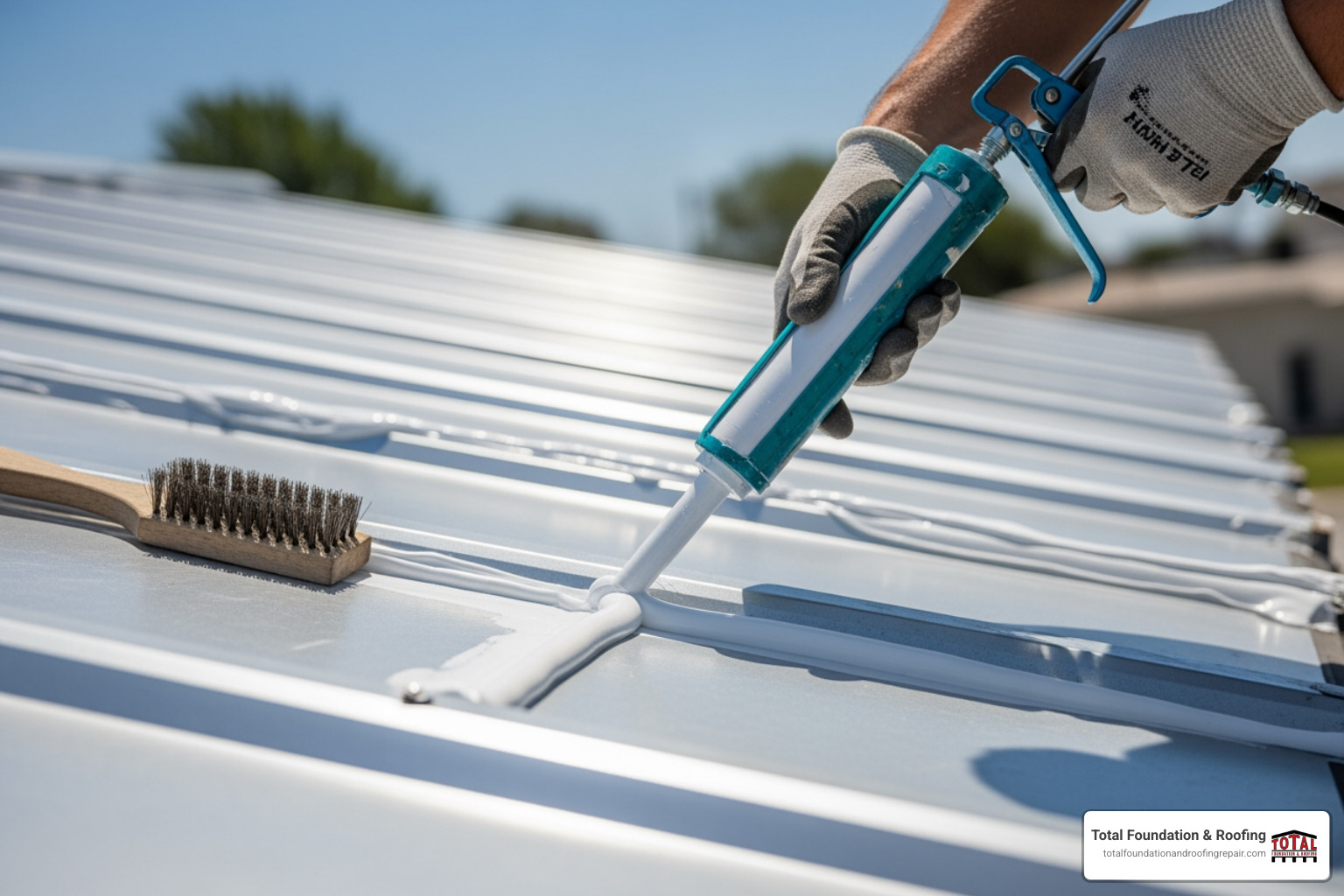
- Apply the right sealant — Use butyl rubber or polyurethane sealant rated for metal roofs
- Patch larger holes — Cut a matching metal patch overlapping at least 2 inches beyond the damage
- Seal seams and flashing — Reseal with fresh sealant or replace flashing entirely
- Apply a roof coating — Add an elastomeric coating for long-term protection
Metal roofs are built to last. According to the Metal Construction Association, aluminum and steel roofs routinely last 50 years or more — far outlasting asphalt shingles (about 20 years) or wood shakes (about 30 years). But even the toughest roofing system can develop leaks over time, especially here in the Texas Hill Country, where heat, storms, and temperature swings put every fastener, seam, and sealant through its paces. The intense UV radiation in Texas can degrade even the most durable materials over several decades.
The early signs are easy to miss: a faint water stain on the ceiling, a musty smell after rain, or a single rust patch on an otherwise solid roof. Left alone, those small problems turn into expensive ones — damaged insulation, mold growth, and structural rot. In many cases, the water doesn’t just sit; it travels along the metal panels and drips far from the original entry point, making detection a challenge for the untrained eye.
The good news? Many metal roof leaks are fixable with basic tools and a few hours of careful work. Knowing where to look and what to use makes all the difference. I’m Daniel Sowell, owner of Total Foundation & Roofing Repair based in Kerrville, Texas, with over 18 years of hands-on experience helping Texas homeowners and business owners fix metal roof leak damage before it becomes a costly disaster. This guide covers everything I’ve learned in the field — from quick DIY fixes to knowing when it’s time to call in a pro.
Proven Methods to Fix Metal Roof Leak Points
When we talk about the longevity of Metal Roofing, we aren’t exaggerating. While zinc roofs can last 80 years or more, the components holding them together—the sealants and fasteners—have a much shorter lifespan. Most leaks originate at specific “weak points” where the metal panels meet or where they are pierced.
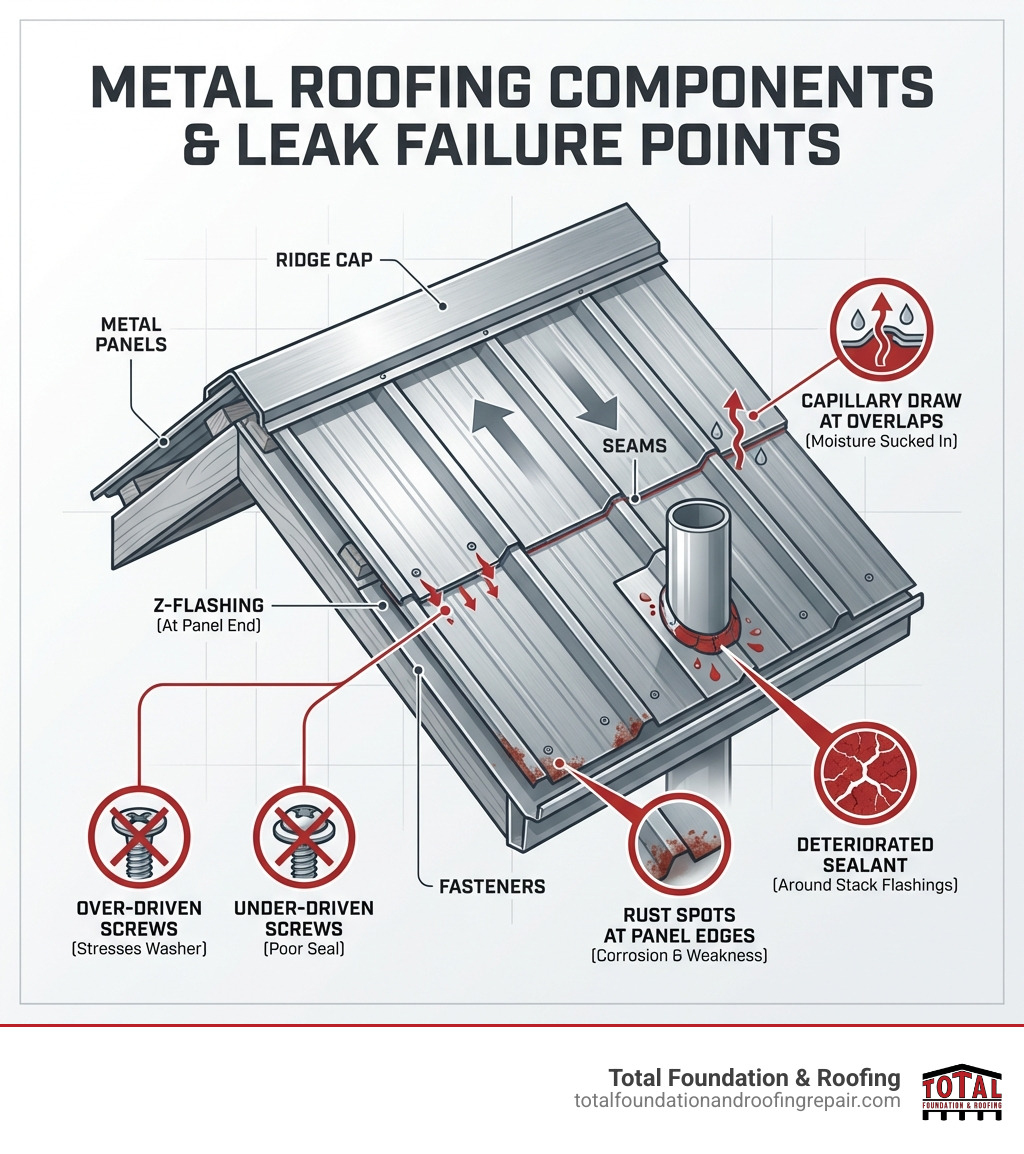
One of the most common physical phenomena we encounter is capillary draw. This occurs when water is “sucked” into the tiny gaps between overlapping metal sheets due to surface tension. If the original mastic or sealant between these laps has dried out or cracked, water will travel uphill and enter your building. This is why high-quality underlayment and proper lap sealing are critical, as noted in technical bulletins from GAF.
Another major factor is thermal expansion. Metal panels expand and contract significantly as the Texas sun beats down on them. This constant movement puts immense stress on fasteners. Over time, screws can back out, or the rubber washers (gaskets) can dry rot and crack. Because the metal moves more than the wood or steel frame beneath it, the screw holes can even become elongated, creating a perfect entry point for water. This “oil canning” or movement is natural, but it requires the right hardware to manage.
Identifying the Source of the Leak
Finding the exact entry point is often the hardest part of the job. At Total Foundation & Roofing, we recommend a systematic approach to Roof Leak Detection. Start by inspecting your attic or the underside of the roof deck during a rainstorm. If you see water dripping, don’t assume the leak is directly above that spot; water often travels down a purlin or rafter before falling. For difficult-to-track moisture, we often utilize Thermal Imaging to Detect Roof Leaks, which identifies temperature differences caused by trapped water.
Visual Inspection Checklist:
- Fasteners: Look for screws that are crooked, over-driven (the washer is crushed and protruding), or under-driven (the washer isn’t touching the metal).
- Seams: Check for gaps in the vertical or horizontal laps, especially at the ridge caps.
- Rust: Patches of orange or brown indicate the protective coating has failed.
- Stack Flashings: These rubber “boots” around pipes only last about half as long as the roof itself. If they are cracked or the sealant at the base is peeling, they need attention.
| Repair Type | Average Professional Cost | Range |
|---|---|---|
| Patching a Hole | $375 | $150 – $600 |
| Repairing Splits/Cracks/Gaps | $600 | $400 – $800 |
| General Leak Repair | $700 | $500 – $1,200 |
| Rust & Corrosion Repair | $1,750 | $1,000 – $3,000 |
Preparation and Safety to Fix Metal Roof Leak Hazards
Safety is non-negotiable. According to OSHA’s guide on Protecting Roofing Workers, falls are the leading cause of injury in the trade. Always use a sturdy, secured ladder and wear non-slip shoes. If the roof is steep, do not attempt a DIY repair without a safety harness and anchor system. Metal roofs are notoriously slippery when wet or even slightly dusty.
Surface preparation is the secret to a repair that lasts 10 years versus one that fails in six months. Sealants will not stick to dirt, algae, or old, flaking caulk.
- Clean: Use a cleaner like Simple Green to remove film and grime.
- Scuff: Use a wire brush to scuff the metal surface. This creates “teeth” for the new sealant to grab onto.
- Dry: The area must be bone-dry.
- Temperature: For proper adhesion, wait for a day when temperatures are above 50°F.
Step-by-Step Repairs to Fix Metal Roof Leak Issues
Once the area is prepped, follow these steps based on the specific problem you found during your Metal Roof Installation Complete Guide review.
1. Loose or Damaged Fasteners If a screw has backed out, don’t just tighten it. Remove the old screw, clean the hole, and replace it with a “long-life” fastener that is one size larger in diameter. This ensures the threads grip fresh wood or metal. Apply a small bead of polyurethane sealant over the head for extra security.
2. Sealing Small Holes and Punctures For tiny holes caused by rust or falling branches, a high-quality polyurethane sealant is your best friend. Unlike cheaper silicone, polyurethane is UV-resistant and paintable. Apply the sealant in a steady stream, ensuring it fills the void completely.
3. Patching Larger Holes If the hole is larger than a screw head, you need a metal patch.
- Cut a piece of matching metal that overlaps the hole by at least 2 inches on all sides.
- Round the corners of the patch so they don’t catch snow, ice, or debris.
- Apply a thick bead of sealant to the underside of the patch, press it down, and secure it with pan-head sheet metal screws spaced 3–4 inches apart.
- Pro Tip: Never screw the patch through to the roof decking; only screw it to the metal panel to allow for thermal expansion.
4. Fixing Damaged Flashing Flashing is the most common leak site. Whether you are Flashing a Chimney on a Metal Roof or Installing Metal Roof Transition Flashing, ensure the metal is tucked under the panels above it and over the panels below it to direct water flow correctly.
Advanced Restoration and Professional Guidance
If your roof has multiple leaks or is showing widespread rust, individual patches might be like putting a band-aid on a broken leg. In these cases, we look toward restoration systems. A fluid-applied commercial roof restoration system can extend the life of your roof by 10–20 years for a fraction of the cost of replacement. This approach is often preferred for large-scale industrial buildings where replacement would disrupt operations.
According to the EPA’s Brief Guide to Mold and Moisture, keeping the building envelope tight is the only way to prevent indoor air quality issues. This aligns with moisture control and energy efficiency recommendations from Owens Corning. For older roofs, we often suggest a Metal Roof Cost Per Square Foot Installed evaluation to see if a full coating or a spray foam system is more economical than constant repairs. Spray foam, for instance, provides an R-value of 6.5 per inch, which can pay for itself in energy savings in less than 5 years.
Choosing the Right Sealants and Coatings
Not all “roof tar” is created equal. In fact, we rarely recommend standard roofing tar for metal because it becomes brittle and cracks under the Texas sun. When performing Metal Roofing Fredericksburg TX repairs, we focus on three main materials:
- Polyurethane Sealant: The industry standard for fasteners and small gaps. It’s tough, handles movement well, and lasts about 20 years.
- Butyl Tape: Essential for sealing laps and joints. It stays “sticky” and flexible for decades, providing a gasket-like seal between panels.
- Elastomeric Coatings: These are like “rubber paint.” To get a 10-year warranty, you need to install 20 mils of coating. For a 20-year warranty, you need 30 mils. These coatings reflect UV rays, significantly lowering roof surface temperatures.
While fibered aluminum paint is a common “cheap” fix, it often requires reapplication every 1–2 years. If you want a DIY repair to last 5–10 years, stick with high-solids silicone or polyurethane.
Avoiding Common DIY Mistakes
We’ve seen it all in the Texas Hill Country. To ensure your fix metal roof leak project is successful, avoid these pitfalls:
- Using the Wrong Sealant: Never use “caulk” from a bargain bin. If it isn’t rated for metal and high UV exposure, it will peel off within a year.
- Skipping the Cleaning: If you apply sealant over dust, the sealant is only sticking to the dust, not the roof.
- Capping Screws: Don’t just put a “dollop” of sealant over a leaking screw. If the washer is rotten, the water will just leak underneath the sealant. Replace the screw.
- Ignoring Rust: If you seal over rust without treating it, the corrosion will continue to eat away at the metal underneath your repair.
- Rushing the Cure: Most sealants take 24 hours to skin over and a full week to reach maximum strength. Don’t perform repairs right before a massive thunderstorm.
When to Hire Professional Metal Roofers
While we encourage homeowners to handle minor maintenance, there is a “20% rule”: if more than 20% of your roof is damaged or leaking, DIY repairs are no longer cost-effective or safe. At this stage, the structural integrity of the decking or the purlins may be at risk.
You should call Professional Metal Roofers if:
- The Roof is Steep or High: Safety equipment and experience are required for heights.
- Storm Damage: If hail has dented the seams or high winds have lifted panels, the structural integrity may be compromised.
- Widespread Rust: This often requires professional-grade primers and industrial coatings.
- Warranty Concerns: Many metal roof warranties are voided if repairs aren’t performed by a certified contractor.
If you are in Kerrville, Fredericksburg, or Comfort, and you’re tired of chasing drips, let us help. Whether you need a simple Roof Repair or an Emergency Roof Leak Fix after a Hill Country storm, our team is ready.
Don’t let a small drip turn into a flooded home. Call Total Foundation & Roofing today at 830-257-3333 for a professional evaluation. We’ll make sure your roof stays as tough as the day it was installed.