
Why Identifying Hail Storm Roof Damage Early Can Save You Thousands
Hail storm roof damage is one of the most costly and frequently overlooked threats to your home. Here’s what you need to know right away:
Quick answers at a glance:
- Signs to look for: Dented gutters, granule loss in downspouts, circular bruise marks on shingles, cracked tiles, soft spots on roofing surface
- What size hail causes damage: Hailstones 1 inch (quarter-size) or larger commonly damage asphalt shingles — but even ¾-inch hail can cause harm in high winds
- What to do first: Document everything with photos before making any repairs or calling your insurance company
- Repair vs. replace: If more than 25–30% of your roof is affected, full replacement is usually the smarter investment
- Time limit: Most insurance policies require you to file a hail damage claim within one year of the storm
Hail storms are brief — they rarely last longer than 15 minutes — but the damage they leave behind can quietly destroy your roof over months. A bruised shingle may look completely normal the day after a storm, yet fail months later when rain finds its way through. By then, you could be facing leaks, mold, and structural rot that cost far more to fix than the original roof damage ever would have.
Wind and hail already account for 42.5% of all homeowners insurance losses in the U.S., and the average hail damage claim over the past decade has reached $9,000. In Texas — which led the nation in hail incidents in 2024 — that risk is very real for homeowners in the Hill Country and surrounding regions.
Knowing what to look for, and how to look for it safely, is the difference between a straightforward insurance claim and an expensive surprise. Total Foundation & Roofing has helped Texas homeowners navigate exactly that process for nearly two decades.
I’m Daniel Sowell, owner of Total Foundation & Roofing Repair in Kerrville, Texas, with over 18 years of hands-on experience assessing and repairing hail storm roof damage across the Texas Hill Country. In this guide, I’ll walk you through how to spot damage like a professional inspector — safely, accurately, and without missing the details that insurance adjusters look for.
Identifying the Signs of hail storm roof damage Across Different Materials
Not all roofs react to hail the same way. While a heavy stone might crack a clay tile, it might only leave a cosmetic “ding” on a metal panel. Understanding how your specific roofing material handles impact is the first step in a professional-grade inspection.
In the Texas Hill Country, we see everything from traditional asphalt shingles to high-end Spanish tile and standing seam metal. The severity of hail storm roof damage is determined by the “impact energy” — a combination of the hailstone’s size, its density (hard ice vs. slushy snow), and the wind speed at the moment of impact.
Homeowners in “Hail Alley” — which technically spans from Texas up through Nebraska — are particularly vulnerable. According to the National Severe Storms Laboratory, hailstones can fall at speeds up to 100 mph. When that kind of energy hits your home, the damage can be either functional (compromising the roof’s ability to shed water) or cosmetic (affecting only the look). Insurance typically covers functional damage, but the line between the two can be thin.
Recognizing hail storm roof damage on Asphalt Shingles and Wood Shakes
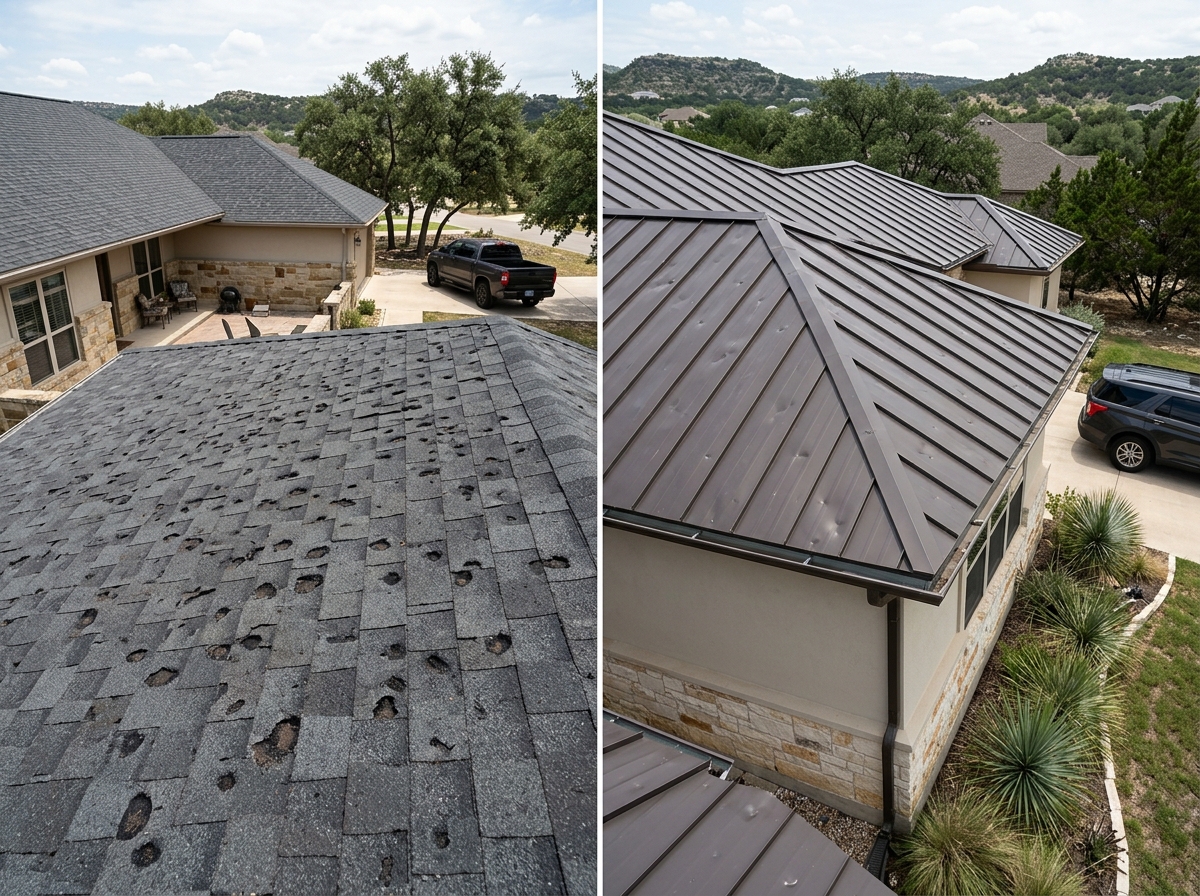
Asphalt shingles are the most common roofing material in Kerrville and Fredericksburg, covering roughly 75% of U.S. homes. Because they are flexible, they don’t usually “shatter.” Instead, they “bruise.”
When a hailstone hits an asphalt shingle, it knocks away the protective granules. These granules aren’t just for color; they protect the underlying asphalt from UV rays. Without them, the sun will bake the shingle, causing it to become brittle and leak.
Signs of asphalt shingle damage include:
- Granule Loss: Check your gutters and downspouts. If they are overflowing with sandy granules after a storm, your shingles have likely been stripped.
- Bruising: Press your thumb against a dark spot on the shingle. If it feels soft or spongy, like a bruised apple, the internal fiberglass mat is fractured.
- Circular Dents: Look for random patterns of circular hits. Unlike mechanical damage, which often follows a straight line, hail is chaotic.
- Exposed Mat: In severe cases, the hail will strip away enough material to reveal the shiny fiberglass mat underneath.
Wood shakes and shingles react differently. Because wood is a natural fiber, it tends to split along the grain when struck.
Signs of wood shake damage include:
- Sharp-Edged Splits: A fresh hail hit will cause a split with sharp, clean edges.
- Orange/Brown Color: If you see a split that shows bright orange or light brown wood inside, that’s a sign of a recent impact. Older splits will be weathered and grey.
- Impact Marks: Dents or “divots” along the edges of the shakes.
If you suspect your roof has taken a hit, our guide on Minor Hail Damage Roof can help you determine if the damage requires immediate professional intervention.
Assessing Metal and Tile Roof Vulnerabilities
Metal roofing is often touted for its durability, and for good reason. It is highly resistant to fire and wind, but it isn’t “hail-proof.” In fact, State Farm reports that while metal roofs last two to three times longer than asphalt, large hail can still cause significant issues.
Metal Roof Damage:
- Dents and Dings: Large hailstones (1.5 inches+) can leave visible craters. While often cosmetic, large dents can pool water or cause fasteners to loosen, eventually leading to leaks.
- Scratched Coating: If the protective paint or stone coating is chipped, the underlying metal is exposed to rust and corrosion.
Tile and Slate Damage: Tile and slate are brittle. Think of them like a ceramic plate; they don’t bruise, they break.
- Star Fractures: Small cracks that radiate out from a central impact point.
- Chipped Edges: Pieces of the tile breaking off and falling into the gutters.
- Shifted Tiles: The force of the impact can sometimes knock tiles out of alignment, exposing the underlayment.
For those with commercial properties or homes featuring low-slope sections, it’s worth reviewing our insights on Flat Roof Storm Damage, as these systems face unique drainage challenges after a storm.
Distinguishing Hail Impact from Normal Wear and Tear
One of the biggest hurdles in an insurance claim is the “wear and tear” argument. Insurance adjusters are trained to look for reasons to deny a claim, often attributing damage to the age of the roof rather than a specific storm.
To protect yourself, you need to know the difference. Hail damage is random and impact-based. Wear and tear is usually uniform across the entire roof.
| Feature | Hail Damage | Normal Wear & Tear |
|---|---|---|
| Pattern | Random, chaotic clusters | Uniform across the whole slope |
| Shape | Circular or oval “bruises” | Cracks, “alligatoring,” or bald spots |
| Texture | Soft, spongy indentations | Brittle, dry, or curling edges |
| Metal Parts | Dented vents, gutters, and flashing | Rust, oxidation, or fading paint |
| Granule Loss | Concentrated in impact circles | General thinning across the shingle |
Manufacturing defects, such as “blistering,” are often mistaken for hail. Blisters happen when moisture is trapped in the shingle during manufacturing; they look like small bubbles that have popped. Unlike hail, blisters won’t have the “bruised” feel under the surface. For a deeper dive into these differences, check out our Storm Damage Repair Guide 2025.
Navigating the Insurance Claim and Repair Process for hail storm roof damage
Filing an insurance claim can feel like a full-time job. Between the paperwork, the adjuster meetings, and the contractor estimates, it’s easy to get overwhelmed. However, with over $1 billion in hail-related property damage reported annually, insurance companies are well-equipped to handle these claims—if you provide the right evidence.
The most important thing to remember is that you are the policyholder. You have the right to choose your contractor and the right to a fair assessment. In Texas, it is also important to know that contractors cannot waive your deductible. This is considered insurance fraud under Texas law. If a “storm chaser” offers to cover your deductible, they are likely cutting corners on your roof or breaking the law.
Immediate Steps After a Storm to Document hail storm roof damage
The first 48 hours after a storm are critical. While we never recommend homeowners climb onto a steep or wet roof, you can gather a significant amount of evidence from the ground.
- Check for “Collateral Damage”: Look at your “soft metals.” This includes gutters, downspouts, window wraps, and the fins on your outdoor AC unit. If these are dented, it’s a near-certainty that your roof is damaged too.
- Use Binoculars: Stand back from your home and scan the roof slopes. Look for dark spots or areas where shingles look “shiny”—this is often the fiberglass mat reflecting light after granules have been knocked off.
- Document the Date and Time: Note exactly when the storm hit. Screenshot local weather reports or hail maps for Kerrville, Texas or Fredericksburg.
- Take Photos: Take wide shots of the whole house and close-ups of any damage you can see from the ground or a ladder.
If you’re in the Fredericksburg area, our specific guide on Roof Insurance Claim Fredericksburg offers localized tips for navigating the claims process in Gillespie County.
When to Choose Roof Repair vs. Full Replacement
Does a few missing granules mean you need a whole new roof? Not always. But in many cases, a full replacement is actually the more cost-effective choice in the long run.
The “10×10 Rule”: Adjusters often use a “test square”—a 10-foot by 10-foot area. If they find more than 7 to 10 hail hits within that square on multiple slopes, they will typically approve a full replacement.
The 25% Threshold: If more than 25% of the roof is damaged, most building codes (and insurance policies) require a full replacement rather than a patch job. Patching a hail-damaged roof is difficult because the surrounding shingles are often too brittle to be lifted without breaking, leading to a “domino effect” of damage.
If you do go for a replacement, we highly recommend upgrading to Class 4 Impact-Resistant Shingles. These are tested to withstand 2-inch hailstones without fracturing. Many insurance providers offer premium discounts of up to 30% for homes with these shingles. Learn more in our Storm Damage Roof Replacement Guide.
How to Hire a Trustworthy Storm Damage Contractor
After a major storm, “storm chasers” often flood the Texas Hill Country. These are out-of-state contractors who follow hail maps, knock on doors, and disappear once the check clears. To protect your home, you need a local partner who will be here for the next twenty years to honor your warranty.
At Total Foundation & Roofing, we pride ourselves on being a part of the Kerrville and Fredericksburg communities. We don’t just “fix roofs”; we provide peace of mind through certified workmanship and high-quality materials tailored to the unique heat and storm patterns of the Hill Country.
Why choose us?
- Local Expertise: We know the local building codes and the specific challenges of Texas weather.
- Certified Quality: We use top-tier materials from manufacturers like GAF and Owens Corning.
- Prompt Service: We offer emergency roof repair when you need it most.
- Insurance Assistance: We can meet with your adjuster on-site to ensure no damage is overlooked.
Don’t let a 15-minute storm turn into a 15-year headache. If you suspect your home has sustained hail storm roof damage, act quickly to protect your investment.
Contact us today for a professional, no-obligation inspection: Call us at 830-257-7663 Or visit our Storm Damage Repair service page to schedule an appointment online.
Whether you need a minor repair or a complete storm damage restoration service, our team is ready to help you get your home back to “right as rain.” We serve residential and commercial clients across Kerrville, Fredericksburg, Comfort, and the surrounding Texas Hill Country.