
Why a Water Test Is the Fastest Way to Find a Hidden Roof Leak
A water test roof leak diagnosis is the most reliable method to pinpoint exactly where water is entering your home when a visual inspection alone falls short. As the premier choice for Total Foundation & Roofing Repair, we provide expert roofing and foundation services in Kerrville and the surrounding Texas Hill Country. We recommend a systematic approach to prevent costly structural damage that often follows unaddressed moisture intrusion. When you are dealing with a mystery drip, the goal is to replicate the conditions of a storm in a controlled environment to see exactly where the barrier has failed.
How to water test a roof for leaks:
- Choose a dry day: Ensure the roof surface and the attic space are completely dry for at least 48 hours before starting.
- Start at the lowest point: Always begin at the bottom of the suspected area to avoid false positives from water running down from above.
- Spray water in small sections: Use a garden hose at low to medium pressure, mimicking a steady rainfall rather than a high-pressure jet.
- Have a helper inside: One person must monitor the interior (attic or ceiling) for water entry while communicating via phone or walkie-talkie.
- Move upward section by section: Spend at least 15-20 minutes on each 5×5 foot area before moving higher up the roof slope.
- Mark the spot: Once the leak appears, mark the exterior entry point, inspect the underlying cause, repair it, and re-test to confirm the fix.
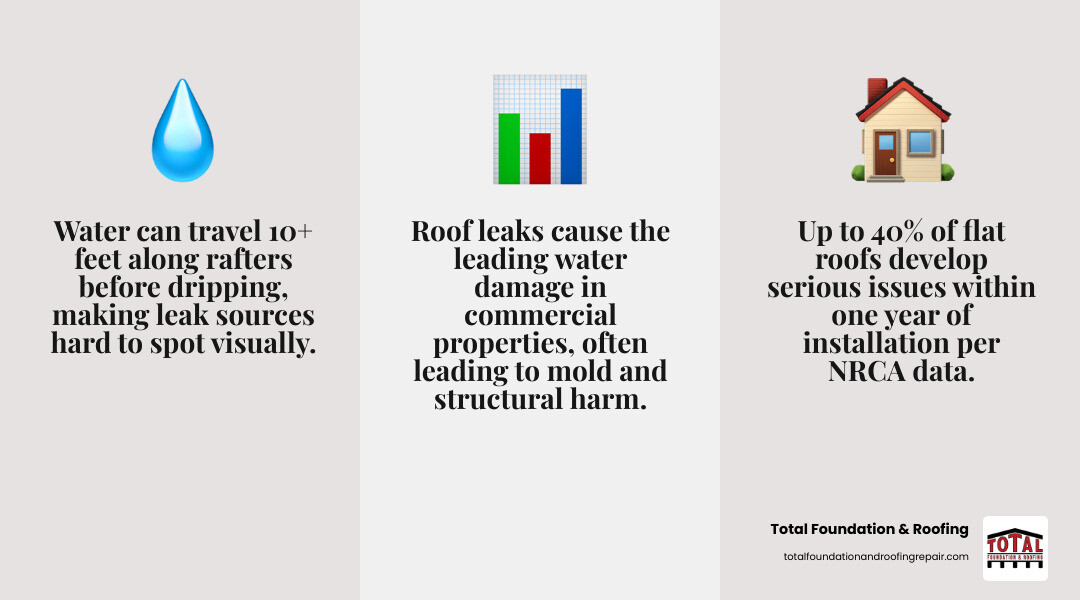
Roof leaks are one of the most stressful problems a homeowner can face — and they’re rarely where you think they are. Water is opportunistic; it can travel 10 feet or more along rafters, electrical conduits, or plumbing stacks before finally dripping onto your ceiling. This means the visible stain in your living room and the actual entry point on the roof are often in completely different locations, separated by several feet of structural material.
That’s what makes water testing so valuable. Instead of guessing and applying expensive patches to areas that aren’t actually leaking, you apply water in a controlled, systematic way to force the leak to reveal itself. This diagnostic precision is essential for maintaining the long-term health of your home’s envelope.
According to the National Roofing Contractors Association (NRCA), up to 40% of flat roofs develop serious problems within one year of installation — and water damage is the leading cause of commercial property loss. For homeowners in the Texas Hill Country, where storms can be sudden and severe, knowing how to find and confirm a leak quickly can mean the difference between a minor shingle repair and major structural rot or mold remediation.
As the roof leak detection experts at Total Foundation & Roofing Repair, we’ve helped hundreds of homeowners and business owners across Kerrville and surrounding areas track down leaks that stumped other contractors. I’m Daniel Sowell, Owner and Operator of Total Foundation & Roofing Repair, LLC, with over 18 years of hands-on experience conducting water test roof leak investigations. In that time, I’ve learned that a methodical water test — done correctly — saves homeowners thousands of dollars in unnecessary repairs and provides the peace of mind that the problem is truly solved.
Similar topics to Water test roof leak:
Step-by-Step Guide to Performing a Water Test for Roof Leak Detection
When a visual inspection fails to find the source of a water coming through the ceiling, a systematic water test is your best diagnostic tool. This process simulates a rain event in a controlled environment, allowing you to isolate specific sections of the roof. By breaking the roof down into a grid, you can eliminate variables and focus on the specific flashing, shingle, or penetration that has failed.
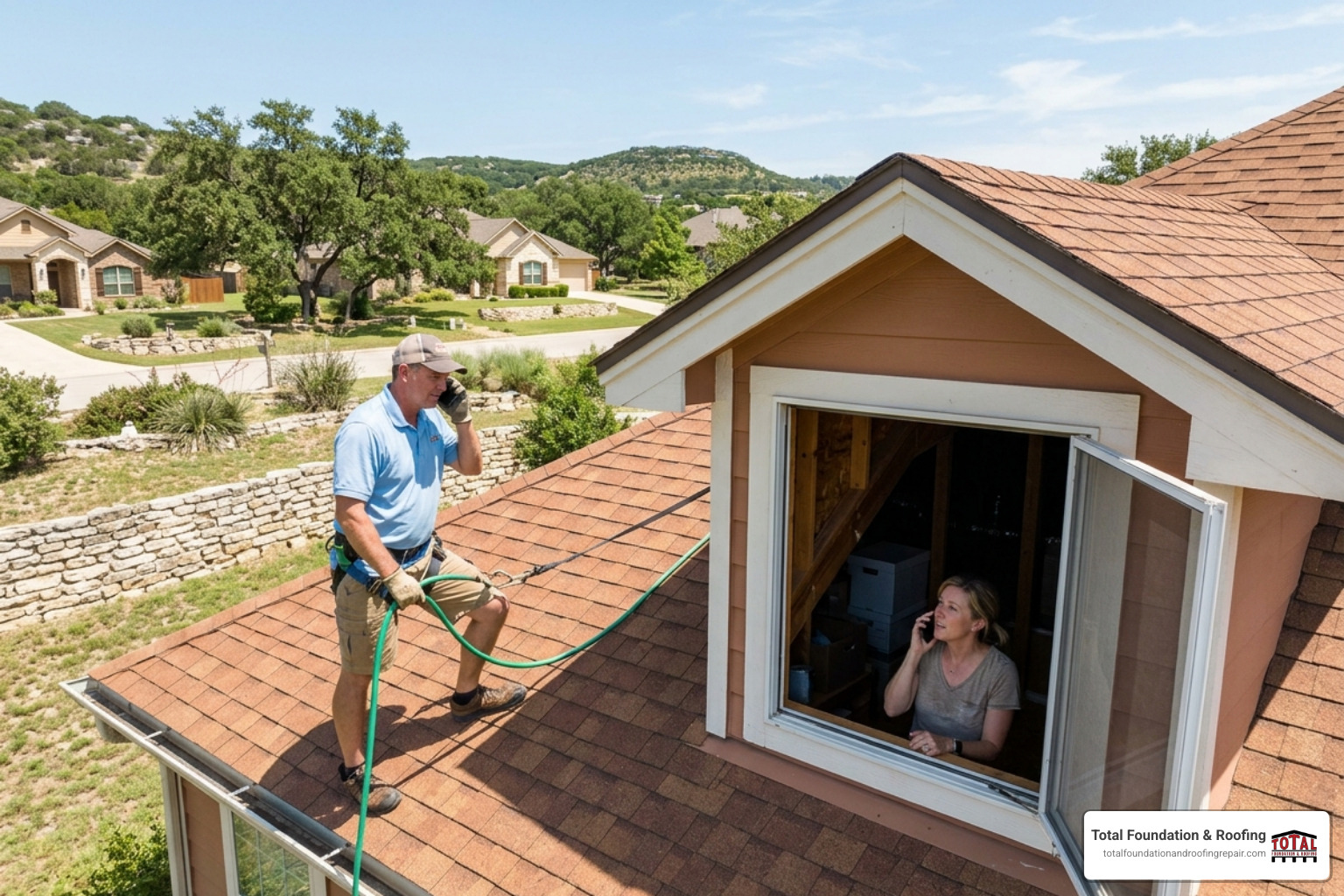
A successful test requires two people: one on the roof with a garden hose and another inside the house (typically in the attic or the room with the stain) monitoring for the first sign of moisture. Clear communication via cell phone or walkie-talkie is essential, as the person inside needs to signal the exact moment water begins to penetrate the decking.
| Testing Method | Best Use Case | Primary Advantage | Limitation |
|---|---|---|---|
| Spray Testing | Sloped residential roofs | Pinpoints specific breaches | Time-consuming for large areas |
| Flood Testing | Flat roofs/Terraces | Tests membrane integrity | High structural load; risk of overflow |
| Electronic Leak Detection (ELD) | New installations/Green roofs | Finds pinhole leaks | Requires conductive path/special gear |
| Infrared Thermography | Hidden moisture/Insulation | Non-destructive; fast | Requires specific temperature conditions |
Preparing Your Roof for a Successful Water Test
Before you drag the hose up a ladder, preparation is key. You cannot perform an accurate water test roof leak investigation on a wet roof. If it rained yesterday, wait at least 24 to 48 hours for the materials to dry completely. Wet materials will mask the new water you are applying, making it impossible to determine the entry point.
First, perform a thorough attic water leak inspection. Look for “tea-colored” stains on rafters — this color comes from tannins in the wood and is a telltale sign of a roof leak rather than a plumbing issue. Once you’ve narrowed down the general area, clean your gutters. Clogged gutters can back up water under shingles, creating “false” leaks that aren’t actually roof breaches. Major manufacturers like Owens Corning emphasize that proper drainage is the first line of defense for any roofing system.
Safety is paramount. Always use a sturdy ladder and, if the pitch is steep, a safety harness. If you are uncomfortable with heights or the roof is too high, it is always safer to call for professional roof leak detection. For more technical details on industry standards, you can review scientific research on water testing methods.
The “Start Low” Method: How to Water Test Roof Leak Points
The golden rule of water testing is to start low and work your way up. Because gravity pulls water downward, starting at the top of the roof would wet everything below it, making it impossible to tell if the leak is coming from the ridge or a shingle halfway down the slope. This methodical approach ensures that when water finally appears inside, you know exactly which horizontal plane it entered from.
- Isolate the Section: Focus on a 5-foot by 5-foot area directly above the interior damage. If the damage is near a wall, start at the bottom of that wall’s flashing.
- Apply Low Pressure: Use a garden hose without a high-pressure nozzle. You want to mimic a steady rain, not a pressure washer. High pressure can force water into places it would never naturally go, such as upward under shingles, leading to inaccurate results and “finding” leaks that don’t exist during normal weather.
- Dwell Time: Hold the water on a specific spot (like a vent pipe or a valley) for at least 15–20 minutes. Water often takes time to migrate through multiple layers of shingles, underlayment, and decking. Patience is the most important tool in this process.
- The Helper’s Role: The person inside should use a high-powered flashlight to monitor the underside of the roof deck. They should look for the “shimmer” of new water or the expansion of an existing damp spot. They should alert the person on the roof the second a drip appears.
This “bottom-up” approach is the industry standard for how to water test your roof to find the source of a leak. It helps identify if a ceiling leak is from the roof or a pipe by observing if the drip starts only when the exterior is wetted.
Identifying Common Leak Sources and Post-Test Actions
As you move the hose, pay special attention to “penetrations.” These are the most common culprits for a water test roof leak.
- Vent Boots: The rubber seal around PVC pipes often cracks after 7–10 years in the harsh Texas sun. Leading manufacturers like GAF emphasize that these seals are critical for maintaining a watertight envelope and are often the first point of failure.
- Flashing: Check the metal around chimneys and where different roof planes meet (valleys). Step flashing along dormers is a frequent offender.
- Nail Pops: Sometimes a single nail driven at the wrong angle or one that has backed out over time can create a slow, persistent drip that only appears during heavy, wind-driven rain.
Once the leak is identified, mark the spot on the roof with chalk or a piece of tape. After finding the source, you’ll need to decide between a DIY patch or a professional roof leak damage repair. For minor issues, an emergency roof leak fix like roofing cement might buy you time, but permanent repairs usually involve replacing shingles or re-flashing the area to ensure the integrity of the system.
Advanced Methods and Professional Leak Detection Strategies
Sometimes, a garden hose isn’t enough. If water is trapped between layers of a flat roof or migrating through a masonry wall, you may need advanced technology to see what the naked eye cannot. In complex building envelopes, water can take highly non-linear paths, requiring a more sophisticated diagnostic toolkit than just a hose and a ladder.
When to Use Infrared Thermography for a Water Test Roof Leak
Infrared (IR) thermography is a game-changer for thermal imaging to detect roof leaks. This method relies on “evaporative cooling.” Because wet insulation and wood hold temperature differently than dry materials, an IR camera can “see” the moisture signature behind your drywall or under the roof membrane. This allows us to map the entire path of the water from the entry point to the exit point.
The best time for this test is at dusk after a sunny day. As the roof cools down, the wet spots will retain heat longer (or cool faster depending on conditions), appearing as distinct “hot” or “cold” spots on the camera screen. This is a non-invasive way to handle ceiling water stains and repair without tearing a hole in your ceiling first. It provides a visual map of the damage that is invaluable for insurance claims.
Specialized Testing for Flat Roofs and Commercial Structures
Flat roofs present a unique challenge because water can pond and travel long distances horizontally. For these structures, we often utilize flood testing. This involves blocking the roof drains and filling a section of the roof with roughly 2 inches of water for 24 to 48 hours. This is the ultimate test for the integrity of a flat roof membrane.
While effective, flood testing is risky. You must ensure the building can handle the weight of the water (about 10.4 lbs per square foot at 2 inches deep). For modern commercial buildings, we often prefer Electronic Leak Detection (ELD). This uses a low-voltage electrical current to find breaches in the membrane. If there is a hole — even one as small as a pinhead — the water will complete the circuit to the grounded deck, and our sensors will beep. For more on this, check out our flat roof water damage guide or read more about roof water testing to identify leaks.
Professional Solutions in Kerrville and the Texas Hill Country
In the Texas Hill Country, our roofs take a beating from heavy hailstorms, high winds, and intense UV exposure. At Total Foundation & Roofing, we understand the specific building assemblies used in Kerrville, Fredericksburg, and Comfort. We know how the local climate affects materials like asphalt shingles, metal roofing, and TPO membranes.
A water test roof leak investigation is only as good as the technician performing it. As the WBDG (Whole Building Design Guide) notes, integrity testing is the “holy grail” of building envelope work, but the equipment is only as smart as the person using it. We combine old-school “hose and ladder” methods with modern moisture meters and thermal imaging to give you a definitive answer. Our goal is not just to find the leak, but to understand why it happened so we can prevent it from returning.
If you are struggling with a mystery leak, don’t wait for the next storm to cause more damage. We provide specialized Kerrville leak detection services and serve the entire region from our areas served in Kerrville page. Whether it is a residential home or a large commercial facility, we have the tools and the expertise to stop the water in its tracks.
Ready to stop the drip? Contact our experts for a professional water test roof leak investigation today. We’ll find the source, fix the damage, and give you back your peace of mind with a roof that is ready to stand up to whatever the Texas weather throws its way.