
Why Foundation Crack Sealing Is Critical for Texas Hill Country Homes
Foundation crack sealing is the process of professionally filling and waterproofing cracks in concrete to prevent structural deterioration. As a Texas Hill Country contractor, Total Foundation & Roofing focuses on crack sealing that stops water intrusion before it turns into soil erosion, mold, or structural movement. If you are comparing service providers, start with our Texas Hill Country foundation and roofing repair company to understand what certified workmanship and transferable warranties should include. In our region, the unique combination of limestone bedrock and thin layers of highly expansive clay creates a volatile environment for residential slabs. When the intense heat of a Texas summer evaporates soil moisture, the ground shrinks away from the foundation, leaving it unsupported. Conversely, heavy spring rains cause the clay to swell rapidly, exerting immense pressure. This constant ‘heaving’ and ‘shrinking’ cycle is the primary reason why foundation crack sealing is a mandatory maintenance task for local homeowners.
Quick Overview:
- Definition: Injection of specialized epoxy or polyurethane resins into cracks to create a permanent, watertight seal.
- When to Seal: If you observe horizontal or vertical cracks, sticking doors, or water seepage.
- Cost: DIY kits range from $75-$225, while professional repairs cost $500-$2,500.
- Best Approach: Professional sealing uses commercial-grade materials and includes transferable warranties.
Unsealed cracks allow water to penetrate the home, soften supporting soils, and raise hydrostatic pressure against foundation walls. In the Texas Hill Country, expansive clay soils and rapid wet-dry cycles make foundation crack sealing a maintenance priority, not an optional upgrade. The practical rule is simple: seal cracks to block moisture and pests, and pursue structural repair when cracking indicates movement or load failure. When you need a long-term fix, our foundation repair services help address underlying causes like settlement, drainage issues, and wall displacement.
As Daniel Sowell, owner of Total Foundation & Roofing Repair in Kerrville, I have spent 18 years diagnosing foundation issues. This guide identifies which cracks require immediate sealing and which repair methods provide lasting results.
What we see in the Hill Country (field notes you can use)
The most common pattern we document in Kerrville-area inspections is shrinkage cracking that later becomes a leak pathway after seasonal rain events. In our service area, crack sealing is frequently paired with drainage improvements because water management determines whether a sealed crack stays sealed. Because our local climate fluctuates between extreme drought and flash flooding, the concrete is under constant thermal and mechanical stress.
Our internal inspection checklist flags these conditions for same-week action:
- Active water seepage or damp staining along a crack line.
- Efflorescence (white mineral deposits) indicating repeated moisture migration through concrete.
- Cracks that widen at the top or bottom (differential movement).
- Any horizontal cracking, bowing, or wall bulging.
If you want to estimate typical budgets before scheduling, use our breakdown of foundation crack repair cost.
Learn more about foundation crack sealing:
For homeowners who want a standards-based reference on why crack sealing and drainage matter, the International Code Council (IRC) explains minimum residential construction expectations, including moisture control and structural performance.
Understanding the Causes and Types of Foundation Cracks
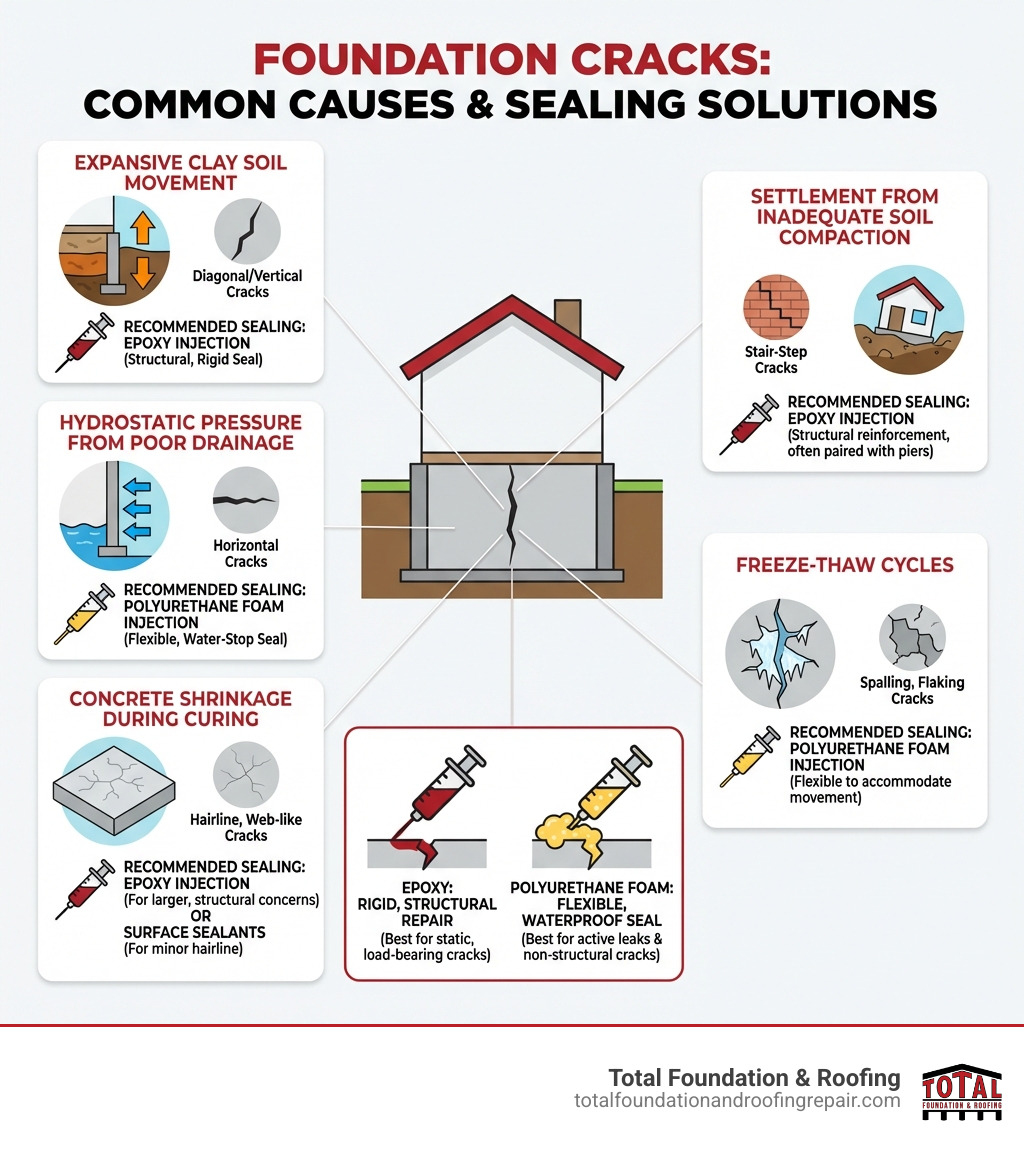
Foundation cracks form when concrete shrinks, soils move, or water pressure loads the wall. In the Texas Hill Country, the key driver is predictable: expansive clays expand when wet and contract when dry, cycling stress into slabs and stem walls. Correctly identifying the crack type and the force behind it determines whether foundation crack sealing is sufficient or whether stabilization is required. Understanding the physics of these cracks helps homeowners prioritize repairs before they escalate into total foundation failure.
Primary Causes of Cracking
- Expansive Clay Soils: These soils swell when wet and shrink during dry spells, creating pressure against foundations. This is often referred to as ‘soil heave.’
- Construction Quality: Pouring concrete in extreme heat or using improper mixes can lead to shrinkage cracks within 30 days of curing. In Texas, high evaporation rates during the pour are a common culprit.
- Hydrostatic Pressure: High water tables or poor drainage force water against foundation walls, leading to fissures and soil erosion. This pressure can be powerful enough to snap concrete walls if not relieved.
The Role of the Active Zone
The “active zone” refers to the depth of soil that is affected by changes in moisture content. In the Hill Country, this zone can extend several feet deep. When cracks form, they provide a direct conduit for surface water to reach deeper into this active zone, accelerating the rate of soil expansion and contraction. This is why sealing is not just about the concrete; it is about protecting the soil stability beneath the concrete. For homeowners looking for broader structural insights, the American Society of Civil Engineers (ASCE) provides extensive research on soil-structure interaction.
A practical takeaway: water problems create crack problems. If runoff and grading are not addressed, even well-sealed cracks can reappear nearby. For related remediation, see our foundation waterproofing service page.
Common Crack Types
- Vertical Cracks: Often caused by concrete shrinkage or minor settlement; common in poured foundations. These are usually the easiest to seal with injection methods.
- Horizontal Cracks: Signal structural integrity concerns, often resulting from soil expansion or hydrostatic pressure. These often require carbon fiber reinforcement in addition to sealing.
- Stair-step Cracks: Typical in masonry or block foundations, indicating differential settlement where one corner of the home is sinking faster than the rest.
Identifying the root cause is essential before sealing. Consult our foundation problems repair guide or this technical reference on how pros diagnose and repair concrete cracks. For a step-by-step evaluation process, our foundation inspection guide explains what to measure, photograph, and monitor.
Identifying Warning Signs
Homeowners should monitor for these indicators of foundation stress:
- Sticking doors and windows: Shifting foundations distort frames, making them difficult to operate.
- Visible gaps: Spaces between walls and ceilings or exterior brickwork (fascia gaps).
- Water damage: Damp spots, mold, or efflorescence (white powder) in crawlspaces or basements.
- Bulging walls or a leaning chimney: These conditions can indicate lateral pressure or differential settlement and should be evaluated promptly.
Early intervention with foundation crack solutions reduces the chance of major repairs. A foundation specialist can confirm whether sealing is appropriate or whether the structure needs stabilization. If you are deciding what to do next, our foundation repair advice guide outlines a safe, decision-first approach.
Static vs. Moving Foundation Cracks
- Static cracks: Result from initial settlement or curing and do not grow. Seal these primarily to prevent water intrusion, pest entry, and corrosion of embedded steel.
- Moving cracks: Grow in width or length over time, indicating ongoing structural stress or displacement. These require monitoring and potentially piering.
Sealing a moving crack without addressing the cause is a temporary fix. We use crack monitors to track movement and recommend escalation when measurements change. Our concrete crack solutions and foundation services complete guide explain how sealing fits into a full repair plan. For additional, non-commercial guidance on residential moisture and drainage concepts that affect foundation performance, FEMA’s flood and water mitigation resources are a helpful reference: https://www.fema.gov/flood-maps.
Professional Methods for Foundation Crack Sealing
Professional foundation crack sealing is designed to fill the entire crack plane, not just the visible opening. The goal is straightforward and measurable: create a continuous, watertight seal that resists hydrostatic pressure and prevents recurring moisture migration through the wall. At Total Foundation & Roofing, we typically use controlled, high-pressure injection for poured concrete and proven repair techniques appropriate for the crack type.
Epoxy vs. Polyurethane Injection
- Epoxy injection: Best for structural bonding. This two-part resin can cure to strengths up to 8,000 psi, effectively bonding the crack faces together. It is ideal for dry, static cracks in poured concrete and can restore continuity where stresses are non-recurrent. It essentially welds the concrete back together.
- Polyurethane foam: Best for waterproofing. This moisture-activated resin expands (often up to 35 times its volume) to fill voids and irregular pathways. Its flexibility helps tolerate minor future movement and is the gold standard for stopping active leaks.
If you are price-planning, see foundation crack repair costs. We align installations with recognized construction detailing principles such as those outlined in Best practices for residential construction, especially where moisture management and material compatibility determine longevity. When cracks are tied to moisture intrusion, pairing injection with foundation waterproofing improves outcomes by reducing the water load that drives leakage.
The Step-by-Step Injection Process
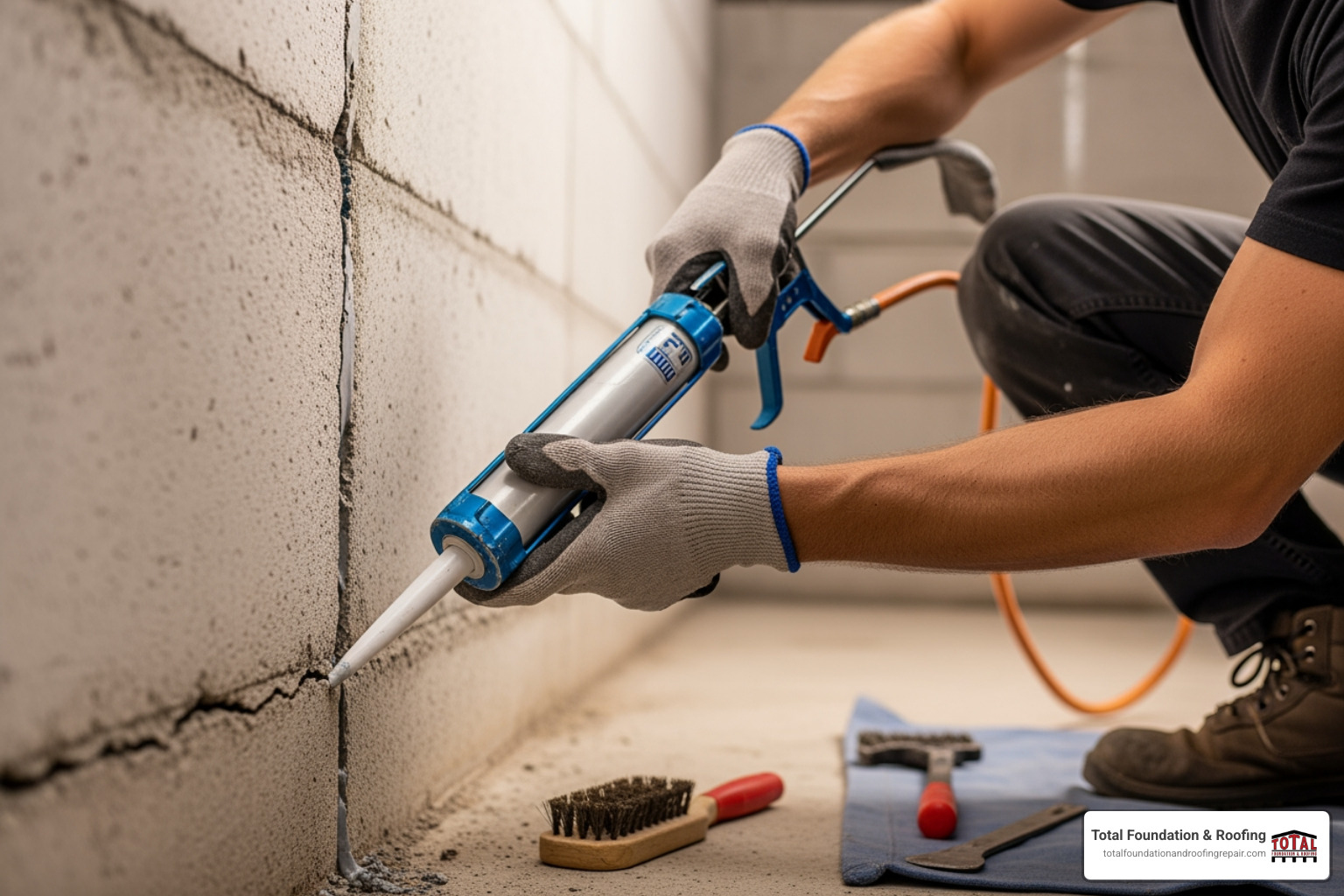
- Preparation: The crack is cleaned of debris, dust, and loose concrete using high-pressure air to ensure maximum adhesion.
- Port Installation: Injection ports are adhered to the crack at specific intervals, usually every 8 to 12 inches, depending on the wall thickness.
- Surface Sealing: A high-strength epoxy paste is applied over the crack surface to ensure the resin stays contained during the high-pressure injection phase.
- Injection: Starting from the bottom, resin is pumped into the ports until it emerges from the port above, ensuring a bottom-to-top, full-depth fill.
- Finishing: Once cured, the ports are removed and the surface is ground smooth for a clean, professional finish.
For more how-to context on crack types and repair selection, read our guides on repairing cracks in concrete foundation and basement crack repair.
What “professional” sealing includes (and why it matters)
A durable injection repair depends on process control as much as resin choice. In professional applications, the crack is cleaned, ports are properly spaced, surface paste is applied to prevent blowouts, and injection pressure is matched to the wall condition. The result should be full-depth fill, not a surface cap. In Texas Hill Country homes, we also evaluate the conditions that often repeat cracking: drainage, downspout discharge, and soil washout along the perimeter. When needed, our broader foundation repair services address stabilization so sealing is not asked to solve a movement problem.
The Risks of DIY Kits
DIY kits ($75-$225) often fail because:
- Inferior materials: Consumer-grade sealants often lack the adhesion and elongation properties of commercial resins.
- Surface-only fixes: DIY methods rarely fill the full depth of the crack, leaving hidden water pathways.
- No warranty: Failed DIY attempts can lead to recurring leaks, concealed deterioration, and sometimes expensive exterior excavation ($5,000+).
If you are weighing options, review our foundation crack repair cost tips and patching cracks in concrete to understand what works, what doesn’t, and why. Hiring qualified foundation repair contractors helps ensure compatibility between the repair method and the crack’s behavior.
Choosing the Right Solution
| Feature | DIY Crack Repair Kits | Professional Sealing |
|---|---|---|
| Cost | $75 – $225 | $500 – $2,500 |
| Materials | Consumer-grade | Industrial-grade |
| Effectiveness | Temporary surface fix | Permanent watertight seal |
| Warranty | None | Transferable |
Do’s and Don’ts:
- Do address all cracks to preserve wall integrity and reduce moisture pathways.
- Do use epoxy for structural needs and polyurethane for active leaks.
- Don’t use hydraulic cement as a primary repair; it has a weak bond and will eventually shrink and pull away.
- Don’t ignore horizontal or widening cracks, as these are signs of structural failure.
For homeowners in Kerrville and surrounding communities, local conditions matter. If you are looking for service availability in the area, see our Kerrville page and then request the appropriate repair scope. Total Foundation & Roofing provides certified workmanship custom to Texas Hill Country soils. For expert help with foundation crack repair, request an evaluation and estimate today. We serve Kerrville, Fredericksburg, and Comfort.
For additional engineering-oriented background on why water pressure and soil conditions matter, the American Concrete Institute (ACI) offers concrete resources and publications: https://www.concrete.org/.