
Why a Metal Roof Leaking Around a Chimney Is One of the Costliest Leaks to Ignore
Quick answer — the most common reasons your metal roof is leaking around the chimney:
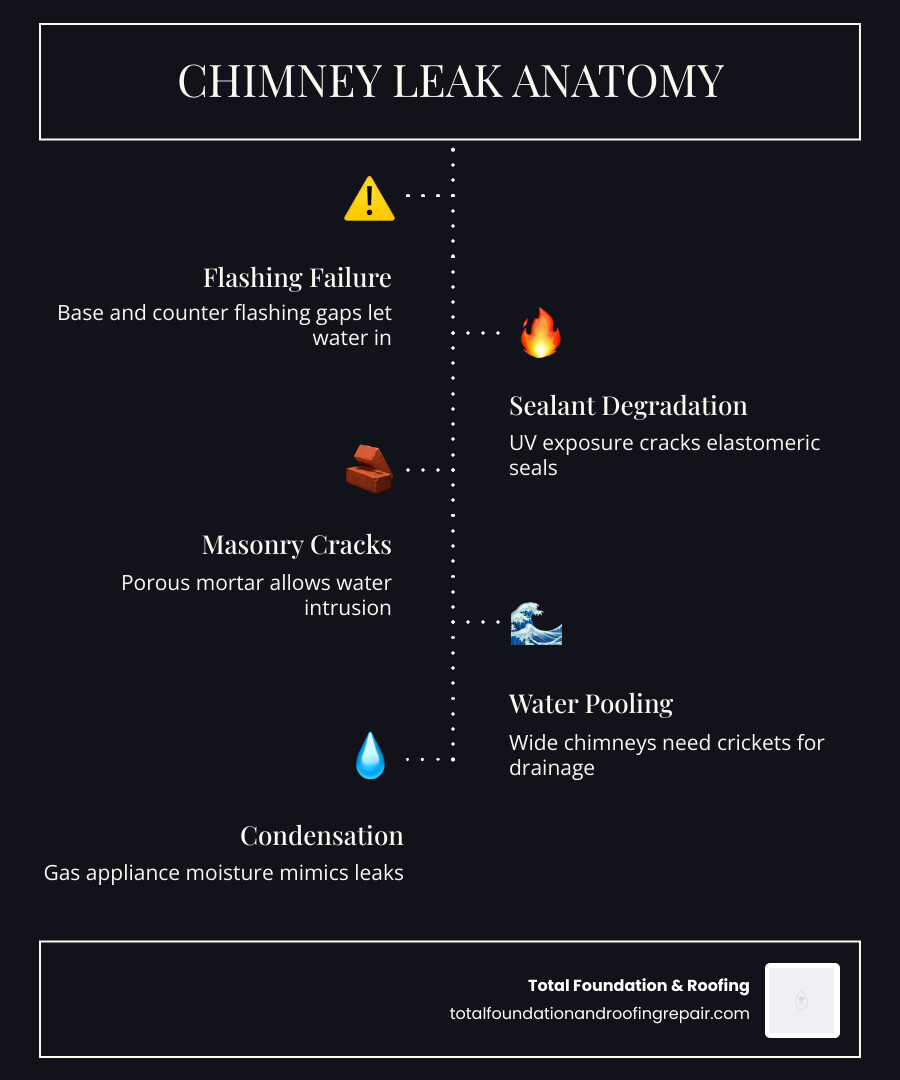
- Failed or improperly installed flashing (the leading cause by far)
- Degraded sealant around flashing edges
- Cracked chimney crown or mortar joints
- Missing or damaged chimney cap
- Water pooling behind a wide chimney (needs a cricket/saddle)
- Condensation from gas appliances mimicking a roof leak
That sound — water dripping somewhere near your fireplace during a Texas Hill Country storm — is one of the most stressful things a homeowner can hear. A metal roof leaking around a chimney is not just an annoyance. Left untreated, it can rot your roof decking, grow mold in your attic, and turn a few-hundred-dollar repair into a multi-thousand-dollar rebuild. At Total Foundation & Roofing Repair, we specialize in identifying these vulnerabilities before they compromise your home’s structural integrity. According to industry leaders like GAF, the chimney is statistically one of the most common failure points on any residential roof. In our region, where intense heat is followed by sudden, violent thunderstorms, the expansion and contraction of metal panels create unique challenges that standard roofing techniques often fail to address.
The chimney is one of the most vulnerable points on any roof. It punches straight through your roofing system, creating a seam where water is always looking for a way in. On metal roofs, thermal expansion and contraction add extra stress on seals and flashing — making the chimney junction even trickier to waterproof than on a shingle roof. This is because metal panels are designed to move, while a brick chimney is a rigid, static structure. When these two opposing forces meet, the sealant is the only thing keeping your living room dry.
The good news: most chimney leaks are fixable. And knowing why yours is leaking is the fastest path to fixing it right the first time. For comprehensive roofing solutions in Kerrville and the Texas Hill Country, this guide walks you through every cause, fix, and prevention strategy you need.
I’m Daniel Sowell, owner of Total Foundation & Roofing Repair with over 18 years of hands-on experience diagnosing and fixing metal roof leaks around chimneys across the Texas Hill Country. I’ve seen how a small flashing gap can spiral into structural damage when the Hill Country rains hit hard — and in this guide, I’ll show you exactly how to stop it.
Easy metal roof leaking around chimney glossary:
Common Causes of a Metal Roof Leaking Around Chimney
When water finds its way into your home, it doesn’t always take the most obvious route. Understanding the causes of roof leaks around chimneys is the first step toward a permanent solution. In our region, from Kerrville to Fredericksburg, our roofs face intense UV exposure and sudden, heavy downpours that test every seam. The National Roofing Contractors Association (NRCA) emphasizes that metal roofing systems require specific flashing details to accommodate the high rate of thermal expansion inherent in steel and aluminum panels.
Flashing Failure and Sealant Degradation
Flashing is the metal transition that bridges the gap between your roof panels and the chimney masonry. On a metal roof, this is particularly complex because metal panels move. Thermal expansion causes the metal to grow and shrink as temperatures swing from a 100-degree Texas afternoon to a cool Hill Country night. This constant movement stresses the sealants. Most high-quality sealants only last 10–15 years before becoming brittle. Once the sealant cracks, wind-driven rain is forced under the flashing. In the Texas Hill Country, we see temperatures fluctuate wildly. A metal roof can reach 160 degrees in the summer sun and then drop 40 degrees in an hour during a thunderstorm. This rapid cooling causes the metal to contract quickly, pulling at the flashing and sealant.
Masonry Porosity and Structural Settling
Sometimes the “roof leak” isn’t the roof’s fault at all. Brick and mortar are naturally porous. Over decades, they can act like a sponge, absorbing water until it saturates the interior wall. Additionally, freeze-thaw cycles—though less frequent here than up north—can cause moisture inside the masonry to expand by about 9%, widening small cracks into major entry points. Capillary action is another often-overlooked culprit. This occurs when water is literally sucked upward into tight spaces between the flashing and the metal panel. Even if the flashing looks correct from the outside, if the gap is the right size and the sealant has failed, surface tension will pull water into your home.
The “Hidden” Leak: Gas Condensation
If you notice moisture near your chimney during cold snaps but it hasn’t rained, you might be dealing with condensation. Gas furnaces or logs vent moisture-heavy air. If the chimney liner is cracked or cold, this steam turns back into water inside the flue, mimicking a metal roof leaking around chimney.
Identifying the Source of Your Metal Roof Leaking Around Chimney
Before you climb a ladder, start your investigation inside. Finding and fixing roof leak damage requires a systematic approach.
- The Attic Inspection: Grab a powerful flashlight and head into the attic during or immediately after a rainstorm. Look for “water trails” along the rafters. Water often enters at the chimney but travels down a beam before dripping, making the leak appear 10 feet away from the actual source.
- Visual Indicators: Look for damp insulation, rusted fasteners on the underside of the metal panels, or a musty odor. If you see white, crusty deposits on the chimney bricks (efflorescence), water is definitely moving through the masonry.
- The Hose Test: If the source is still a mystery, have someone stand on the roof with a garden hose while you stay in the attic. Start at the bottom of the chimney and work upward slowly. This helps isolate whether the leak is at the base flashing, the counter-flashing, or the chimney crown itself.
Flashing and Sealant Failures
The area where the chimney meets the roof is a “high-stress” zone. Proper flashing a chimney on a metal roof requires two distinct layers to ensure long-term durability. Manufacturers such as Owens Corning recommend high-performance synthetic sealants over traditional oil-based mastics, as they offer superior adhesion to non-porous metal surfaces and better resistance to UV degradation.
- Base Flashing: This sits on the roof panels and turns up against the chimney. On metal roofs, we often use butyl tape or high-grade elastomeric sealants to ensure a flexible, watertight bond between the metal and the flashing. Base flashing must be integrated with the metal panels using a combination of mechanical fasteners and specialized sealants.
- Counter-Flashing: This is the “cap” that is embedded into the mortar joints of the chimney and hangs down over the base flashing. It acts like a shingle, shedding water over the base layer.
If your roofer simply “gooped” the joint with roofing cement, it will fail. Professional repairs involve mechanical fasteners and high-performance silicone or urethane sealants that can handle the Texas heat without cracking. Many homeowners make the mistake of using silicone from a big-box store. While silicone is great for bathrooms, it often struggles to bond permanently to the specialized coatings found on modern metal roof panels, such as Galvalume or Kynar 500. We utilize high-performance tri-polymer sealants that are specifically engineered to bond to these coatings and remain flexible through thousands of thermal cycles.
Structural Issues and the Need for a Cricket
If your chimney is wider than 30 inches, it acts like a dam on your roof. Water rushing down the roof hits the back of the chimney and pools. This is why the International Residential Code (IRC) Section R903.2.2 specifically mandates a cricket (or saddle) for any chimney that is wider than 30 inches on the ridge side.
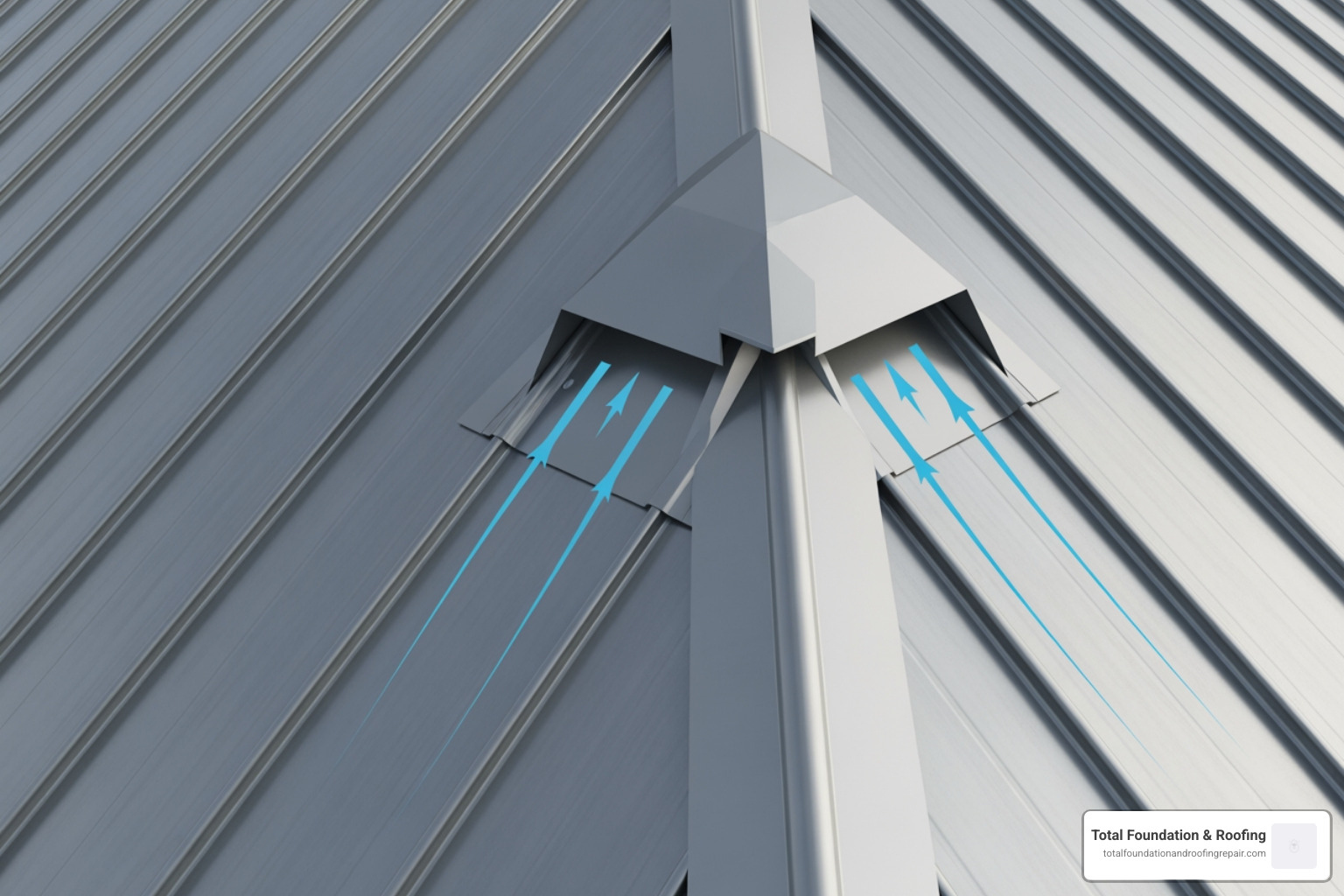
A cricket is a small, peaked structure built behind the chimney to divert water to either side. Without one, the constant “ponding” at the back of the chimney will eventually find a way through even the best flashing. Installing a cricket is one of the most effective ways to stop roof leaks around your chimney for the long term, as it prevents the hydrostatic pressure that forces water into seams. The 30-inch rule in the IRC isn’t arbitrary. It is based on the volume of water a typical roof slope generates during a standard rainfall event. When a chimney exceeds this width, the ‘damming’ effect becomes significant enough that water can actually rise above the height of the base flashing. A cricket acts as a hydraulic diverter, ensuring that the velocity of the water is maintained as it moves around the obstacle, preventing the ‘dead zones’ where debris and moisture accumulate.
Professional Repair and Prevention Strategies
While a tube of caulk might provide a temporary fix, permanent repair of a metal roof leaking around chimney usually requires professional intervention. At Total Foundation & Roofing, we specialize in residential metal roofing services that address the unique challenges of the Texas Hill Country climate, ensuring your home remains dry through every season.
Best Practices for Repairing a Metal Roof Leaking Around Chimney
When we perform a repair, we don’t just patch; we fortify.
- Surface Preparation: We clean all old, brittle sealant and rust off the metal panels. Sealants won’t bond to dirt or oxidation.
- Material Compatibility: We use stainless steel or aluminum transition pieces to prevent “galvanic corrosion”—a chemical reaction that occurs when incompatible metals touch and rust through. Galvanic corrosion is a silent killer of metal roofs. When two dissimilar metals—like a copper flashing and a steel roof panel—touch in the presence of moisture, an electrical reaction occurs that eats through the metal.
- Mechanical Bonding: We ensure all flashing is properly integrated into the masonry joints, not just stuck to the surface. This creates a mechanical “shingle effect” that gravity alone can’t defeat.
- Comprehensive Guide: For more details, see our Ultimate Metal Roof Leak Repair Manual.
Cost Estimates and Repair Timelines
The cost to fix a chimney leak varies based on the severity of the damage and the height of the roof. When considering the cost of repair, it is important to factor in the “cost of delay.” A leak that starts as a small stain on the ceiling is often the result of months of saturation in the attic insulation.
| Repair Type | Estimated Cost | Timeline |
|---|---|---|
| Minor Resealing/Caulking | $300 – $800 | 2–4 Hours |
| Full Flashing Replacement | $800 – $2,500 | 1 Day |
| Cricket Installation | $1,500 – $3,500 | 1–2 Days |
| Masonry Repointing/Crown Repair | $500 – $4,000 | 1–3 Days |
Investing in a professional roof repair near you is significantly cheaper than replacing rotted structural decking or dealing with interior mold remediation.
Long-Term Maintenance and Prevention
The best way to handle a leak is to prevent it from ever happening.
- Annual Inspections: Have a professional look at your chimney flashing every spring. We check for lifted fasteners and thinning sealant.
- Chimney Caps: Ensure you have a high-quality cap to keep rain out of the flue and prevent wildlife from nesting.
- Debris Removal: Keep the area behind the chimney clear of leaves and branches. Trapped debris holds moisture against the metal and accelerates corrosion.
- Waterproofing: Applying a breathable siloxane-based water repellent to your chimney bricks can stop masonry leaks before they start.
If you are dealing with a leaking chimney in Fredericksburg or surrounding areas, don’t wait for the next storm. Schedule a professional roof repair online with Total Foundation & Roofing. We provide the prompt, reliable service the Texas Hill Country deserves to keep your home dry and secure.