
Why Commercial Concrete Crack Repair Can’t Wait
Commercial concrete crack repair is one of the most critical maintenance tasks for any business owner, warehouse operator, or facility manager. For businesses in the Texas Hill Country, working with a trusted team for foundation and roofing solutions in Kerrville and surrounding areas is the first step in preventing long-term structural damage. Here’s what you need to know at a glance:
Quick Answer: How to Repair Commercial Concrete Cracks
| Step | Action |
|---|---|
| 1. Identify | Determine crack type: shrinkage, settlement, or heaving |
| 2. Assess | Is the crack active (still moving) or dormant? |
| 3. Prepare | Clean, widen to 1/4 inch minimum, remove loose material |
| 4. Select material | Polyurethane (water/active cracks), epoxy (structural), polyurea (fast-set horizontal) |
| 5. Apply | Surface seal, injection, or full-depth patching |
| 6. Cure | Allow traffic return per product specs (10 min to 3 hrs) |
Cracks in commercial concrete are not just cosmetic problems. They are early indicators of structural movement, moisture intrusion, or slab stress that can compromise safety, uptime, and compliance. In a high-traffic facility like a warehouse, parking structure, or industrial plant, an unrepaired crack can widen fast. Forklifts, heavy equipment, and constant foot traffic turn a hairline fracture into a serious safety hazard and a much more expensive repair.
The real danger is water. Once moisture enters a crack, it softens the soil underneath the slab. That leads to more movement, bigger cracks, and eventual slab failure. Patching the surface without fixing the root cause is, as one industry expert from the American Concrete Institute puts it, a losing battle – the crack simply comes back. In many cases, the right next step is a targeted commercial and foundation crack repair service instead of another temporary patch.
Acting early is always the smarter financial decision. Total Foundation & Roofing helps commercial clients across Texas stop small problems before they become structural emergencies.
I’m Daniel Sowell, owner of Total Foundation & Roofing Repair with over 18 years of hands-on experience in commercial concrete crack repair, foundation work, and concrete construction throughout the Texas Hill Country. I’ve seen how fast an ignored crack can escalate into a costly structural failure – and I’m here to walk you through exactly how to stop it.
Commercial concrete crack repair terms made easy:
Advanced Materials for Commercial Concrete Crack Repair
In industrial maintenance, a “one-size-fits-all” approach to commercial concrete crack repair is a recipe for failure. The material we choose depends entirely on the crack’s location, whether it is “active” (moving) or “dormant” (static), and how quickly you need to get your forklifts back on the floor.
Modern chemistry has given us tools that are vastly superior to the brittle cement patches of the past. These advanced polymers bond with the concrete at a molecular level, often becoming stronger than the surrounding slab itself.
Polyurethane
Polyurethane is the go-to choice for cracks that are actively leaking or located in damp environments. In our experience in the Texas Hill Country, where heavy rains can suddenly saturate the soil, polyurethane’s ability to expand is a lifesaver. Some polyurethane foams can expand up to 15 times their original volume, making them perfect for filling large voids behind a wall or under a slab. It remains flexible, which means if the building continues to shift slightly, the seal won’t snap.
Epoxy
When you need to restore the structural integrity of a building, epoxy is the gold standard. High-strength epoxies are used for repairing cracks in concrete foundations and structural elements like columns or beams. Unlike polyurethane, epoxy is rigid. It acts like a powerful glue, “welding” the two sides of the crack back together. For vertical walls, we often use the sticky solution of epoxy injection to ensure the repair goes all the way through the concrete.
Polyurea
For high-traffic horizontal surfaces, polyurea is often the winner. It is incredibly fast-setting—often tack-free in minutes—and remains flexible enough to handle the impact of heavy machinery. It is particularly effective for repairing control joints and spalls in warehouse floors where downtime is not an option.
Hybrid Polymers
Hybrid polymers combine the best of both worlds: the strength of epoxy with the speed and flexibility of polyurea. Products like CretePro 500 or Roadware 10 Minute Concrete Mender fall into this category. These materials have an incredibly low viscosity (thinner than water), allowing them to penetrate deep into hairline fractures through capillary action, a process often called “microdoweling.”
Material Comparison for Commercial Repairs
| Material | Best Use Case | Traffic Ready | Flexibility |
|---|---|---|---|
| Polyurethane Foam | Wet cracks, voids | 1-2 Hours | High |
| Structural Epoxy | Foundation walls, beams | 12-24 Hours | Low (Rigid) |
| Polyurea | Warehouse floors, joints | 15-30 Mins | Medium |
| Hybrid Polymer | Deep injection, spalls | 10-60 Mins | Low/Medium |
Understanding Causes and Material Selection
Before we squeeze a single drop of resin into a crack, we have to ask: Why is this happening? In places like Fredericksburg or Kerrville, the answer is often related to our unique soil.
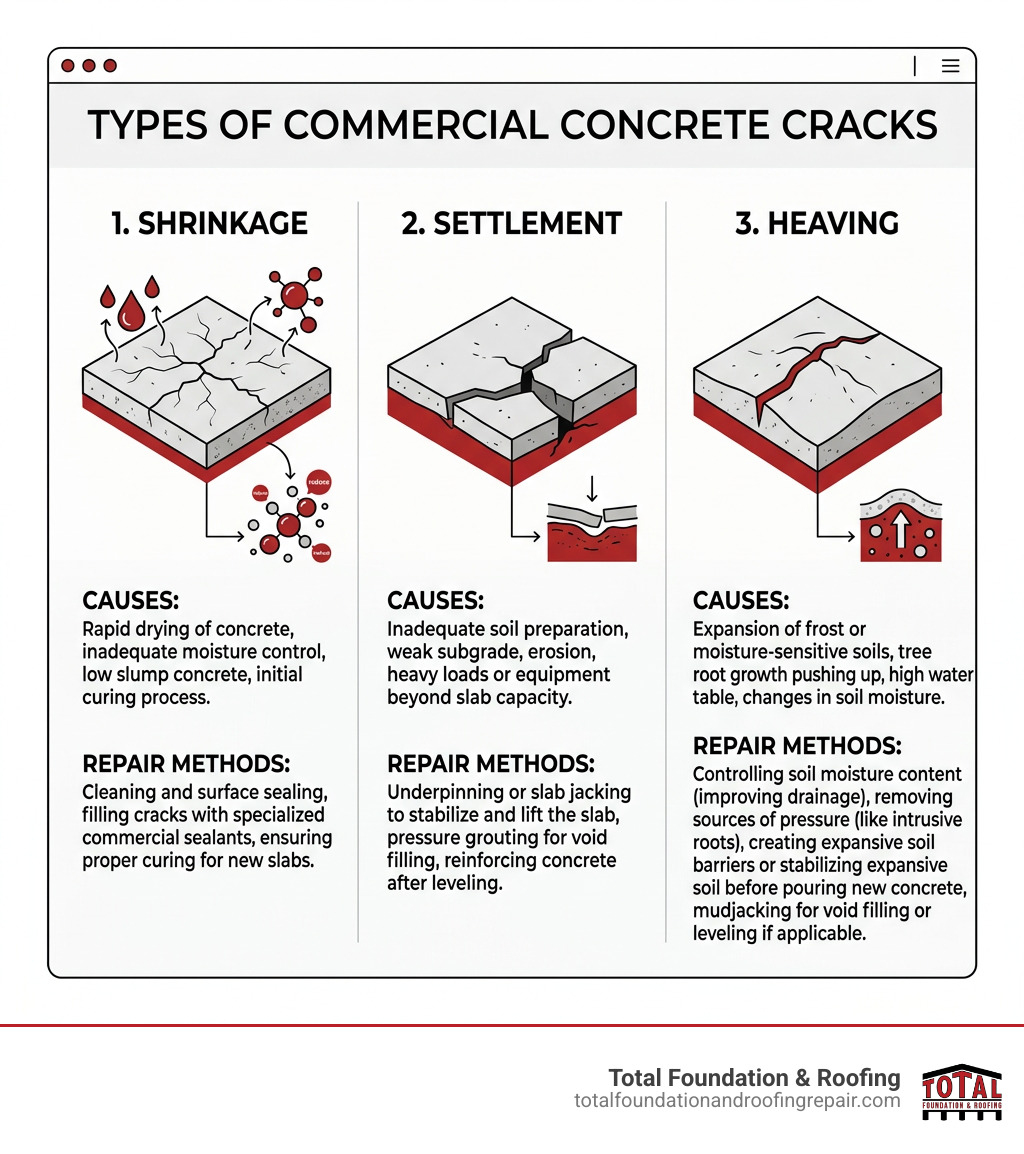
- Shrinkage: This happens as concrete cures. As water evaporates, the slab slightly reduces in volume. These are usually dormant and easy to fix.
- Settlement: When the soil under a slab wasn’t compacted correctly or has washed away, the concrete loses its support and “drops.” This creates structural cracks that require more than just a surface filler.
- Heaving: This is common in the Texas Hill Country. When our clay-rich soils get wet, they expand with immense force, pushing the slab upward.
- Moisture Intrusion: Water is the enemy. It accelerates soil instability and can cause rebar to rust, which expands and cracks the concrete from the inside out.
Identifying these causes helps us choose between a flexible sealant for an active crack or a rigid epoxy for a dormant one. For more in-depth reading, check out our foundation crack solutions.
High-Traffic Solutions for Commercial Concrete Crack Repair
In a commercial setting, time is money. You can’t close a loading dock for three days while a patch dries. We specialize in ultra-fast commercial concrete crack repair solutions designed for heavy forklift traffic.
Products like SealBoss 6060 or Roadware 10 Minute Concrete Mender allow for a “return to service” that feels like magic. For example:
- 10-Minute Cure: Foot traffic can often resume in just 10 minutes.
- 30-60 Minute Traffic-Ready: Heavy equipment like forklifts and reach trucks can roll over the repair in less than an hour.
These materials are designed for high abrasion resistance. They won’t “pop out” when a forklift with hard poly wheels hits them, which is the most common failure point for cheap, hardware-store patches. If you’re looking for DIY tips on smaller slabs, our guide on repairing concrete cracks like a pro is a great resource.
Precision Injection and Surface Patching Methods
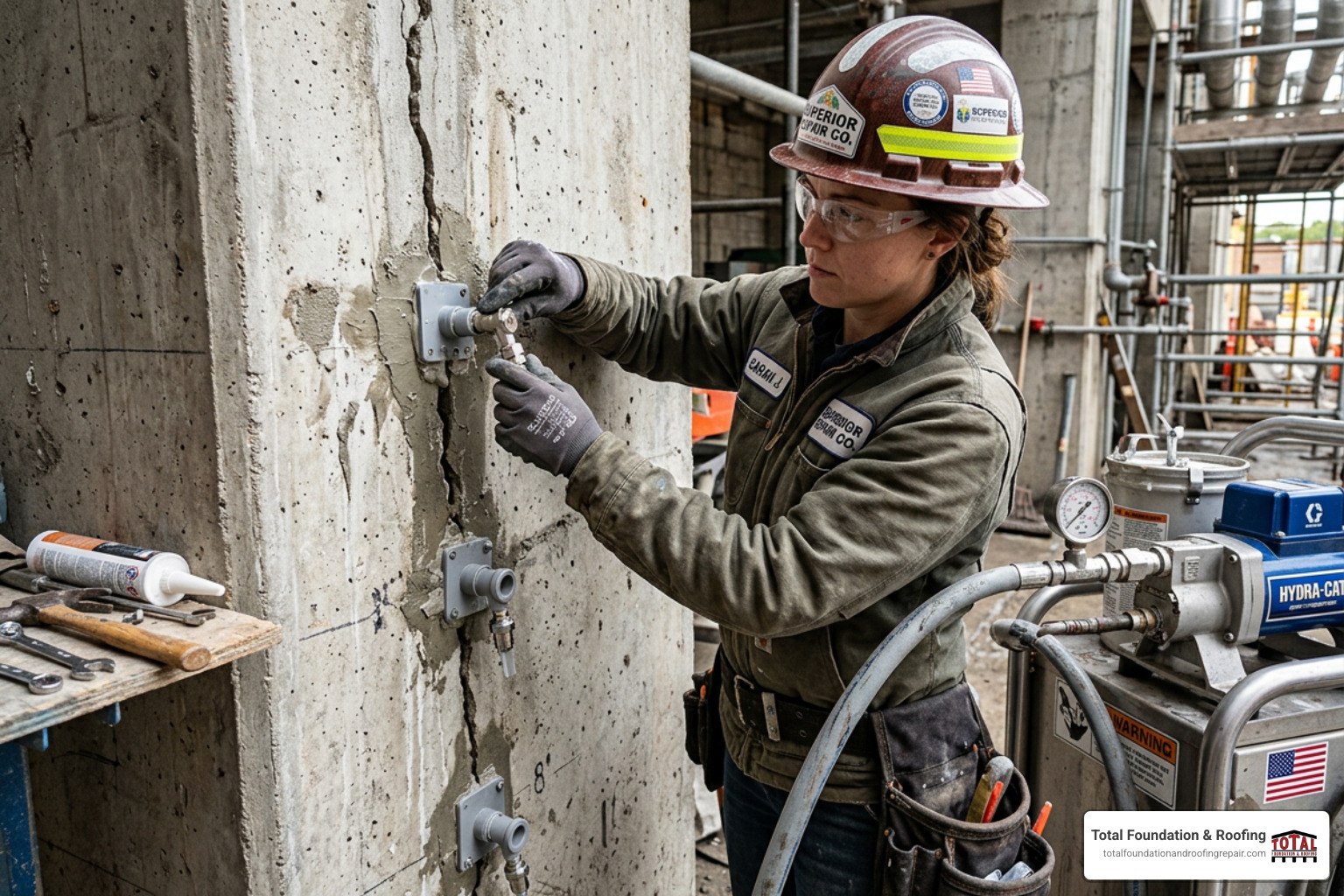
The method of application is just as important as the material. For structural repairs, we don’t just “smear” goop over the top. We use injection ports.
- Preparation: We widen the crack to a minimum of ¼ inch using a chisel or saw. This creates a “reservoir” for the material. We bevel the edges into an inverted “V” shape to lock the repair in place.
- Cleaning: We remove all dust and loose debris. This is critical—polymers won’t bond to dust.
- Port Setting: For walls, we place injection ports every few inches and seal the surface of the crack.
- Injection: We pump the resin from the bottom up. This ensures we fill the entire depth of the crack, not just the surface.
In some industrial applications, we’ve seen core samples showing 100% full-depth injection down to 24 inches. This level of penetration restores aggregate interlock and prevents the crack from spreading.
Implementation and Long-Term Maintenance Strategies
Executing a successful commercial concrete crack repair involves more than just technical skill; it requires strict adherence to safety and regulatory standards. In commercial environments, we have to consider factors that residential repairs never touch, such as OSHA regulations and USDA food safety requirements. All repairs should be performed in accordance with ASTM International standards for concrete repair to ensure material compatibility and longevity.
Structural Reinforcement and Regulatory Compliance
When a crack indicates a wall is bowing or losing its structural integrity, we often turn to carbon fiber. Carbon fiber is a high-performance reinforcement material used in construction because it delivers exceptional tensile strength while maintaining a very low profile.
At Total Foundation & Roofing, we use carbon fiber straps to reinforce foundation walls that have begun to deflect. It’s non-corrosive and low-profile, meaning you can paint right over it. It’s a permanent solution that helps prevent further inward movement without the need for massive steel beams. For facilities dealing with structural wall movement, our professional crack repair services are designed to stabilize the problem before it spreads.
For our clients in the food and beverage industry, we ensure all materials are suitable for USDA-approved facilities when required by the environment and use case. This means the repair products are non-porous, easy to sanitize, and won’t off-gas dangerous chemicals into a food production environment. Additionally, sealing these cracks is a primary defense for radon gas prevention, as cracks are the most common entry point for soil gases.
Safety Note: Silica Dust Protection Whenever we grind or cut concrete to prepare a crack, we produce silica dust. Breathing this dust is extremely dangerous and can lead to silicosis. We use vacuum-shrouded tools and HEPA filtration to keep your facility safe. You can find more scientific research on working safely around silica dust to understand the importance of these precautions, and OSHA also maintains detailed guidance through its construction silica standards.
Regional Considerations for Commercial Concrete Crack Repair
The Texas Hill Country presents a unique set of challenges for concrete. Our “Texas Red” clay is notorious for its high shrink-swell capacity.
- Soil Expansion: In towns like Comfort, TX, the soil can exert thousands of pounds of pressure on a slab when it gets wet.
- Extreme Temperatures: Our concrete has to handle 100 degrees F summers and sudden freezes. This constant expansion and contraction means that many cracks in our region are active.
- Local Expertise: We understand the specific geological makeup of Kerrville and Fredericksburg. We don’t just fix the crack; we look at drainage, moisture management, and soil conditions around your commercial property to help the repair last.
Professional Standards and Expert Consultation
While there are many DIY guides to fixing foundation cracks, commercial-grade work usually requires professional equipment. Achieving a 100% full-depth injection repair on a thick industrial slab is difficult without metered pumping systems.
At Total Foundation & Roofing, we provide a complete ROI analysis for your repair. We help you understand the cost of the repair versus the cost of potential downtime or future slab replacement. Our certified workmanship helps keep your facility safe, compliant, and operational.
Maintenance Tips for Longevity:
- Keep it Dry: Ensure gutters and downspouts direct water at least 5-10 feet away from your foundation. Proper moisture management often starts at the roofline, and we recommend following GAF’s commercial roofing guidelines for optimal drainage.
- Monitor Joints: Check your expansion joints annually. If the sealant is failing, moisture is getting in.
- Address “Bugholes”: Small surface pits can trap moisture and chemicals, leading to larger spalls. Patch them early with a high-performance aggregate crack filler.
Don’t let a small crack turn into a structural catastrophe. We offer professional crack repair services tailored to the specific needs of Texas businesses.
Whether you are in Kerrville, Fredericksburg, or anywhere in the Hill Country, we are here to help you stop the shakes and get your facility back on solid ground. For more information on pricing and options, check out our concrete crack repair cost tips.