

How Often Do Roofs Need to Be Replaced? Here’s What Every Homeowner Should Know
How often do roofs need to be replaced depends primarily on the material your roof is made from, your local climate, and how well it has been maintained. If you are concerned about your home’s structural integrity, partnering with a professional Texas Hill Country roofing contractor can help you determine the exact condition of your system. Here is a quick answer:
| Roofing Material | Typical Replacement Frequency |
|---|---|
| 3-Tab Asphalt Shingles | Every 15–20 years |
| Architectural Asphalt Shingles | Every 25–30 years |
| Metal Roofing (Standing Seam) | Every 40–70 years |
| Wood Shingles / Shakes | Every 20–35 years |
| Clay or Concrete Tile | Every 50–100+ years (underlayment every 20–30 years) |
| Natural Slate | Every 75–150+ years |
Most Texas homeowners are living under an asphalt shingle roof, which covers roughly 80% of U.S. homes. That means the typical replacement window — every 20 to 30 years — applies to the majority of households. But in a high-UV, hail-prone climate like the Texas Hill Country, that window can shrink significantly.
Your roof is one of the most expensive parts of your home to replace, and one of the most consequential to neglect. A roof that looks fine from the driveway can be quietly failing from the inside — degraded underlayment, poor ventilation baking shingles from beneath, or flashing that has been leaking for years without a visible stain on the ceiling. Waiting until you see obvious damage often means the repair bill is already much larger than it needed to be.
At Total Foundation & Roofing Repair, we help Texas Hill Country homeowners cut through the confusion and get a straight answer about what their roof actually needs. I’m Daniel Sowell, owner and operator of Total Foundation & Roofing Repair, and with over 18 years of hands-on roofing experience in Kerrville and the surrounding area, I’ve seen what poor maintenance, bad ventilation, and delayed replacement decisions cost homeowners — and this guide covers everything you need to know about how often roofs need to be replaced so you don’t end up there.
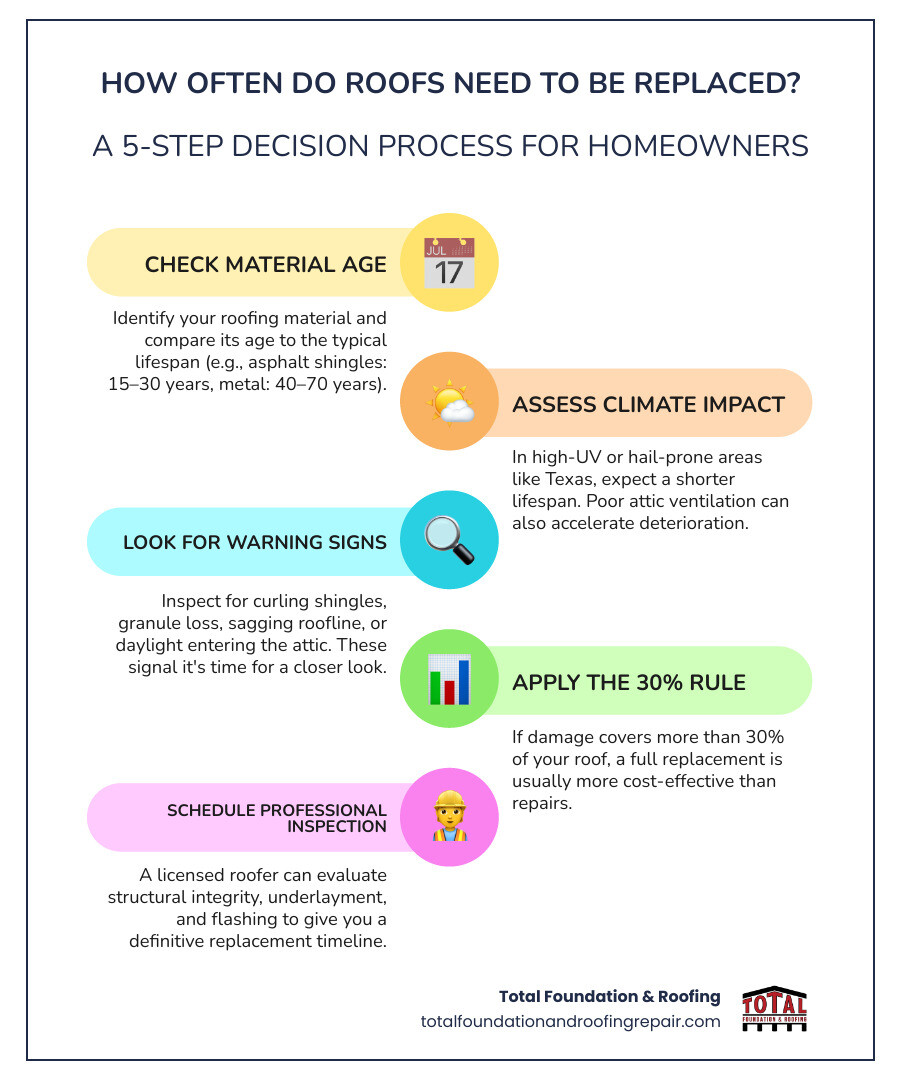
How often do roofs need to be replaced vocabulary:
How Often Do Roofs Need to Be Replaced: Lifespan by Material
When we talk about the lifespan of a roof, we are looking at a complex equation of material durability, installation quality, and structural integrity. A roof is only as strong as its weakest component. If a contractor cuts corners on the underlayment, starter strips, or ventilation, even the highest-grade shingles will fail prematurely.
To understand how often do roofs need to be replaced, you must first understand the realistic performance limits of the material sitting on your roof deck.
How Often Do Roofs Need to Be Replaced Based on Material?
Every roofing material has a distinct operational lifecycle. In our service areas of Kerrville, Fredericksburg, and Comfort, Texas, we work with several primary materials, each responding differently to our unique climate.
- Asphalt Shingles (3-Tab vs. Architectural): Traditional three-tab asphalt shingles typically last 15 to 20 years. However, we rarely recommend them today because architectural (dimensional) shingles offer vastly superior wind and impact resistance. High-quality architectural shingles from leading manufacturers like GAF and Owens Corning generally last 25 to 30 years under average U.S. conditions, though their realistic lifespan in South-Central Texas is closer to 22 to 28 years due to intense heat. If you are researching costs, you can read our detailed breakdown on the cost to replace roof shingles to plan your budget.
- Premium & 50-Year Shingles: For those seeking maximum protection without upgrading to metal, premium shingles are an excellent option. Check out our best 50 year roof shingles guide to see how these heavy-duty laminates hold up.
- Metal Roofing (Standing Seam): A 24-gauge standing seam metal roof is a 40-to-70-year proposition. It is highly reflective, sheds debris easily, and handles Texas hailstorms with ease. Budget metal options like 29-gauge exposed-fastener panels are cheaper but only last 20 to 25 years, and their rubber fastener gaskets require replacement or maintenance every 15 to 20 years.
- Clay and Concrete Tile: Clay and concrete tile roofs can easily last 50 to 100+ years. However, there is a catch: the waterproofing underlayment beneath the tiles degrades much faster, typically requiring a full replacement (known as a “tile relay”) every 20 to 30 years.
- Natural Slate: Natural slate is the undisputed king of longevity, routinely lasting 75 to 150+ years. It is virtually indestructible, though it requires a highly specialized structure to support its immense weight.
For a deeper dive into how these materials stack up nationally, you can read the comprehensive guide on How Long Does a Roof Last? Lifespan by Material Type (2026).
How Climate and Attic Ventilation Affect Roof Lifespan
Our local weather in the Texas Hill Country is beautiful, but it is brutal on building materials. The combination of intense ultraviolet (UV) radiation, rapid temperature swings (thermal shock), and sudden, severe hailstorms acts as an accelerant for roof degradation.
In hot, sunny climates, a standard asphalt shingle roof is subjected to surface temperatures exceeding 150°F. This extreme heat bakes the volatile oils out of the asphalt, causing the shingles to become brittle, lose their protective granules, and crack.
This is where attic ventilation becomes the ultimate wild card. Proper attic ventilation is the single most important factor in extending the life of an asphalt roof. According to the International Residential Code (IRC R806), a balanced ventilation system requires 1 square foot of net free vent area for every 150 square feet of attic space.
When attic ventilation is restricted or unbalanced, heat gets trapped directly under the roof deck. This heat bakes the shingles from the inside out. In fact, poor attic ventilation can cut an asphalt shingle’s lifespan by 20% to 30%. Ensuring your home has continuous soffit-to-ridge airflow is a core focus of our ultimate roof replacement guide. You can also explore more about localized climate adjustments in the Lifespan of Materials 2026 | FindRoofingPros report.
Understanding Roof Warranties and the “Lifetime” Myth
One of the most common points of confusion we encounter is the difference between a manufacturer’s warranty label and the real-world lifespan of the material.
In 2012, major shingle manufacturers shifted away from numeric lifespan ratings (like “30-year shingles”) to “Limited Lifetime” warranties. Many homeowners assume this means the roof is guaranteed to last as long as they live in the house. In reality, a “lifetime” warranty is a legal depreciation schedule built around manufacturer liability for material defects, not a wear-and-tear guarantee.
Most standard shingle warranties are highly prorated. After the first 10 years (the “non-prorated” or “smart choice” period), the manufacturer’s coverage for replacement costs drops significantly year over year. Furthermore, these warranties only cover manufacturing defects—not normal wear and tear, wind damage, hail, or poor installation.
If you are considering high-end shingles, it is vital to look at the actual warranty terms. We break down these financial details in our 50 year asphalt shingles prices guide. When it comes to long-term performance, roofing materials don’t get topped by poor quality installation. A lifetime shingle is only as good as the certified contractor putting it on.
Signs Your Roof Needs to Be Replaced and Next Steps
Knowing how often do roofs need to be replaced is only half the battle; you also need to know how to spot the physical warning signs of failure before they cause catastrophic damage to your home’s interior.
How Often Do Roofs Need to Be Replaced: Key Warning Signs
You don’t necessarily have to climb onto your roof to check its condition. In fact, we recommend conducting a safe ground-level inspection using binoculars or a drone. Keep an eye out for these critical warning signs:
- Curling or Buckling Shingles: When shingles lose their flexibility, the edges curl upward (cupping) or the middle bows up (clawing). This leaves your roof highly vulnerable to wind uplift and leaks.
- Heavy Granule Loss: Check your gutters and downspouts. Finding piles of sand-like ceramic granules (“roof sand”) means your shingles have lost their UV protection and are rapidly decaying.
- Sagging Roofline: Step across the street and look at your ridge line. A sagging, drooping, or wavy roofline is a clear indicator of structural deck damage or rotting rafters that require immediate attention.
- Daylight Through Attic Boards: On a sunny day, head into your attic, turn off the lights, and look up. If you see pinpricks of daylight filtering through the roof boards, water is getting in. In older homes with spaced board decking, tiny pinpricks of light can sometimes be normal design features for ventilation, but only if there are no accompanying water stains.
- Damaged or Rusted Flashing: The metal flashing around chimneys, skylights, and valleys directs water away from sensitive joints. If it is cracked, rusted, or lifting, a leak is either active or imminent.
If you spot several of these indicators, it’s time to start planning. Our guide on replacing your roof walks you through the step-by-step process of preparing for a project. For a 2026 market perspective on timing, consult When to Replace Your Roof in 2026 | RoofVista.
Repair vs. Full Replacement: The 30% Rule and Insurance Factors
When is a repair sufficient, and when do you need a complete tear-off?
As a professional rule of thumb, we use the 30% Rule: if the cost of repairs exceeds 25% to 30% of the full replacement value, or if more than 25% of the total roof surface is damaged, a full replacement is the most cost-effective long-term decision. Patching a severely aged roof is simply throwing good money after bad.
Insurance is another massive factor, especially in 2026. Due to increasing storm severity and rising material costs, insurance carriers have tightened their underwriting rules. Many carriers now transition roof coverage from Replacement Cost Value (RCV) to Actual Cash Value (ACV) once a roof reaches 15 to 20 years of age. Under ACV, the insurer only pays out the depreciated value of your roof, leaving you to cover the difference out of pocket.
Furthermore, insurance companies are increasingly issuing non-renewal notices to homeowners with roofs over 20 years old unless they get a professional certification of good condition or replace the system entirely. We explain how to navigate these challenges in our home roof replacement ultimate guide. You can also read about code compliance and permitting triggers under the Roofing Service Frequency and Roof Lifecycle | Roof Services Authority standard.
Average Costs and Maximizing Your Roof’s Lifespan in 2026
In 2026, macroeconomic factors like new tariffs on imported steel, aluminum, and lumber have driven up roofing material costs by 8% to 15%. Currently, a standard architectural shingle replacement on a 2,000-square-foot home in the Texas Hill Country runs roughly $10,000 to $14,000. While this is a significant investment, it breaks down to an average of just $400 to $560 per year of protection over a realistic 25-year lifespan.
To maximize your roof’s lifespan and delay a costly replacement, we recommend taking these proactive maintenance steps:
- Clean Gutters Regularly: Ensure water flows freely off your roof. Backed-up gutters allow water to seep under the starter shingles and rot your roof deck.
- Trim Tree Limbs: Keep overhanging branches trimmed back at least 10 feet from your roof to prevent physical scraping and stop leaves from trapping moisture on the shingles.
- Schedule Bi-Annual Inspections: Catching minor issues like a popped nail or a cracked pipe boot during a routine spring or fall checkup can save you thousands of dollars in water damage.
If your roof is showing signs of wear, or if you simply want an honest, professional assessment of its remaining life, let our team take a look. We specialize in both high-quality roof replacement services and targeted roof repairs. For historic homes or commercial properties, we also offer specialized roof restoration options.
If you are located in Kerrville, Fredericksburg, Comfort, or the surrounding Hill Country, visit our Kerrville location page to schedule your professional roof inspection. Let’s make sure your home stays safe, dry, and secure for years to come.