
Why Slate Roof Maintenance Is the Key to a Century-Long Roof
Slate roof maintenance is the set of regular practices — inspections, cleaning, flashing checks, and timely repairs — that keep a natural slate roof watertight and structurally sound for 60 to 200+ years. For homeowners seeking professional assistance, Total Foundation & Roofing Repair provides expert professional roofing services in Kerrville to ensure your home remains protected. Understanding these requirements is the first step in protecting a significant architectural investment. Slate is not merely a building material; it is a geological legacy that requires a specialized touch to preserve its integrity over the decades. When you invest in a slate roof, you are investing in a material that has been graded (such as S-1 grade slate) to withstand the elements for over a century, provided the supporting structure and fasteners are maintained with equal care.
Quick answer: the core slate roof maintenance tasks are:
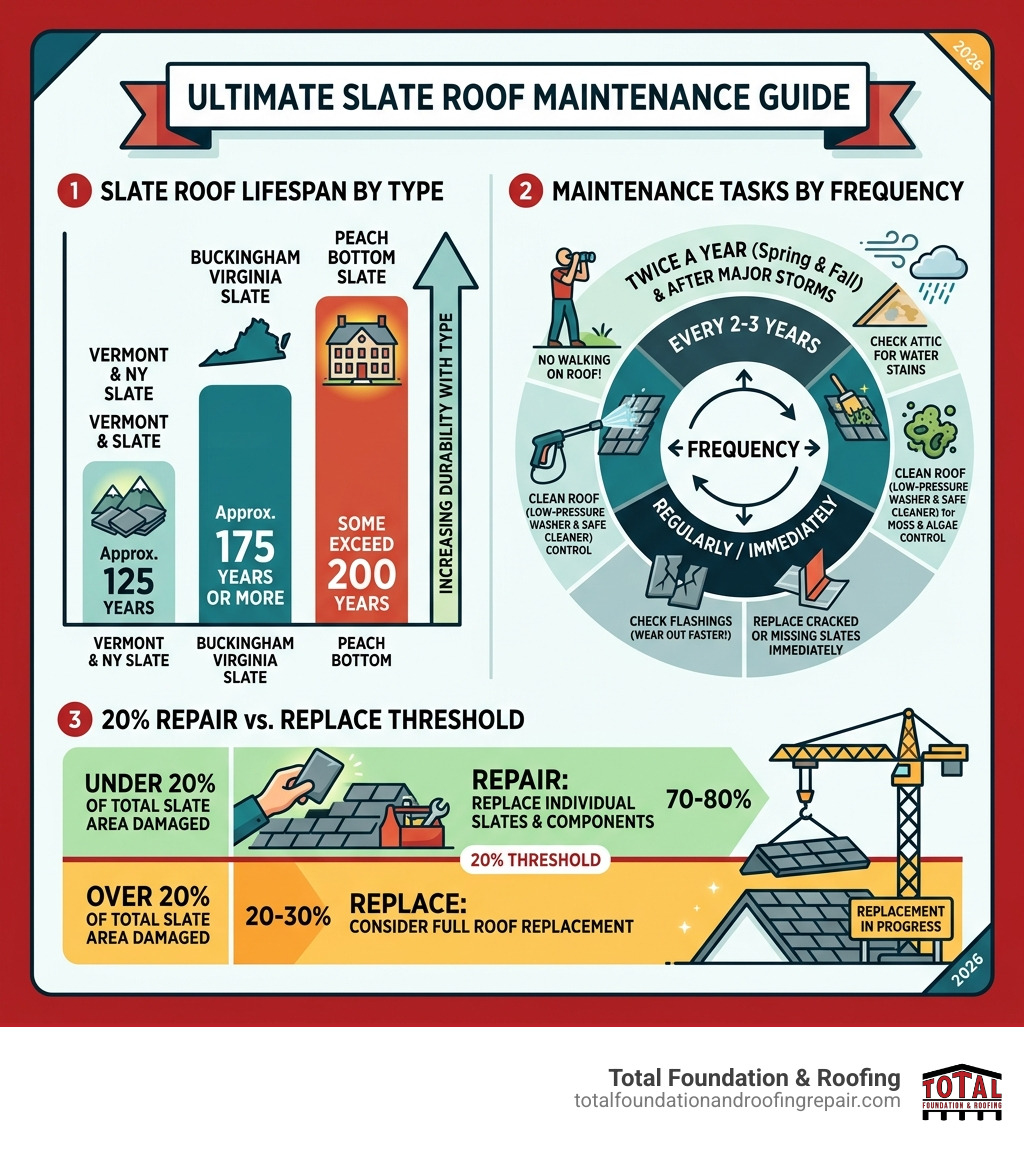
- Inspect twice a year (spring and fall) plus after major storms — from the ground using binoculars, never by walking on the roof
- Clean every 2–3 years using a low-pressure washer and a slate-safe cleaner to control moss and algae
- Check flashings regularly — they wear out faster than the slate itself
- Replace cracked or missing slates immediately using matching materials and non-ferrous nails
- Inspect your attic after rain for water stains, which reveal leaks before they cause serious damage
Slate is a natural metamorphic rock — dense, fire-resistant, and remarkably durable. A properly installed and maintained slate roof can outlast two or three generations of homeowners. This longevity is why slate is often referred to as the “forever roof.” Vermont and New York slates are documented to last around 125 years, Buckingham Virginia slates 175 years or more, and some Peach Bottom slates have exceeded 200 years. These stones are often tested against ASTM C406 standards to ensure they meet the highest levels of weather resistance and structural density. However, this lifespan is entirely dependent on the quality of the maintenance program you implement.
But here is the catch: the slate itself is rarely what fails first. Flashings, gutters, mortar joints, and fasteners deteriorate long before the stone does. Neglect those components, and a roof that should last a century may fail in decades. The roofing specialists at Total Foundation & Roofing understand exactly how this plays out — especially in the Texas Hill Country, where temperature swings, hail, and summer heat put every roofing material through its paces. Proper care involves monitoring the interaction between the heavy stone tiles and the wooden rafters that support them.
I’m Daniel Sowell, owner and operator of Total Foundation & Roofing Repair with over 18 years of hands-on roofing experience in Kerrville, Texas — and slate roof maintenance is one of the most misunderstood areas I encounter. In the sections below, I’ll walk you through everything you need to know to protect your investment without making costly mistakes.
Slate roof maintenance word guide:
Essential Strategies for slate roof maintenance
Maintaining a slate roof in April 2026 requires a blend of old-world respect for the material and modern, non-invasive technology. Unlike asphalt roofs that you might climb on to check a shingle, slate is brittle. The number one rule of slate roof maintenance is to stay off the roof. Walking on slate tiles is the fastest way to crack them, leading to leaks that wouldn’t have existed otherwise. Even the most experienced roofers can cause accidental damage if they do not use specialized equipment like roof ladders or “chicken ladders” — specialized ladders that hook over the ridge of the roof to distribute weight evenly across the structure rather than on individual tiles.
Instead, we recommend a biannual schedule — ideally in the spring and fall. This allows you to catch damage from winter ice or the intense Texas summer heat before the next season begins. According to the Slate Roof Maintenance Guide, the goal is prevention. If you wait until you see a puddle in the living room, the repair bill has already tripled. Organizations like the National Roofing Contractors Association (NRCA) and industry leaders like Owens Corning emphasize that proactive inspections and high-quality underlayment are the most cost-effective ways to manage high-end roofing systems. Modern synthetic underlayments can provide a secondary drainage plane that protects the home even if a single slate slips.

Routine Inspections and Identifying Damage
A thorough inspection starts on the ground. Grab a pair of high-quality binoculars or use a high-resolution camera to scan the roof from several vantage points. You are looking for:
- Misaligned or “Sliding” Slates: This often indicates a fastener failure. If the nail has rusted through, the slate will begin to slip out of position. This is common in older roofs where steel nails were used instead of copper. A single sliding slate can expose the nail holes of the course below, creating a direct path for water.
- Cracks and Chips: Even small hairline cracks can allow water to seep through via capillary action. Over time, this moisture can rot the roof deck beneath. Hail impact often leaves circular “bruises” or star-shaped cracks that may not be immediately visible without close inspection.
- Delamination: This is a key sign of aging. If the surface of the slate looks powdery or is flaking off in thin layers, the stone is reaching the end of its service life. This occurs when mineral impurities like calcite react with moisture to form gypsum, which expands and splits the stone from the inside out.
- The 20% Rule: Industry standards, including those from the National Park Service, suggest that if more than 20% of the slates on a slope are damaged or missing, a full roof replacement is usually more cost-effective than individual repairs.
Don’t forget the interior. Take a flashlight into your attic after a heavy rainstorm. Look for water stains on the rafters or sheathing. Often, roof leak detection identifies issues in the attic that are completely invisible from the ground. For more technical details on slate health, the National Slate Association provides excellent resources on identifying different types of slate deterioration and the specific tools, like the slate ripper, required for proper extraction.
Safe Cleaning and Debris Removal
In the humid parts of the Texas Hill Country, or on the north-facing sides of homes in Fredericksburg and Comfort, moss and algae can become a significant problem. These organic growths trap moisture against the slate, which can lead to cracking during freeze-thaw cycles. While slate is a natural product, the integration of modern moisture barriers, such as those developed by GAF, can provide an extra layer of security beneath the stone, but the surface must still be kept clear of organic debris like leaves and pine needles.
We suggest cleaning your roof every 2 to 3 years. However, “cleaning” does not mean high-pressure power washing. High pressure can force water under the slates and damage the delicate stone. Instead, use a low-pressure sprayer with a solution specifically formulated for slate roofs — often a mix of water and a specialized roof cleaner. Apply the solution, let it sit for about 20 minutes to kill the organic matter, and then gently rinse it away. Our residential roofing team always emphasizes safety; if the growth is heavy, it’s best to call in professionals who have the right scaffolding to reach the area without stepping on the tiles.
Maintaining Flashing and Drainage Systems
The slates might last 100 years, but the metal “connectors” — the flashing — usually won’t. Flashing is the metal used in valleys, around chimneys, and at roof edges to direct water.
- Copper Flashing: This is the gold standard. Copper flashings have a service life of about 70 years and are virtually maintenance-free until they eventually thin out and develop pinholes. They develop a beautiful green patina that protects the metal from further corrosion.
- Galvanized Steel: Common on many homes, galvanized flashing only lasts 15–20 years. It must be kept painted to prevent rust. Once rust starts, the flashing must be replaced immediately to prevent major leaks.
Check your gutters and downspouts at least twice a year. On a slate roof, water backup is particularly dangerous because it can get behind the starter course of slates. Ensure all solder seams on metal gutters are intact. If you notice holes or sagging, prompt roof repair is necessary to protect the wooden eaves and rafters from rot.
Professional Repairs and Long-Term Preservation
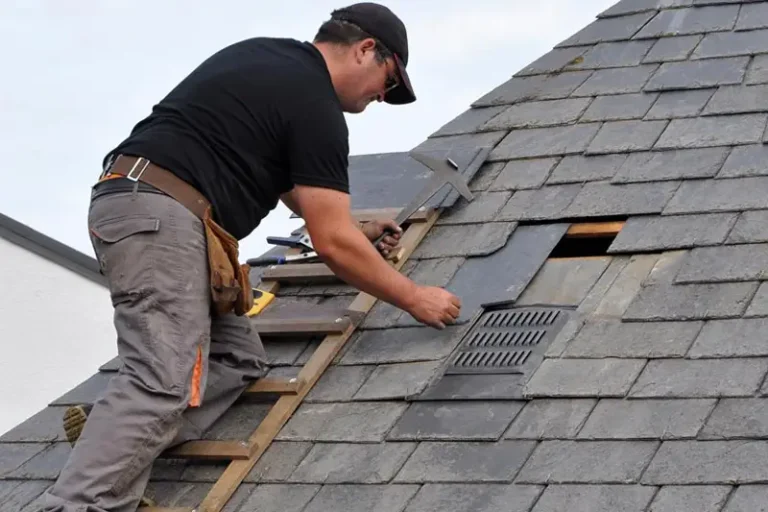
When a slate does break, it needs to be replaced using traditional methods to maintain the roof’s integrity. This isn’t a job for a general handyman with a tube of caulk. Proper slate roof maintenance involves “nail and bib” or “slate hook” techniques that allow the new slate to be secured without nailing through the overlapping tiles above it. The “nail and bib” method involves driving a new copper nail in the gap between the slates above, then sliding a small piece of copper (the bib) under the slates to cover the nail head and prevent water entry.
When to Repair vs. Replace Your Slate Roof
Deciding between a repair and a full replacement is a major financial decision. Here is how we evaluate it at Total Foundation & Roofing:
- The Sound Test: A healthy slate tile should emit a clear, resonant ring when tapped with a knuckle or a small tool. A “dead” or dull thud indicates the slate is porous and failing internally. This is a time-tested method used by slaters for centuries.
- Surface Condition: If the slates are brittle enough that they crumble when handled, they have reached the end of their life. This is often seen in “soft” slates that have been exposed to acidic rain over many decades.
- Widespread Damage: If more than 20-25% of the tiles are slipping or broken, the labor cost to repair them individually will likely exceed the cost of a new installation.
When replacing slates, matching the original material is vital. You must match the region (e.g., Vermont vs. Pennsylvania), the color, the thickness, and the weathering characteristics. Using the wrong type of slate can result in a “patchwork” look that ruins the home’s aesthetic. The Heritage Home Program emphasizes that for historic homes, preserving the original character is just as important as the function.
Seasonal slate roof maintenance for Texas Weather
The Texas Hill Country presents unique challenges for slate roof maintenance.
- Hail: While slate is stone, large hail can crack even the toughest tiles. We recommend a professional inspection after any significant hailstorm in Kerrville or Fredericksburg.
- Extreme Heat: Our 100°F+ summers cause significant expansion and contraction. This can stress the flashing and mortar joints around chimneys.
- Winter Preparation: While we don’t get the heavy snow of the North, we do experience ice storms. Ensure all debris is cleared from the roof in the fall. Debris traps moisture, which turns to ice and can expand in the gaps between slates, causing them to “pop” or crack.
If you’ve recently experienced a severe storm, our storm damage repair experts can provide a detailed assessment of your slate’s condition.
Why Professional Expertise is Non-Negotiable for slate roof maintenance
Slate roofing is a specialized trade. Most modern roofing companies focus on asphalt shingles and may not even own a “slate ripper” (the tool used to hook and cut the nails of a broken slate). Hiring an inexperienced contractor is dangerous. They may try to use tar or “mastic” to glue slates back together — a short-term fix that traps moisture and ruins the surrounding stone. Or worse, they may walk all over your roof in heavy boots, causing thousands of dollars in new damage.
At Total Foundation & Roofing, we serve Kerrville, Fredericksburg, and Comfort with the precision these historic roofs deserve. We use the right tools, the right non-ferrous nails (copper or stainless steel), and the right techniques to ensure your roof lasts for the next century.
If you are concerned about a slipping tile, a rusty flashing, or a mysterious attic stain, don’t wait for a disaster. Contact us today for a professional evaluation. Whether you need a minor fix or an emergency roof repair, we are here to help.
Protect your historic investment with the experts. Visit our Roof Repair Services page.